With the right computer program, proteins become pleasant music.
There are many surprising analogies between proteins, the basic building blocks of life, and musical notation. These analogies can be used not only to help advance research, but also to make the complexity of proteins accessible to the public.
We’re computationalbiologists who believe that hearing the sound of life at the molecular level could help inspire people to learn more about biology and the computational sciences. While creating music based on proteins isn’t new, different musical styles and composition algorithms had yet to be explored. So we led a team of high school students and other scholars to figure out how to create classical music from proteins.
The musical analogies of proteins
Proteins are structured like folded chains. These chains are composed of small units of 20 possible amino acids, each labeled by a letter of the alphabet.
A protein chain can be represented as a string of these alphabetic letters, very much like a string of music notes in alphabetical notation.
Protein chains can also fold into wavy and curved patterns with ups, downs, turns and loops. Likewise, music consists of sound waves of higher and lower pitches, with changing tempos and repeating motifs.
Protein-to-music algorithms can thus map the structural and physiochemical features of a string of amino acids onto the musical features of a string of notes.
Enhancing the musicality of protein mapping
Protein-to-music mapping can be fine-tuned by basing it on the features of a specific music style. This enhances musicality, or the melodiousness of the song, when converting amino acid properties, such as sequence patterns and variations, into analogous musical properties, like pitch, note lengths and chords.
For our study, we specifically selected 19th-century Romantic period classical piano music, which includes composers like Chopin and Schubert, as a guide because it typically spans a wide range of notes with more complex features such as chromaticism, like playing both white and black keys on a piano in order of pitch, and chords. Music from this period also tends to have lighter and more graceful and emotive melodies. Songs are usually homophonic, meaning they follow a central melody with accompaniment. These features allowed us to test out a greater range of notes in our protein-to-music mapping algorithm. In this case, we chose to analyze features of Chopin’s “Fantaisie-Impromptu” to guide our development of the program.
To test the algorithm, we applied it to 18 proteins that play a key role in various biological functions. Each amino acid in the protein is mapped to a particular note based on how frequently they appear in the protein, and other aspects of their biochemistry correspond with other aspects of the music. A larger-sized amino acid, for instance, would have a shorter note length, and vice versa.
The resulting music is complex, with notable variations in pitch, loudness and rhythm. Because the algorithm was completely based on the amino acid sequence and no two proteins share the same amino acid sequence, each protein will produce a distinct song. This also means that there are variations in musicality across the different pieces, and interesting patterns can emerge.
For example, music generated from the receptor protein that binds to the hormone and neurotransmitter oxytocin has some recurring motifs due to the repetition of certain small sequences of amino acids.
On the other hand, music generated from tumor antigen p53, a protein that prevents cancer formation, is highly chromatic, producing particularly fascinating phrases where the music sounds almost toccata-like, a style that often features fast and virtuoso technique.
By guiding analysis of amino acid properties through specific music styles, protein music can sound much more pleasant to the ear. This can be further developed and applied to a wider variety of music styles, including pop and jazz.
Protein music is an example of how combining the biological and computational sciences can produce beautiful works of art. Our hope is that this work will encourage researchers to compose protein music of different styles and inspire the public to learn about the basic building blocks of life.
^^^
This study was collaboratively developed with Nicole Tay, Fanxi Liu, Chaoxin Wang and Hui Zhang.
Today’s virtual reality, or “VR,” is the stuff of yesterday’s science fiction; it’s become an amazing, immersive world filled with hyper-realistic dance clubs, parties, museums, cityscapes, expansive natural worlds, many inhabited by thousands of avatars, real people who mingle freely, hidden behind computer-animated identities.
It was in this world that we met “Shu Shu,” who is working on an ambitious theatrical presentation entitled Nymphs, which is to be presented at VRium, Shu Shu’s own VR performing arts center. Shu Shu graduated from the department of Drama Directing in the National Academy of Theatre PWST in Poland and Andrzej Wajda Film School, worked as an art-director and creative director in large artistic projects, as a theatre director, stage designer, graphic designer, 3D animation script writer, and as an opera stage technician and manager in his earliest years — back then, every night after La Boheme, directed by Franco Zeffirelli, he would grab a brush, sweep the stage and imagine that someday he would create his own theatre.
We caught up with ShuShu recently to talk about his vision.
AUDERE: What made you decide to mount a play in VR?
SHUSHU: Theatre is the thing for which I have dedicated all my life, my greatest love in life, the only thing worth living for, as an old famous actor whom I admire once said.
I gained a significant experience in several fields of art. In each of those fields I have achieved a high level of art, a deep connection to my inner core, where you feel the essence of the art you are doing.
And now, I immerse myself in VR. My imagination and my soul are literally flying in VR. I can now do the only thing I was always dreaming of — theatre. In VR, all the fields of art I covered in the course of my artistic life assemble together in harmony.
Why your shift to VR?
A great polish theatre creator, Tadeusz Kantor, wrote once : “A theatre artist must explore and control all the fields of arts, if he wishes to understand the very essence of the theatre.” It feels like everything I have done in my life was meant to be accomplished in VR. I chose to focus all my efforts in the most powerful medium in art, an extremely metaphysical space, where your mind and soul can experience spiritual and mental elevation in its highest and deepest manner — the theatre.
I first heard of you through an earlier project of yours, a really elaborate nightclub that I believe you created.
LOVEHOTEL. This was my first VR creation ever. I created it not a long while ago, in January 2021, about 8 months ago.
This venue is a sensual space for live avatars concerts and VR love raves. This was the moment, where I first grabbed the world builder tolls and started placing basic objects piece by piece, using my VR headsets — not in PC, not using any 3D software, but simply flying in the air with a few screens with world building tolls in front of me. This was a truly joyful adventure. I recall some friends were calling me on phone inviting me to go out, while I was building LoveHotel — I said: “No! No, no way! Listen, I am flying here, do you have something better to offer me? Forget about it!”
What was the reaction to LoveHotel?
LoveHotel became famous, it opened people’s hearts. I even met some couples who fell in love there. They performed their first “avatar kiss” in this venue.
What is your vision for VR?
I knew exactly what I am looking for in VR. I had no doubts about it. I knew, I am going to immerse myself for years in VR in order to create art. But before I begin to invest so much work and time in VR, I felt there is one thing I must prove to myself — that is, whether I am able to bring the metaphysical aspect of the “real” theatre into VR. And I believe we succeeded – myself and the creative team working together with me – in NYMPHS, the first VR performance which we are currently developing. This is more than just another VR world. It is an emotional, and I would even say that it is a transcendental experience, with its own space narrative.
Tell us about NYMPHS.
I have been working on this piece for over 6 years already. So far, mainly on the concept, and now it is actually happening, in VR. It is definitely not a usual script, which you could have imagined on a real stage. In fact, it is a VR score, with detailed audio-visual instructions, more similar to a movie script.
What makes it different than a usual play for the stage?
There is one crucial thing I have learned in VR : you no longer need the stage. In a “real” theatre the stage was created to define an autonomic space with its own reality. In VR you create an immersive world and “all the world’s a stage”, as William Shakespeare’s once wrote. Just imagine, what can be done in theatre in VR — this is the ultimate medium that could bring the magic back into theatre. Yet, the story you wish to tell should have a different structure, which reminds of a myth structure, rather than a linear realistic narrative, something that uses symbols and visual counterpoints, dissonances and by this creates a whole new meaning. NYMPHS has a dramaturgical structure of a myth.
So “where” will the play be mounted?
NYMPHS is to be the first project in our theatre, which we call “VRium.” It is meant to be a futuristic “acropolis” of art in the cyber world, an international VR performing arts centre which offers a new quality of VR art-works : theatre & dance performances, opera shows, VR fairy tales, VR art exhibitions and online concerts. This space is created to deliver you an emotional experience — to brings into VR the very essence of a theatrical artwork.
The exterior is inspired by Newton’s Cenotaph — a futuristic tomb, designed by the French architect Étienne-Louis Boullée in 1784. The project was never realized before (in reality) — and here we will bring it to life, with a very specific usage. The design-concept of the interior is based on the Theatrum Anatomicum (the anatomical theatre). The anatomical theatre was one of the most bizarre phenomena in the history of theatre. It used to be an amphitheatrical space, dedicated for autopsy and anatomical lectures. A truly macabre “theatre” of death. And so, our VR theatre is meant to be a sacral space.
Tell me more about the show itself.
NYMPHS is a requiem, an ode to those of the female persuasion, whose mind is forever poisoned by toxic love. Here they become Nymphs in an amorous yet lethal underwater dream.
The performance is a post-mortem study for the “stage.” It examines the anatomy of the female psyche, the beauty and insanity of love, using a collage of canonical literature (ancient and modern plays for theatre, myths and legends) as well as medical, psychiatric and pathological essays, cases of mental disturbances and true-life contemporary reports of female death by love. In this play, an extreme desire reveals itself to be destructive; the destructive side, on the other hand, is rendered as a pictorial fantasy.
All characters in this theatrical art-work had died by drowning — just like Ophelia from Shakespeare’s Hamlet, or water creatures from myths and legends. That is why those characters are called “Nymphs” — because here they are submerged in the depth of the ocean instead of rising up to heaven.
In this performance we flow through two dimensions: the dramatic “reality”, where motives are set up in an autopsy space that resembles an anatomical theater and a mental hospital, while imaginary characters from ancient myths and legends take us into a scenic dream, “far out in the ocean, where the water is as blue as the prettiest cornflower, as clear as crystal….”
How long will NYMPHS be?
This is an ambitious vision and it requires a huge amount of work in collaboration with several artists. I assume, that together with my creative team we will be developing this project continuously. It all depends on whether we will manage to bring some investors, sponsors and donors on board. At the moment we are doing what we can investing a huge amount of time and work. And also money. It might take some two years to create a complete animated performance. NYMPHS is planned to be 30 minutes long and composed of several short episodes. Each episode is an independent art-work, and each will be performed in a different language.
The dolls used in NYMPHS are huge, a really breathtaking image. How did you arrive at this vision?
There’s a famous theatre manifest written back in 1907 by Edward Gordon Craig, called “The Actor and the Uber-Marionette.” This was a revolutionary call for all theatre artists to resign once and for all from using actors on stage, since they are “no longer considered to be a good material for a pure artwork.” Instead, Craig offers to replace them with a superior automated doll. Today we would call it an “actroid.” There is a Japanese genius, a scientist, professor Hiroshi Ishiguro, who is currently developing animatronic “humanoids” and “geminoids”, human robots. I was inspired by Craig’s vision and by Mr. Ishiguro’s robots for quite a while already and I wish to realize Craig’s vision for the first time — in VR. Our theatre will be performed by automated monumental art-dolls.
There is a great potential in monumental dolls which lays in the essence of my VR theatre — in one of the scenes in NYMPHS, called A Requiem for a Nymph, you will see a giant necro-doll submerged in the depth of the ocean, like an ancient goddess. When she dives and falls apart in the deep waters with her long hair swirling and waving through the water with the Love Dolls choir around her singing “Ave Maria” by Giulio Caccini — you can feel the power of the VR theatre.
This is another thing I have learned about VR — in VR everything has to be monumental.
Will actors perform it live each day?
No. The VR actors in NYMPHS are ACTROIDS, Fine Art Dolls, designed by the Popovy Sisters. However, when it comes to voice, this is where we need the actor. In VR, the voice is the soul of the character, so it is very crucial it is played by good actors. The moves and gestures of the dolls are planned to be achieved by using motion capture technology with an original choreography performed by dancers. The doll will then imitate the same choreography performed by the dancer.
Tell me a little bit about your team.
I am lucky to have the privilege to collaborate with a very talented creative team. Among them the brilliant Andy Wood, Jose Ferrer, Daniele Colombo, Carlos Austin — a VR Director of Photography with a unique vision for VR filming — and Niko Lang, who in my opinion created a VR masterpiece called “Niko’s Solar System.” Lately, we were blessed in having new talents on board, among them the Popovy Sisters, who create extraordinary art-dolls. Some of these dolls are about to perform in NYMPHS.
What VR worlds do you work in?
We have a theatre space and a VR art gallery called ArtSpaceVR, where we invite unique artists from around the world to present their art. The plan is to get investors and sponsors and elevate the project up to a range that it becomes an independent platform. At the moment, we are developing our project in AltspaceVR, which, despite all its limitations, is a wonderful tool with an inspiring community.
Lately we have presented our project in the BRCvr — the Virtual Burning Man Festival, which took place in AltspaceVR in September this year.
Explain your avatar name.
My avatar’s name is ShuShu. My mother and my beloved aunt both used to call me this nickname when I was a little child. I feel that in VR I earned back the child that is in me. I enjoy my creativity just like little ShuShu used to enjoy creating his “inventions.”
How did you decide how you wanted to present yourself in the virtual world as an avatar?
My appearance is just the best I could come up with, taking into consideration the limitations of the avatars in the app I am currently using. If I could, I might have had a different avatar — for example, a unicorn, or one of the dolls used in my theatre.
Do you prefer virtual reality to “real” reality?
There’s one thing I missed a lot in the “real” theatre and opera — it is the feeling that you belong to a family of artists, of people who breath theatre and “live” on the stage. And I found it in VR. I have managed to “infect” some artists with my VR theatre vision and I am blessed to have the opportunity to work and create with wonderful people. I came into VR just a few months ago and I was completely unknown. It took less than a half a year till my creations were exposed to thousands of people from all around the world.
Do you have friends you know only in VR?
I’ve met great personalities, whom I wouldn’t have the chance to meet in the “physical” world. I feel as we were all the pioneers of the VR technology.
What do you think the future is for VR?
The future? I think we are the future for VR — the first people, who understand the potential of this new universe and invest all their efforts in VR with a great joy. For most of our friends from the “other” world, we seem “weird” and “disconnected from reality.” I think that my friends from the “physical world”, those who are not yet familiar with VR and are not interested in VR, have no clue of what I am experiencing, and I cannot even find a way to describe them, how it feels to fly in my theater and dive in the depth of the ocean with monumental “actroids” surrounding me.
^^^
All illustrations courtesty of ShuShu. VR Worlds photography by Niko Lang. Special thanks to Chiara Feriani.
VRium | NYMPHS Creative Team : ShuShu, Niko Lang, Andy Wood, Jose Ferrer, Timo, Daniele Colombo, Carlos Austin, Luminosity, Igor Korzhov, the Popovy Sisters.
An English transplant to Berlin, Rebecca Saunders is a former pupil of Nigel Osborne, a composer with ties to Germany, and Wolfgang Rihm, one of the leading lights of German Modernism in the last few decades. As such, listeners approach her music with the expectation that it will operate outside of many heartfelt assumptions.
Not for her the fought-over terrains of minimalism, serialism, neoromanticism, stochasticism, or music “based on” philosophy, or the psychology of sound or whatever Karlheinz Stockhausen was about. Of the latter, I’ve often wondered if he were really Frank Zappa in disguise, but that’s a topic for another time.
In short, Saunders’ music strikes out into a sound world less connected to even the recent past than that of Un Suk Kim. What the two have in common, is an ear for the uncommon sonority. But Saunders is much farther afield from the quasi- (and I mean quasi-) symphonic diction of Kim, both on a moment-to-moment basis, and in regard to the gestalt.
This is music for, by and of sound and sound complexes to an extent I haven’t heard before. While it may owe something to the experience of purely electronic music, Saunders’ “Void” is something else and, I believe, something more.
Whereas, from my limited perspective, the average piece of electronic music is much more involved with experimentation for its own sake — aside from its tendency toward techno-fetishism — Saunders, to my ear, seems more concerned with developing a novel sonic diction. What sets “Void” apart is the existence of a vocabulary, a grammar and a syntax for her highly original compositions.
And that’s saying something. Listen with ears open and you’ll discover that, like the best 18th century music, it teaches you how to listen, how to grasp the structural signposts. That is, despite the fact that the latter remain nameless, elusive and hard to categorize. This is due in large part to the fact that Saunders has actually managed to create a feeling of progression. Who knows? After so much time in Germany, Saunders, who is in her 50s, may even have a theory about it.
Fortunately, any such considerations seem to be decidedly in the background. Her ideas unfold unfettered and her imagination as both a “sound-colorist” and a “sound-structuralist” is rich, variegated and blessedly surprising. Missing from “Void” (for percussion duo and orchestra) are the obsessive, eat-your-spinach, obligatory transformations that many forward-looking composers believe are their obligation to present, out of some sort of moral responsibility. Saunders’ mentor Rihm, I believe, falls into that category and it’s a relief to see that she has sidestepped that nonsense.
Many have noted that great artists make great choices. They select well from the infinite array of the possible. That’s what makes art in any medium, in my opinion, a human endeavor, if not necessarily a humanistic one. Its inherent subject matter is human thought processes. And that’s the opposite of any mechanistic approach. Why? Because as Oliver Sacks has shown, music isn’t an external, objective function It‘s hard-wired into the human mind.
_____________________________
ADVERTISEMENT
________________________________________________
Granted, there are historical works, like Beethoven’s “Diabelli Variations,” Schumann’s “Symphonic Etudes,” JS Bach’s “The Art of the Fugue” — or for that matter, Mahler’s Eighth — that jam an entire kitchen sink into the spaces between F and A on the treble clef. But they are all, believe it or not, carefully selected excerpts from their composers’ imaginations.
Do you really think that Bach couldn’t have written twice as many fugues on his theme? There’s plenty of evidence to the contrary. In the case of the Schumann, there are even surviving sketches of the variations he discarded, in order to present only the “A material.” Sure, these pieces are encyclopedic, but they’re thumb-indexed, cross-referenced and tightly conceived. They are not the logorrheic bucket lists of our latter-day saints.
In any case, Saunders vocabulary in “Void” consists of bell chimes, flute warbles, brass growls, metallic clangs, string slides, percussive beats — including prepared piano — as well as any number of ingenious combinations of these resources.
At a superficial level, I suppose, the piece might remind you of the sounds “after dark” in an urban setting but in a way that gives the lie to John Cage’s idea of ambient noise as music. Seriously, there’s no more reason to sit in a concert hall and watch a pianist do nothing, when one could sit at home with the windows open and achieve the same thing.
I don’t think any one with two ears and an imagination ever needed that dose of medicine, but Cage delivered it, mostly to give his career a shot in the arm. By contrast, “Void” illustrates the difference between a generalized appreciation for intimate, passing flecks of noise and actual music very clearly. While Cage’s philosophical, and ultimately, political statement is not music, “Void” definitely is. To me, it’s the difference between whining about the limitations of “the musical establishment” and doing something about it.
Repeated hearing of “Void” will allow all but the most resistant to hear a progression emerge. In simplest terms, its a movement from quiet musings to a more frenetic level of activity. Some of the latter is either violently comic or comically violent, in a way that reminds me of those old-fashioned Weimar cabaret lyrics. Did someone get kissed or killed? It’s sometimes hard to tell.
The last few minutes take on a slightly more ominous tone. Or is it more ritualistic? My point is that the nature of the work’s sound world, the extent to which it mimics that odd mix of natural and machine-made sounds familiar to urban denizens, plays on the imagination in a highly effective, subliminal way. At times, it’s as if you were listening to the soundtrack of a film filled with intrigue. And yet, as intriguing as these mental meanderings can be while listening, to get lost in them is to miss the value of the piece. Aside from all else, “Void” will also remind you, perhaps, of certain schools of abstract painting that evoke so much more of the real world than they let on. Whatever inspired Saunders to move in this direction, whether over a period of years or from the start, her novel musical diction is the work of a gifted musical mind and a composer with an unusually clear artistic vision.
There is so much to love in the 1927 action film, The Gaucho: a lively, funny performance by Douglas Fairbanks, a fiery turn by Lupe Velez, who reminds us that she was a great actress before she became a gruesome punchline. That color sequence, those amazing technical innovations. Once derided, now recognized as a masterpiece, as well as an over-the-top hoot.
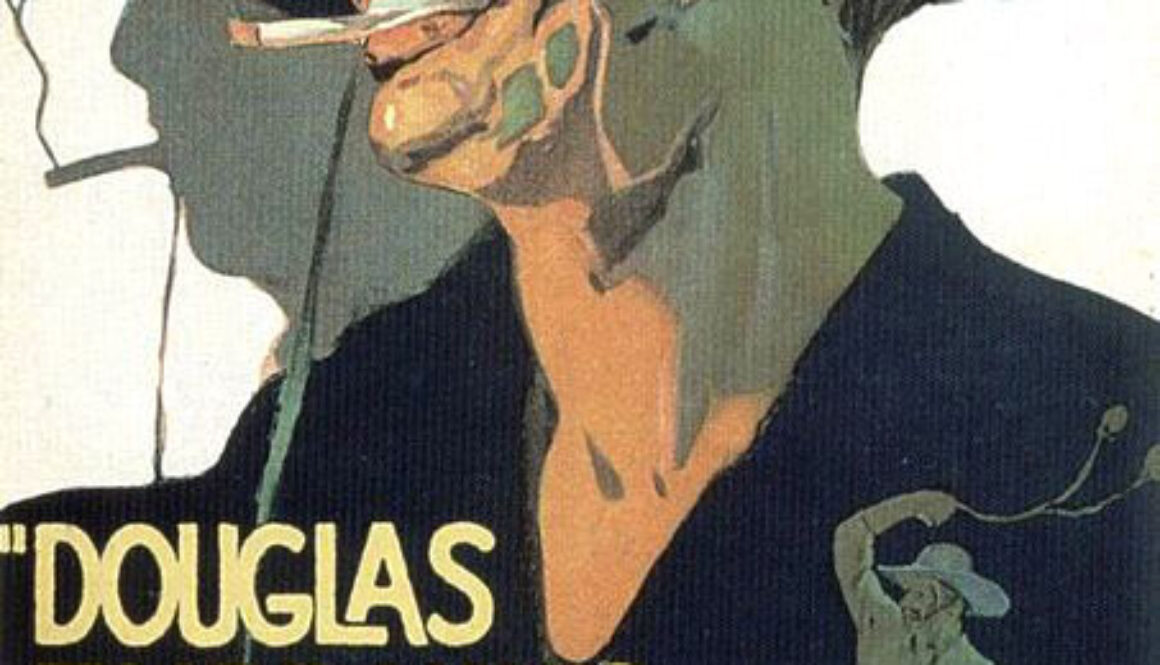
Not least among its pleasures, this wonderful poster by some anonymous artist, the kind of thing that could stand on its own even if there were no movie to advertise.
Just look at this.
One other thing: Don’t smoke, kids. But sometimes, in art, smoking is cool. And it’s Douglas Fairbanks smoking, back in 1927. He’d be dead now anyway.
Facebook is an interesting thing. Bad in lots of ways, and I think it is mostly bad. Friends bragging about their kids, about their lives that are better than yours, visiting your home city and not calling you, going to parties you weren’t invited to. Terrible.
But it also serves as a sort of weird diary, or even a memory bank.
For example, today, FB reminded me of an opinion that I expressed seven years ago about the Chelsea Cain controversy.
The what?
Chelsea Cain’s 2014 Controversy
This is what I said on Facebook.
I felt really strongly about the cause of supporting unlikable authors back then, and I swore that I would buy her books. (Full disclosure: I didn’t buy any of her books. I didn’t even download a sample. I announced my intentions to the world and promptly forgot all about it.) I also blogged about her.
What did Chelsea Cain do, back then, that was so bad?
It’s awfully hard to figure out what she did after the space of just under a decade. The screen shots are available on Goodreads, in a closed group, and of course, as with anyone who speaks a little too loudly on the web, she has since deleted whatever it was she said.
But from various comments on Goodreads in response to my post, I can gather this: Ms. Cain, a thriller writer, received a bunch of questions from readers about what order she would prefer that they read her books. At one in the morning, facing disappointing sales of her most recent novel, she released a post somewhere expressing some annoyance. It appears she used the “eff word,” and that she referred to these questions as “boneheaded.” And the feeding frenzy began. She deleted her posts but clarified that she would not apologize for a single word she had written, and a new feeding frenzy began.
Should we cancel books written by jerks?
I wrote a column, not defending her poor manners, but arguing that we should still read books by poor mannered authors, if they are good. I received responses! One reader, Zahara Cerise, wrote, “the idea that any person is going to be hurt by not reading a particular author’s books is kind of silly. Unless the author has written the most unqualifiedly brilliant book of all eternity past, present and future, no one is going to sustain any damage from not reading certain books.”
While Ms. Cerise overstated the point, I generally agreed. If the author has not written a good book, no one who does not read it will suffer in any way. So if the author is not nice, and the book is not especially good, then by all means don’t read it. I would go a step further: if the author is nice, but the book is not good, you should still not read it. As I wrote back then, “If she is good but not great, then we shouldn’t be reading her anyway (at least till we’ve finished with all the greats, which will take some time)!”
But what if the author is a jerk and her book is great? Then, by all means read it. What if the author is a criminal, but her book is great? Read it. Don’t invite the author to your cocktail party, or to speak to your bridge club, but read her book.
A qualified defense of novelists who are jerks
And, as I noted seven years ago:
Many many many novelists are peculiar people who behave in self-defeating ways, and many of them really don’t understand what they’ve done wrong. That’s why they were novelists in the first place back in the good old days – they lacked the talent to go out into the world and hold down a “real” job that required “people skills,” and we could lock them away someplace where they wouldn’t insult too many people, and they could drink themselves to death without ruining too many other lives in the process. Unfortunately, the advent of the internet has changed all that …. Novelists need to package themselves, publicize themselves, write entertaining tweets and so on. I hope I seem relatively comfortable in that sort of venue, but not everyone is. There should be some place in our world for the incurably socially awkward.
You see, if you are an asshole, you should be a novelist!
I also have a day job, which involves sharpening pencils and replying to emails. What if I start sending nasty emails to my colleagues? Then I should be fired. And what if a prospective employer calls for a recommendation? No one should then recommend me. Cannot control his emails.
But people should still read my books if they are great. (Views differ.)
Great literature and great art is more important to the culture than great pencil sharpening and email replying. There are plenty of people who can quite handily step into my shoes at work. But for better or worse, there is only one person who could have written The Strange and Astounding Memoirs of Watt O’Hugh the Third. If it is great, read it. If it is not, do not.
Chelsea Cain, in case you are wondering, remains controversial, shoots off her mouth. And I still haven’t read any of her books. But none of this mishigas is standing in the way.
On Paricia Highsmith, A.A. Milne, Frederick Exley and other jerks
I will tie this up with a few words from the younger Drachman, which I wrote back in 2014:
If we need great suspense writers, we can start with Patricia Highsmith [rather than Chelsea Cain] before we bother with the good-but-not-great. Patricia Highsmith was really really not a nice person, but I am glad that didn’t keep me from reading the first two Ripley books, and if she were alive and on the web, we’d all be in for a lot of abuse.
I am not defending [Chelsea Cain], any more than I defend F. Scott Fitzgerald’s adultery, Frederick Exley’s horrible treatment of his first wife, William Styron’s cold behavior towards his children, J. D. Salinger’s weird stalking of Hollywood starlets, A.A. Milne’s inability to relate lovingly with Christopher Robin other than through the printed page, or any number of other strange and self-destructive things that novelists do and have done and will continue to do.
Back when I was a film critic, one director whom I admire a great deal was horribly and unjustifiably rude to me, regardless of the incredibly nice things I had said about him in print. At that moment, I understood one reason why he had not succeeded in Hollywood, in spite of being one of the most original and entertaining directors around. I still recommend his movies, because they are very good, but I won’t have him over for tea. I hope he will still have a chance to continue to make movies, even though he is a jerk. I do think I would have lost out without that director’s films, and without A.A. Milne’s books, or those of F. Scott Fitzgerald, Frederick Exley, and so on.
A.A. Milne was an interesting case, and I wrote a column on it back in the ’80s when the issue first came to light. (It’s not on the web – it was pre-web.) I just couldn’t believe that he didn’t love his young son. I thought maybe he expressed it through the written word because that was the only way he could. A strange fish indeed, and it was very sad, and he created a lot of pain, not the least of which was the fact that his son, who felt quite unloved, had to hear throughout his life what a wonderful father his old pop was. He could not leave it behind, because it was always there in front of him, on TV, in bookstores, in movie theaters. I hope he found some sort of peace with this. While this wrinkle affects my view of Milne pere, he still created a magical world that I don’t mind visiting. A.A. Milne never had the opportunity to interact with his readers, because he wrote in the 1920s, but I suspect that if he had, it would have been awkward and unsettling for the readers.
Here’s to all the assholes who write great books. Enjoy!
^^^
Steven S. Drachman is the author of The Strange and Astounding Memoirs of Watt O’Hugh the Third, which is available in paperback from your local bookstore, Amazon and Barnes & Noble; it is also available as a Kindle e-book.
We at Audere had a great summer, and it gave us a chance to reflect on our best and most popular stories. Happily, our “stats” app helps, constantly reminding us which stories you, our readers, loved, and which ones you didn’t care for much at all.
The fifth most-read article was our interview with Torsten Krol. The Dolphin People writer has remained stubbornly anonymous (“Torsten Krol” is a pseudonym) and our interview was something of a “get,” his first interview in over a decade. The extremely diverse topics about which he has written books, he told us, “may have created the impression that I’m several people, and in a way I am, but all those people are located inside the one skull. Having asserted that I’m one person, I feel other questions relating to my identity are irrelevant.” It was an interesting chat.
At number 4: In 2018, the Watt O’Hugh novelist Steven S. Drachman reviewed a film weirdly titled Disney Christopher Robin, which he acknowledged that he had not seen, but which in his view told so many extravagant falsehoods about the life of the real Christopher Robin Milne that it deserved a sight-unseen pan. “[W]hy exactly do our totalitarian overlords at Disney need to tell us this lie about the life of a real man?” Drachman asks. “It is because the real Christopher Robin was not a Disneyesque creature at all; he did not believe in eternal childhood and eternal childishness. He grew up.”
In 2020, author Julie Stamm talked to us about Some Days We…., her blunt yet optimistic picture book about being a parent with multiple sclerosis. “I can say wholeheartedly that diagnosis has changed me,” Stamm told us. “I don’t really remember the old me.” The interview is our third most-read article.
In the second most-read article in Audere history, bestselling novelist Donna Levin remembers her grandmother, Rae Stern, a cheerful but secretly depressed rabbi’s widow. “What she needed, I believe, was meaningful work of her own,” Levin writes, “something that was more than just a holdover from the glory days of Rebbetzinhood.”
At #1, A Big Hand for the Raunch Hands, Drachman’s appreciation of the late Mike Chandler, who headed a raucous and popular rock band in New York in the 1980s, and who died of cancer in 2018, having never become world-famous, in spite of expectations all those years ago. “[H]e really did have a lot of great shows and a lot of fans, back then,” Drachman writes, “and not everyone has that, nights when you rule the audience, nights when you are king. I hope that means he would say he had a good life.”
And an honorable mention: Alan N. Levy wrote our seventh most-read article; as a tribute to his deceased best friend, Levy wrote, “I’d like to describe a moment that I’ll simply label, ‘The Funniest Thing Ever Said.’ ” Alan died unexpected and suddenly a few months before his debut novel, The Tenth Plague, appeared in print. We hope wherever he is now, he is enjoying all his posthumous rave reviews.
(For the record, our least popular piece was a digital painting entitled “Autumn in the City,” which depicted beautiful fall leaves puddled around piles of garbage.)
Spying is a risky profession. For the 14th-century English undercover agent-turned-poet Geoffrey Chaucer, the dangers – at least to his reputation – continue to surface centuries after his death.
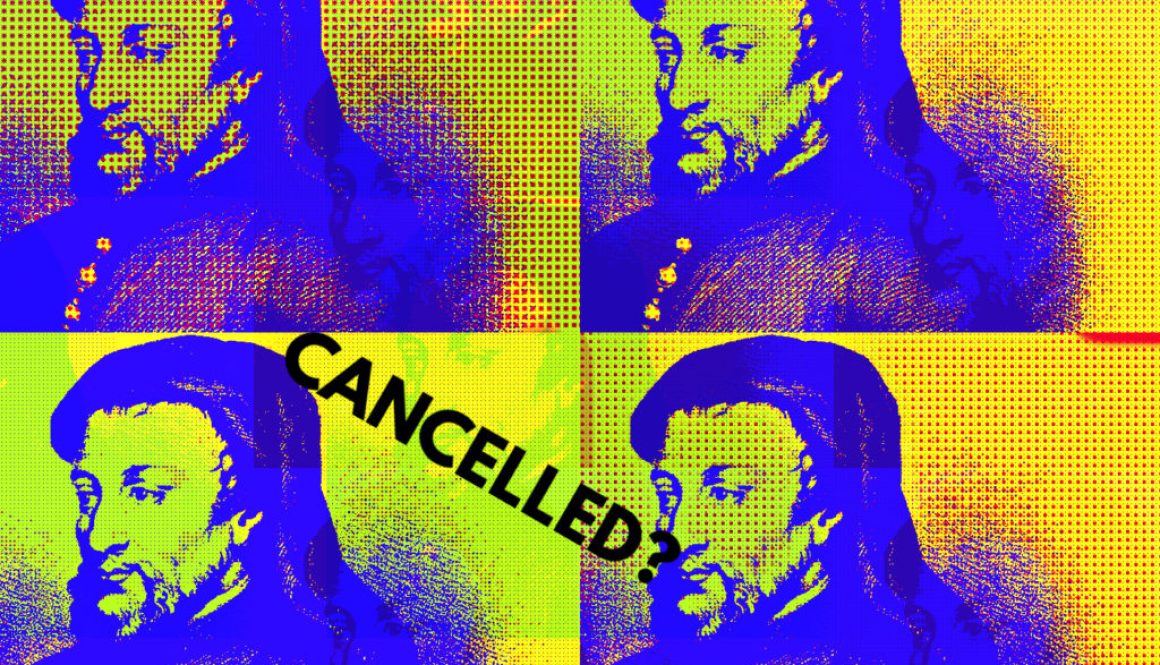
In his July 2021 essay for the Times Literary Supplement, A.S.G. Edwards, professor of medieval manuscripts at the University of Kent in Canterbury, England, laments the removal of Geoffrey Chaucer from university curricula. Edwards says he believes this disappearance may be propelled by a vocal cohort of scholars who see the “father of English poetry” as a rapist, racist and antisemite.
The predicament would have amused Chaucer himself. Jewish and feminist scholars, among others, are shooting down one of their earliest and wisest allies. This is happening when new research reveals a Chaucer altogether different from what many current readers have come to accept. My decades of research show he was no raunchy proponent of bro culture but a daring and ingenious defender of women and the innocent.
As a medievalist who teaches Chaucer, I believe the movement to cancel Chaucer has been bamboozled by his tradecraft – his consummate skill as a master of disguise.
Outfoxing the professors
It’s true that Chaucer’s work contains toxic material. His “Wife of Bath’s Prologue” in “The Canterbury Tales,” his celebrated collection of stories, quotes at length from the long tradition of classical and medieval works on the evils of women, as mansplained by the Wife’s elderly husbands: “You say, just as worms destroy a tree, so a wife destroys her husband.”
These poems in particular generate accusations that Chaucer propagated sexist and antisemitic material because he agreed with or enjoyed it.
Severalprominentscholars seem convinced that Chaucer’s personal views are the same as those of his characters and that Chaucer is promoting these opinions. And they believe he abducted or raped a young woman named Cecily Chaumpaigne, although the legal records are enigmatic. It looks as though Cecily accused Chaucer of some such crime and he paid her to clear his name. It’s unclear what actually happened between them.
Critics cherry-pick quotations to support their claims about Chaucer. But if you examine his writings in detail, as I have, you’ll see themes of concern for women and human rights, the oppressed and the persecuted, reappear time and time again.
Chaucer the spy
Readers often assume Chaucer’s characters were a reflection of the writer’s own attitude because he is such a convincing role player. Chaucer’s career in the English secret service trained him as an observer, analyst, diplomat and master at concealing his own views.
In his teens, Chaucer became a confidential envoy for England. From 1359 to 1378, he graced English diplomatic delegations and carried out missions described in expense records only as “the king’s secret business.”
Documents show him scouting paths through the Pyrenees for English forces poised to invade Spain. He lobbied Italy for money and troops, while also perhaps investigating the suspicious death of Lionel of Antwerp, an English prince who was probably poisoned soon after his wedding.
Chaucer’s job brought him face to face with the darkest figures of his day — the treacherous Charles the Bad, King of Navarre, a notorious traitor and assassin, and Bernabò Visconti, lord of Milan, who helped devise a 40-day torture protocol.
Chaucer’s poetry reflects his experience as an English agent. He enjoyed role-playing and assuming many identities in his writing. And like the couriers he dispatched from Italy in 1378, he brings his readers covert messages split between multiple speakers. Each teller holds just a piece of the puzzle. The whole story can only be understood when all the messages arrive.
He also uses the skills of a secret agent to express dangerous truths not accepted in his own day, when misogyny and antisemitism were both entrenched, especially among the clergy.
Chaucer does not preach or explain. Instead, he lets the formidable Wife of Bath, the character he most enjoyed, tell us about the misogyny of her five husbands and fantasize about how ladies of King Arthur’s court might take revenge on a rapist. Or he makes his deserted Queen Dido cry: “Given their bad behavior, it’s a shame any woman ever took pity on any man.”
My own research shows that in the course of his career he supported women’s right to choose their own mates and the human desire for freedom from enslavement, coercion, verbal abuse, political tyranny, judicial corruption and sexual trafficking. In “The Canterbury Tales” and “The Legend of Good Women,” he tells many stories on such themes. There he opposed assassination, infanticide and femicide, the mistreatment of prisoners, sexual harassment and domestic abuse. He valued self-control in action and in speech. He spoke out for women, enslaved people and Jews.
As for Jews, Chaucer salutes their ancient heroism in his early poem “The House of Fame.” He depicts them as a people who have done great good in the world, only to be rewarded with slander. In “The Prioress’s Tale” he shows them being libeled by a desperate character to cover up a crime of which they were manifestly innocent, a century after all Jews had been brutally expelled from England.
Chaucer’s own words demonstrate beyond the shadow of a doubt that when his much underestimated Prioress tells her antisemitic blood libel tale, Chaucer is not endorsing it. Through her own words and actions, and a cascade of reactions from those who hear her, he is exposing such guilty and dangerous actors as they deploy such lies.
It is bizarre that one of the strongest and earliest writers in English literature to speak out against rape and support women and the downtrodden should be pilloried and threatened with cancellation.
But Chaucer knew the complexity of his art put him at risk. As his character the Squire dryly observed, people all too often “demen gladly to the badder ende” – “They are happy to assume the worst.”