On March 29, 1855, a hundred sixty five years ago, a bunch of rowdies got arrested, and a German grocery store owner lost a finger. Among the rowdies was a man named George Whitney, and another man named Thomas Riley. The criminals were all confined to the Tombs, New York City’s infamous 19th century jail.
This is interesting because it’s a little bit action-packed and violent, and also because it really happened, at a verified date and place, to real people who have now been dead and completely forgotten for many, many years.
Back then, Germans were called “Dutchmen.”
The actual news report from the New York Times follows:
“When Dutch meet Dutch,
Then flows the Lager Bier!”
Yesterday afternoon, an exciting scene occurred at he Lower Police Court, before Justice Connolly, in relation to a bloody battle at the lager bier and grocery establishment of a German named John G. Teitgen, corner of Fifty-second-street and Tenth-avenue.
It appears from the evidence of the proprietor that a gang of up-town bullies entered his premises for the purpose of adjusting matters concerning a challenge for a prize fight between Peter Ferguson and Dominick Carroll.
The proceedings did not exactly suit Tietgen, and he exclaimed, in broken English, “You damn sporters, vot for you cum in my shop to raise de tevil for? I vant you to go out or I get von officer.”
To this command, the rowdies replied, “Shut up, you [expletive], or we’ll storm yer shanty; we won’t do nothin’ else.”
The Dutchman became greatly excited, and when about to take measures to remove his obnoxious customers, the “boys” were true to their word, and sure enough stormed the castle with great violence. Decanters and bottles were hurled in all directions, oil cans were upset, gin and whisky casks damaged, and entire window sashes were smashed.
During the affray, the poor Dutchman received several cuts and stabs in his face and was minus a finger that some of the outlaws severed with a beef knife.
Upon this state of facts becoming known, Justice Connolly acted with commendable promptness and committed eight of the desperadoes to the Tombs in default of $300 bail each.
They gave their names as Dominick Carroll, Thomas Riley, William Travis (an ex-policeman), Peter Ferguson, John Nichols, Thomas O’Donnell, John Stewart and George Whitney.
Illustration: New York’s prison, known as the Tombs, circa 1870.
With this shocking headline, “Mike Bloomberg’s presidential run could cost taxpayers billions,” law professor Edward J. McCaffery accuses my candidate “in a very meaningful sense” of making himself a public charge and stealing money right out of your bank account.
Furthermore, McCaffery avers, Bloomberg’s election spending damages charities around the world.
Is this true?
(Spoiler alert: McCaffery’s full of bunk.)
The professor’s allegation
“The public is effectively picking up at least 40% of the tab for Bloomberg’s massively financed run,” McCaffery alleges.
How so?
Well, he explains, “Any dollar spent today is a dollar not taxed tomorrow under the estate tax.”
If Bloomberg hangs onto his money, then the government will tax the Bloomberg estate, upon his death, at a 40% rate.
Thus, any money he spends now, on anything, will not be in his estate upon his death, and therefore won’t be taxed when he dies.
So, under this theory, whenever Bloomberg spends any of his personal wealth — for a hamburger, a glass of wine, a ticket to see Parasite at the local cinema — we are all paying for it.
Nonsense
It is worse than misleading to say that “taxpayers” (i.e., you and me) are picking up the tab; in reality, the government will tax Bloomberg’s estate a few billion less than it otherwise would, but that doesn’t necessarily mean that this cost will be passed onto us. The government might deficit spend, or it might cut subsidies to tobacco farmers, or it might be so flush with surpluses that it doesn’t need the money.
Or, far more likely, the government would have more money in its coffers tomorrow because of the money Bloomberg spends today.
The sentence itself — a dollar spent today is a dollar not taxed tomorrow under the estate tax — is technically accurate but highly misleading, because that dollar will be taxed in other ways today, as soon as it leaves the mayor’s wallet.
So it is true that every dollar Bloomie spends today is a dollar not taxed tomorrow under the estate tax, but it is not a dollar that isn’t taxed.
When Bloomberg spends a dollar, it is likely that, in total, the government will collect more taxes than it would if Bloomberg saved that same dollar.
Furthermore, those taxes will be paid now, rather than many years from now, which is beneficial to the government’s balance sheet.
So the headline itself, that Bloomberg’s campaign could “cost taxpayers billions,” and McCaffery’s lament, later in the article, that “we would all ultimately be paying in part for the mayor’s ride,” are both downright false.
A simple example
If Bloomberg takes a hundred of his employees to lunch at the diner down the street in Midtown Manhattan, this costs him two thousand dollars, and he is now two thousand dollars poorer. Two thousand dollars has left his bank account, and that’s eight hundred dollars in estate taxes that the government won’t receive in fifteen or twenty years. (Or, rather, eight hundred dollars plus or minus whatever that two thousand dollars would have generated or lost over the course of a couple of decades.)
But because that money is spent today, the diner pays taxes on it today, at the current business tax rate.
The two thousand dollars that passes from Bloomberg to the diner also, in part, pays the diner’s employees, who also pay a portion of their salaries in taxes.
Sales tax makes up a percentage of that two thousand dollars, which goes straight to the government as well.
The diner spends some of the two thousand dollars on supplies, which goes to American farmers, who use part of their earnings to pay taxes.
Bloomberg’s spending binge helps the diner to stay in business, which generates more taxes.
If Bloomberg spends his money, rather than saving it, the government receives several layers of taxes today, rather than later. Receiving a dollar today is better than a promise of a dollar in fifteen or twenty years, so his decision to spend his money now, rather than hoard it, is beneficial to the government’s bottom line.
If one were to accept McCaffery’s confluence of “the government” with “taxpayers” and “all of us,” then Bloomberg’s spending today saves us all money. It’s more complicated than that, of course — a dollar to the government really isn’t a dollar that we the people don’t have to pay later — but it’s his shaky premise, and his logic doesn’t hold up on its own terms.
Bloomberg’s election spending helps the economy and costs us nothing
Bloomberg’s foes frequently accuse him of trying to “buy” the presidency, as though he is bribing party bosses and electors. But what he is doing is paying to get his message out. This involves buying ad time in the local media, who pay taxes today on the money he spends. (Plus: keeping local media in business is a social good.) Bloomberg also must generate content for local media, which involves employing legions of filmmakers and other staff, who also pay taxes.
Does Bloomberg’s election spending damage charities?
Finally, this:
If you imagine that the alternative to Bloomberg spending $5 billion on his campaign would be for him to give it away, the fact that he’s splurging on his campaign is costing the charities dearly. The charities will never see any of the spent money.
McCaffery, every time you go out to dinner and spend fifty bucks, that’s fifty bucks that you’re not giving to your local soup kitchen.
Look, the reason I find Bloomberg’s campaign appealing is that it is issue based. He believes, as I do, that he is best positioned to solve the problem of climate change and of American gun deaths. If he spends $5 billion on his campaign, or on the campaign of the eventual Democratic nominee, that’s $5 billion spent on those problems. He has directed his cash to charities addressing those issues, but with apparent reluctance he has determined that these problems will not be resolved without a change in government. So he will redirect his resources to his own campaign, or to the campaign of the eventual nominee, if it is not him.
A condemnation of Mayor Bloomberg
McCaffery concludes his piece by averring that this is “in no way a condemnation of Mayor Bloomberg, who has presumably earned his money legally, and can spend it however he wants[.]” Instead, he says, it is a condemnation of a tax system that allows individuals to acquire such massive wealth.
OK, fair enough, but the provocative headline, accusing Bloomberg of looting taxpayers to the tune of billions of dollars to fund his campaign, certainly reads as a condemnation. Many readers glance at headlines, and that’s it. Furthermore, changing the tax rate, so that we no longer have billionaires of such extravagant wealth, would do nothing to change the alleged problem that McCaffery seems to find so distasteful, that when a rich man spends a dollar, the government doesn’t get to tax that dollar later under the estate tax. There is literally no way to solve that predicament other than killing the estate tax. As long as the estate tax remains in existence, as it should, a dollar spent today is a dollar that the government cannot tax later under the estate tax. If one favors the estate tax, this is just a fact of life.
Well, who is this apparently silly fellow, McCaffery, with his silky, flowing coif and smirking, pouty lips? He’s a professor of “law and economics,” a mostly discredited Chicago school of thought founded in part by Richard Posner, who disowned it after the 2008 market collapse.
The 1920s still have a certain youthful appeal. Here, for no reason other than our own amusement, we sample a selection of magazine cover art from that romantic, jazzy decade.
We are surprised that Sex Stories magazine lasted only three issues.
Speakeasy Stories was from the very early 1930s, when the sheen was off the Jazz Age.
We are sure that Captain Billy’s WhizBang was filled with amusements, but only in Film Fun Magazine could one learn how to catch a wiffenpoof. (Advice from Buster Keaton, no less.)
Unless you’re living under a rock, or in a cave, you’ve heard by now that my candidate, Mike Bloomberg, laid an egg in his first debate. And not only that: he has been revealed as sexist, racist, an out of touch egotist. A man trying to buy power.
Let’s start with the last part first. He has used his vast wealth, over the last few years, to pursue liberal policies, most notably climate and gun control. He could have used his money to buy vacation properties, cocaine and whores. But instead, he has used his money to save the planet, and to save lives.
Why not endorse Bernie Sanders or Elizabeth Warren, the former an admitted lefty like me, the latter a closet lefty, and also like me?
Because their campaigns, more than anything else, are about a pipe dream of a health care plan. Medicare for all will not happen now; maybe it will happen someday. I don’t care.
I opposed stop and frisk, Bloomberg’s most misguided policy. I never voted for him before. I recognize that he is not a good debater. Maybe that isn’t what matters now.
I am drawn to his campaign because it is issue based, and headed by someone who has devoted the waning years of his life to these issues, because it is about something more than the next step in someone’s career, and because, for voters, and for me, it is a campaign about something more than whether I get a tax cut or whether I get better health care.
Bloomberg’s campaign is not about whether I live to be 85 rather than 90. It’s about something beyond the individual; it is about the collective good. He is the only candidate who has put climate first. If you think this is about power, you are fooling yourself. He has all the power that any man could ever want. He isn’t in this to advance his career. He isn’t in this to give you something. He is in this to save the world.
Some time ago, in these pages, our Oblivioni columnist wrote of discovering a great old fairy tale, from the turn of the 20th century, and noted,
There are few literary experiences more strange and poignant than reading an utterly forgotten children’s book, especially a copy that once belonged to actual children, whose names are still legible in the book. They have since grown into adults, after all, and then grown old. (And then died, of course.) When I used to read a story like that to my kids (back when they were of the age), it was like visiting another world, one which only we knew. My kids may be the only children alive today who know and love this story, I would imagine, as I read.
That fairy tale was “The Dovecoat,” by Violet Jacob, and the column continued,
Thirty years ago or so, I pulled Violet Jacob’s 1905 story collection, The Golden Heart, from a dusty shelf in a used bookstore, somewhere out there in the world. The book was long out of print, utterly unknown. When, at the very end of the last century, my kids entered into our household, one story in this volume, The Dovecote, became a haunting favorite of ours, for a while anyway.
And now, at last, you can read “The Dovecote” yourself, or to your kids. The great story is republished in its entirety, below.
^^^
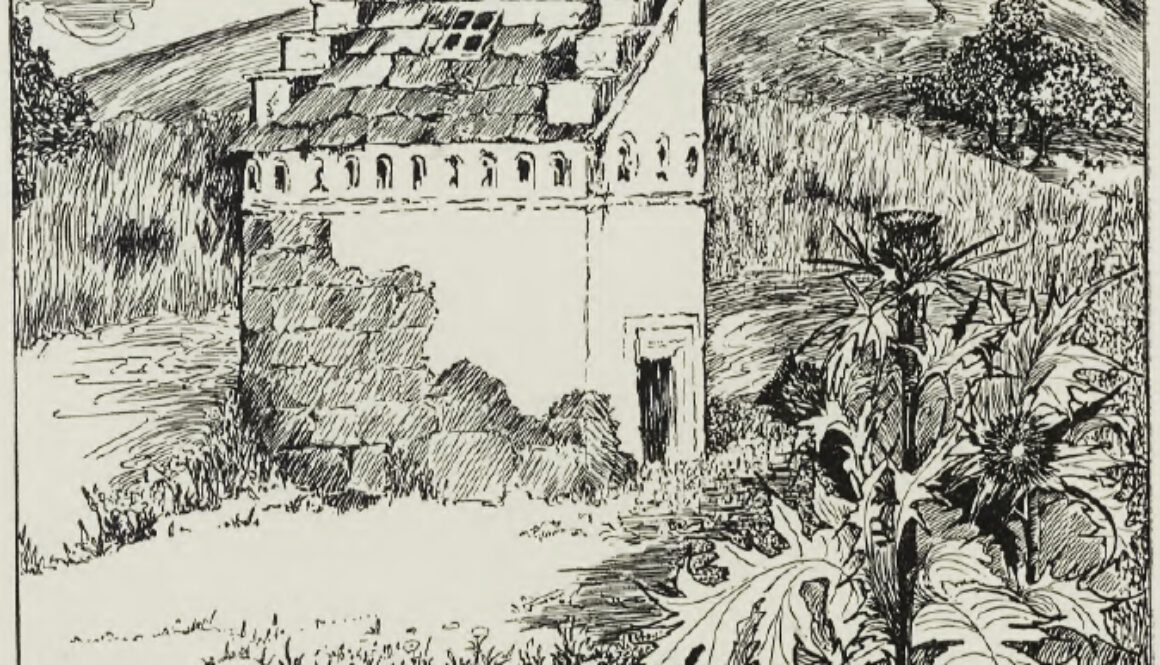
In a wide stretch of pasture, in the middle of a lonely field, with its back to the bleak north blast which swept over the shuddering grasses, making them hum and sing like complaining voices, stood a Dovecote. The solid masonry of its walls, in the crevices of which tufts of stone-crop and shepherd’s purse had sown themselves, and the irregular outlines of the crowsteps which ran up either side of its slanting roof had been familiar to the sight of so many generations that, as it had remained unused within the memory of the oldest, no one thought more of it than if it had been a stone heap in the road, nor noticed the curious fact of its never falling into disrepair. At each end of the roof, above the crow-steps, two large stone balls stood out against the sky, and on these the rooks, going home in the red sunsets to a neighboring rookery, perched from year’s end to year’s end, and no one but themselves, or a few inquisitive sheep, who might rub their woolly heads against the walls, seemed to remember the existence of the solitary building. At some little distance behind it the land rose in a steep slope, rolling upwards to where a fringe of fir-trees looked down upon the Dovecote, the fields, and the scattered habitations below.
Anyone standing beside them might see over a vast area of land. Looking to the west, the hills rose in bold relief, and towards them ran a white road which lost itself now and then, only to reappear in patches till it faded into the distance: looking eastward, there lay spread a long stretch of wooded country, over which the lights and shadows floated and the clouds sailed before the west wind on their way to the sea, which could be seen on a sunny day lying like a blue sapphire upon the horizon. Looking straight southward towards the pastures, the sloping ground at the foot of the trees was all one fertile cornfield, as yet uncut, and, half-way up it, where the hill was steepest, stood three elms, growing close together and making a dark spot of shade in the middle of the yellow grain. These were called” Maddy Norey’s trees.” What Maddy Norey’s history had been no one alive knew, but tradition said that she had lived in a small cottage under the shadow of the elms, and men ploughing the field in the late November days had run their ploughshares against deeply-embedded stones at their roots, and told each other that they had struck the foundations of Maddy Norey’s house. They did not know that the witch, Maddy Norey, was alive still, and living hardly out of the sound of their voices in the Dovecote.
But in spite of the lonely quiet of the old place, and the peace which seemed to brood over the standing corn, there was war and strife in the land. The young King, with his Queen, had been forced to fly from his palace, a fugitive and wanderer, not knowing where to seek shelter for his head; his step-brother, a wicked and unscrupulous man, having, with his plots and cunning and his smooth, lying tongue, stirred up the people in revolt against their sovereign. Through the treachery of some of the soldiery the palace gates had been broken down, the King’s capital was in the hands of the mob, and he and the Queen had made their escape, trying to reach the distant sea-board, and from it to take ship across the Northern Sea to a neighboring land ruled by one of their closest allies.
Under cover of night they fled through the streets of the capital, passing un-noticed in the confusion, and slipping through the city gates deserted by the treacherous guards. Once in the open country, they hid themselves in the woods by day, and travelled forward on foot by night, hoping against hope to elude the pursuers sent out after their flight had become known, and to reach the nearest point of coast from which they might set sail for the friendly land opposite.
At last, after many days, they came to a place only a few dozen miles inland, and the King, who knew the country well, encouraged the weary Queen, telling her how short a space lay between them and the sea. They were on the borders of a birch-wood through which they had travelled all night, and, as they came out and saw the wide pasture stretched before them in the early light (for it was dawning) the Queen sank down on the ground, worn out, declaring that she could go no further.
At this the King was in despair, for day was breaking and there seemed to be no place of safety in which they could conceal themselves until night should come round again and cover the two lonely wanderers with her dark curtain.
“Lie still and rest,” said he, as he drew off his cloak and spread it over his wife, “ I will go a little way forward and find some place in which we can shelter for to-day. Do not move until I come back. I shall not be long away.” And he wandered off into the field towards a strange pile of building which he saw rising like a watch-tower from the level plain.
When he reached it he found it to be a deserted Dovecote, and he walked round it, wondering why such a solid structure had been built for the harboring of a few doves and pigeons.
As he passed round the north side he came upon a wooden door, so low that a man entering would be obliged to bend himself almost double, and he cleared away the nettles and tufts of ragwort which grew by the threshold, pushing with his shoulder against the half-rotten wood. The door opened easily.
The Dovecote was quite dark inside, and only the light from the open door behind him enabled the King to see a crazy staircase running up the side of the wall to what was apparently a room overhead. As he stood irresolute whether or not to venture up, another little door opened at the top of the flight and the bent form of an old woman peered out, illuminated by the sky-light in the ceiling of the room she had just left. The King stood amazed.
“ And so you have come at last,” she said, in a voice which seemed far too soft to proceed from such a crooked body, “and why have you not brought the Queen? Do not be afraid,” she added, seeing the look of consternation on his face, “ I have expected you for some time. I am Maddy Norey, and I have lived here for more years than you and the Queen put together could count if your ages were doubled twice over. Go at once and bring her back with you, for here she can find a safe hiding-place.”
The astonished King could only lean against the wall, and stare up at the strange figure above him.
“Go!” cried the old woman, stamping on the floor.
He turned to obey her, and began groping for the little door by which he had entered; but the more he went from wall to wall, the more amazed was he, for there was no sign nor vestige of such a thing.
Maddy Norey laughed softly.
“Now,” she said, “do you see how safe a castle mine is? If I had not chosen that you should see my door you might still be wandering round the walls among the briar s outside. Is not this a safe retreat for the Queen? “
“Let me go, Maddy Norey, and bring her to you.” And as the King said this he perceived the open door close to him, with the sun’s early beams shooting through like golden lances and striking the cobwebs which hung from the lintel.
A short time later saw him standing in the birch wood by the side of the Queen, who had fallen asleep from exhaustion among the silver stems. The leave s quivered in the breath of sunrise as they emerged together from the wood and took their way to the Dovecote. The wooden door was open to receive them, and Maddy Norey was at the top of her stair, peering down upon the Queen as she ascended, weary and faint, with her beautiful dark hair, which had slipped from its golden comb, falling in masses over her cloak.
“Now,” said the old woman, when they had reached her attic, “look round at my house and tell me what you think of it.”
The King and Queen were silent, for they knew not what to say. They saw nothing but a small bare room with a sky-light in the roof. The light was struggling in among the cobwebs and a cold air blew through the little row of holes among the tiles, by which bygone flocks of pigeons had entered to roost, or emerged to plume themselves in artless vanity on the slanting roof and the crow steps outside. An oaken three-legged stool stood in one corner with an old-fashioned spinning wheel beside it, and this was the only furniture or sign of a human inhabitant visible in the little attic.
Maddy Norey smiled.
“I can see your thoughts,” she said, turning to the King. “But you must not think that I have made no better preparation for the Queen than this. I know a great deal. I know that she will spend much time with me here, and I have arranged all that I can to help you in the time that is coming. Now look into that dark spot in the wall and tell me whether I have not prepared my house well for you.”
As she said this she raised her bent figure and spread out her arms widely. A thin blue mist drove across their vision like a smoke-cloud, and through it broke a glow as of burning coals. It rolled past them, leaving only a faint vapor, behind which they could see a thick hedge of fiery-hearted roses that seemed to burn like living embers. Through a division in the midst of this radiant tangle the light from the glowing flowers shone upon a floor and walls of black oak which could be seen behind it, reflecting itself in the polished darkness beyond, as stars reflect themselves in deep water; and, at the further end of the room, in an angle where the dark walls met, stood a bed carved with designs which could be only dimly seen, and hung with curtains of a rich deep color that might have been either green or blue.
Then Maddy Norey took the Queen by the hand and led her through the roses into the soft darkness. She combed out her long hair, took from her her travel stained garments, and made her lie down in the carved bed. Then her weary head sank back upon the pillows, her tired eyes closed, and she drifted away into a dreamless sleep under the blue hangings.
The King and Maddy Norey sat talking in the little dusty attic all that day and far into the evening. His gratitude knew no bounds when she said that he might leave his wife in her charge while he pursued his Journey.
“When you arrive at the sea-shore,” she told him, “you will find a boat lying on the sand; you must manage so that you get there in two days from now, and during the night-time, when the fisherman to whom it belongs has gone home from fishing, and you must take the oars and row straight out to sea. You will find food and water for three days stored in the boat, for the owner is going a journey in it to an island some way off.”
“Maddy Norey,” said the young man, “promise me that you will care for the Queen.”
“I will,” answered the old woman, holding out her wrinkled hand. “ But be advised, Oh King, and spare her the parting, for it may be a long parting, and even I do not know the end of it. She will never consent to let you go alone, which, by reason of the hardships you may have to undergo, is necessary. I might have to prevent her from going with you by not allowing her to find the door. Surely you will spare her this? Look,” and she pointed to the darkening sky-light, “it will soon be night, and there is no moon. Go now-at once. By to-morrow morning you will be many miles on your way, and if you conceal yourself during the day, another night’s travelling will bring you to the shore. Go; it is best.”
The King stood up.
“I may go in and look at her? “ he said.
Maddy Norey nodded. “I will not wake her,” said he, “it would be too cruel.”
There was silence, in the Dovecote for a few minutes before the King re-appeared. He made a sign of farewell to Maddy Norey and went down the rickety stairs, through the wooden door and out into the night alone.
When the Queen awoke next morning and found that he had gone, her heart seemed broken, and she lay weeping quietly in her carved bed.
“Why did I not awake when he came to say goodbye? “ she sobbed in despair to Maddy Norey, who was sitting by her.
“My dear,” said the old woman, who did not tell her that she had caused her to sleep so soundly on purpose, “it was better it should be so, for it helped the King through it. And he hoped that you would be strong and keep a brave heart. You must summon all your courage and be helpful to him when he returns, for we do not know how soon that may be.”
With such words did Maddy Norey comfort the Queen. And she, when the first freshness of her grief was over, tried with all her strength to be cheerful and affectionate to the old woman who had done so much for them both. But every evening she used to steal away to a dark corner to weep a little and think of the King, perhaps still in hiding near the bleak coast, perhaps tossing alone on the sea.
When several days had gone by the Queen began to feel the monotony of her life very much, and to long with a great longing for the fresh air, as she dwelt in the cramped seclusion of the Dovecote. It was impossible that she should venture out alone, even for the smallest distance, in the rebellious state of the country, more especially as the search for the fugitive pair was still going on. But her strength and spirits were declining daily, and Maddy Norey began to fear that the confinement was telling upon her. One evening as they sat within the windowless walls which surrounded them, the Queen laid her hand on the witch’s knee.
“If I could only have one breath of air,” she sighed, “ and one look at the fields and the sky. May I go to the door and out for just a short, short way into the pasture? “
“ No,” she answered, “ you must not do that. I have to remember my promise to the King to keep you in safety. But I can do this. To-morrow I will work a spell upon you. I will turn you into a white pigeon, whose presence, were it noticed about the old place, would seem but natural. So long as you remain standing on your feet or touch the ground in any way, you will be a woman; but, if you make ever so small a spring upwards, the moment your feet leave the earth you will become a white bird, and you may fly for a little distance round the Dovecote, though I do not wish you to go far away. There is a clump of elm-trees in the cornfield which runs up the hillside, and to them you may go, hiding yourself among the branches, and returning here should you find yourself noticed. by even the most insignificant passer-by.”
On the following day, accordingly, Maddy Norey took from a recess behind the blue-green bed hangings a strangely-shaped goblet which had two crystal wings springing from either side; into this she shook powder which smelt aromatically; then she cut off the head of one of the burning roses and threw it upon the top.
A subtle perfumed smoke rose and filled the room, blinding the eyes of the Queen.
She felt her senses going from her, and clung to the witch’s protecting arm. She heard her repeating to herself a slow, monotonous rhyme:
Sun-spells and moon-spells, (Silver wings and red roses)
Voice that in the wind dwells (Golden wings and white roses).
Sun-power and moon-power, (Wild wings and pale roses)
Love for life or love an hour (Witch-wind and dead roses).
As the words ceased she swooned away, and when she came to herself, she was lying upon the attic floor with the air from the open sky-light blowing in, and Maddy Norey bending over her. She rose, rubbing her eyes.
“Now,” said the old woman, “spring from the ground.”
The Queen obeyed, and in an instant was standing on the window-sill in the flashing sunbeams, a pure white pigeon. She looked at the cornfield sloping away northward, and at the green clump of elms standing rich and heavy in the still heat, then spread out her new-found pinions and sailed away towards them.
Now, one day, as the white pigeon sat among the elm-boughs, her eyes wandered over the slope of golden grain to where the fir-trees stood on the top of the hill; for she knew that from that place could be seen a far wider view, and one that stretched away to the coast and the ocean. What would she not give to have but one glance at the distant leagues of water, one possible chance of seeing some sign of hope on the horizon! She thought of how Maddy Norey, the witch, had commanded her to go no further than the three elms; but she thought also of the aching, unsatisfied heart she would carry back to the Dovecote if she obeyed her. The temptation was too strong for her, and she finally looked out from her shelter, and, seeing nothing living but a few sheep grazing in the mid-day sun, flew upwards over the corn and alighted on one of the topmost branches of the firs. Then she turned her eyes east ward and almost fell from her resting-place.
For the blue sea was all alive with white sails-the sails of a great fleet advancing in a double line to the land.
Prudence, her promise to Maddy Norey and her own safety were alike forgotten; all that she could think of was those approaching vessels which would so soon be landing, and, without fear or hesitation, she spread her wings, and in a moment was flying madly seawards. Over the woods she sped, over the plains and marshes, only now and then passing above a solitary dwelling in the thinly-populated country she crossed. Sometimes she saw a little knot of soldiers encamped in secluded places, and guessed that they were the scouts posted about by the rebels to watch for and capture their sovereign. With a thankful heart she observed that, being stationed in low-lying parts of the country and among the woods, they could not see the sight which she saw from the height at which she flew. It was evident that none suspected the King of having left the country. She hastened forward with redoubled speed as the space between the fleet and the sea-shore lessened. Just before sunset she had almost reached the coast on which the ships were already landing, and could plainly see boats rowing to the shore to empty upon it their loads of armed warriors and going back again to return with more. The sands were black with hurrying figures.
All at once, below her there rose a shout from a watchman who had been climbing to a greater eminence than the others, and, realizing that in an hour the country might be up in arms, she strained every nerve to reach her husband in time to prepare him for an attack.
Scarcely a mile lay between her and the invading army; she was thinking how, in another few moments, she would be once more with the King, when a man, loitering about on the waste land with his crossbow saw the bird passing over his head, took an arrow from the quiver and fitted it to the string. He was a good marksman.
Suddenly a shock of pain passed through the white pigeon and the earth seemed to rise up to meet her; then a giddiness, a drop, and a heavy blow, and she was lying on the wet ground, no longer a bird, but a terrified and wounded woman with an arrow sticking in her arm. Her wing had been broken.
She raised herself a little and saw that her persecutor was rushing forward, and, as the remembrance of her mission came back, she staggered to her feet and tore the arrow from her arm. She was so near safety and succor — so near — she must make one more effort; gathering all her strength together, she bounded on, half faint from loss of blood.
As the King stood on a green mound giving orders for the encampment of his army, he heard a sound of rushing footsteps and turned round. A woman with flying hair and outstretched hands was dashing towards him, through the sea-grass, through the stones and driftwood, and, as she fell fainting at his feet, he recognized the Queen.
The King and his wife sat in the royal tent together. Her arm was stiff and painful and the King was uneasy, for he longed to place her under more skillful care than any which could be got in their present position. They sat at the tent door under the stars; just before morning, when all was beginning to be astir with preparations for the march, a star dropped from its place and fell across the Northern heavens. It travelled slowly along, leaving in its wake a little train of blue sparks.
“That is a good omen,” the Queen said.
Soon the rebels got news that the King bad landed, and they-came with their troops to meet him. There was a great battle that lasted from noon until the evening, and all day the King rode unharmed through the fray with a white pigeon on his shoulder-a white pigeon with a broken wing. The enemy looked upon this strange sight with superstitious awe, and many an arrow tried to find its way to the mysterious bird’s heart. But none succeeded, and when, at the end of that hard day, the King stood victorious on the field, the only signs of blood to be seen upon him were the drops that dripped upon his shoulder from the wing of the white pigeon.
At last he was able to go to his tent and lay aside sword and armor, and he placed the bird tenderly upon the ground. The Queen at once returned to her own shape, half dead with pain and fatigue and scarcely able to stand.
A great fear took hold upon the King. How if he were even now, in the hour of his success, to lose her?
It took him but one moment to make up his mind.
He would take her to Maddy Norey, for, if there were help to be found under heaven, he knew that the witch would give it to him.
Commanding a fresh horse should be brought, he mounted as the moon rose and rode out into the night, holding the bird in the folds of his cloak. The people, when they heard of the advance of the troops and the great defeat from some fugitives who had escaped from the battle, had abandoned their houses and fled in all directions, so it was through a desolate country that the King spurred his good horse. He rode grimly on with his sword drawn in his hand, ready to cut down the first obstacle that might present itself, his eyes fixed steadily in front of him, looking neither to the right nor the left. In the early dawn he stood, as he had stood not so long since, at the foot of the Dovecote. There was the little door in front of him, with its rusty latch and hanging cobwebs. He threw himself from the saddle and rushed into the building and up the crazy stair. Maddy Norey’s voice came from inside the attic.
“Be quick, be quick,” she said, holding out her hands for the bird, “you have not come a moment too soon. Give her to me.”
They laid the fluttering creature on the ground, and, when her natural shape had returned, the Queen was carried to the carved bed where the witch dressed her wound, and, with charms and spells, charmed back her sinking life; and, having been assured by the old woman that all danger was past, the King left her with hope in his heart, and returned to meet his troops.
From that day everything went well; the march to the capital was but a triumphal progress, and the victors were soon joined by bands of those who had remained loyal during the rebellion, but who had not been able to gain the day for their sovereign by reason of the tremendous odds against which they fought.
The cornfield below Maddy Norey’s trees had been cut, the stooks were standing on the hill-side, and the elm-trees were beginning to be faintly touched with autumn, when, one blue, misty morning, the King rode through the pastures to fetch the Queen. He came alone, leading a grey horse by the bridle; and he tied the two animals to an iron ring in the Dovecote wall while he went up to the witch’s attic.
He found the old woman at her spinning-wheel with the young one beside her.
“When he comes to fetch me,” the Queen was saying, “ you will leave the Dovecote, will you not, dear Maddy Norey, and come with us? For our home shall be yours. You have been so good to us that we cannot bear to part from you. Say that you will come.”
“No,” said the witch, “it is impossible. I have lived in this room for such countless years that I can never leave it now. When you have gone no one will ever find the little door again.”
And nothing that they could say would make her consent.
So they went down the wooden stair together, and Maddy Norey came to the top to bid them farewell. For one moment she laid her hand on the King’s curling hair as he bent over her wrinkled figure, and she kissed the Queen, who threw her arms around her crooked neck; then she stood a little space at the head of the stair, looking at the two bright figures as they went out from her into the light.
At the threshold they turned and saw that she was holding up her hands as if in blessing.
Very silently they rode out of the pasture, and, as they were about to turn the corner of the birch-wood, they reined in their horses to take a last look at the curious old building as it stood solitary in the morning mist.
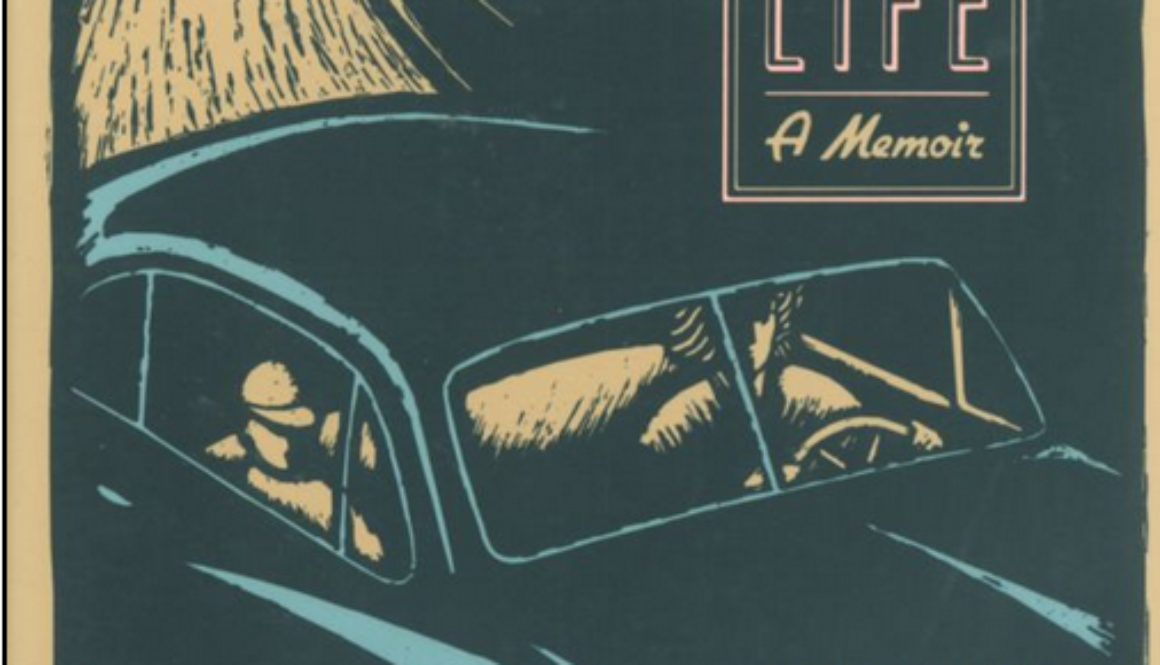
Steven S. Drachman: Hard to believe that it has been three decades (well, three decades and nine months) since the publication of This Boy’s Life, the memoir by Tobias Wolff, which told of his difficult childhood in the 1950s, and his own self-invention (“I was a liar,” he wrote. “I couldn’t help but try to introduce new versions of myself as my interests changed.”) Stuff happens in the book, of course, and the characters are vivid – especially the character known in the book as “Dwight,” the childish and insecure man who tormented young Toby during his brief reign of terror as the boy’s stepfather in a small industrial town, and side characters like “Arthur,” the “uncoolest boy in school,” to whom Toby is drawn – but the story is really about a boy deciding whom he will become. It made a great splash upon its publication – among other things, the book was turned into the movie that made Leonardo DiCaprio a movie star, in 1993. I interviewed Wolff for a New York Times story about the film’s release, in 1993, but I think now the longer conversation about the book itself might be interesting to the public, so here it is. The answers have been edited, the conversation refocused on the book, rather than the film, and the questions have been edited for clarity and brevity.
DRACHMAN: Why did you decide to handle the writing of the book as nonfiction instead of doing a novelized version? I read a lot of your other stuff, which is autobiographical.
WOLFF: How do you know?
Because you said so in interviews.
(Laughs). Like what?
Like The Barracks Thief – your experience in Vietnam.
Well, actually, now, The Barracks Thief is not set in Vietnam. It’s set at Fort Bragg. And it was not autobiographical except that I used a setting in a life that I knew well. In that sense I suppose everybody’s fiction is autobiographical to some extent, but the events that I talk about there are not autobiographical to the extent that I was one of those three boys – that simply is not the case – but what is true is that I was a paratrooper and I was stationed at Fort Bragg waiting to go to Vietnam and I was an officer instead of an enlisted man. So I adapted things a lot. I was also an enlisted man there, but I wasn’t waiting to go to Vietnam at that time. So there’s a lot of alteration of the circumstances that would never allow me to call that a memoir.
I recall writing an attempt at a novel at one point and using things from my own life, and even thinking at one point, Better disguise that a little more. And I would think that writing a memoir like this you would have the same thoughts. Did you ever think of doing it as fiction?
Actually I did. Originally that was my intention. Years ago I tried writing one account of those years heavily fictionalized and actually I tried it more than once, and couldn’t ever get it to come to life.
What actually happened was I started writing some of these things down pretty straight from life just as I remembered it just to give myself a bank of experience that I could draw on later in my fiction. And I realized as I was kind of writing this stuff out more or less straight – although of course nothing is really “straight” in an artful construction like a memoir, that is things are even without the writer’s knowing it, certain things are emphasized, other things are not, there’s a compression of time and you’ve just changed the whole nature of experience by putting it into narrative. I mean, life doesn’t happen in sentences, and if you put in everything that happens you have overwhelming banality.
There’s a tremendous amount of editing that goes into the construction of any artful narrative, whether based on experience or largely invented. So there’s already a difference between memoir and real life, that’s why I don’t call it an autobiography, I call it a “memoir,” that is a story according to memory. Memory itself is a very imperfect recorder of experience. It’s very very subjective, obviously.
But, nevertheless, to get back to your original question, I didn’t call it a novel because it isn’t a novel. I never thought of it as a novel, I didn’t have I don’t think frankly it would be a good novel when I read it. Its interest for me – anybody can make this stuff up – but its interest for me is that it actually happened, and I believe that’s part of its interest for the reader as well. When I invent a lot from my personal experience I really do feel compelled to call something a novel or a short story. When I’m staying close to the truth as I remember it, I give up a lot of the prerogatives of the novelist, and the obligations of the novelist. For example, being fair. It’s a very unfair book. I do not try to be fair, in that I do not try to explain or understand or be compassionate about certain people whose behavior seemed to be at the time to be inexcusable or oppressive. There’s no attempt at objectivity in this or depth of compassion to those for whom at the time I did not feel compassion. So there are a lot of things you do differently in a memoir than in a novel.
How long did it take you to write this?
I worked on it for the better part of four years. Thinking about it, doing preliminary sketches, and that’s also counting a lot of the time I read it and thought about it. I was also writing some stories during that time as well, but I would say then a good 3 years of fairly concentrated writing on it. I write every day but I’m not as productive as I wish I were. I throw away most of what I write and come back to it again and again, so I don’t seem to have written as much as I had once hoped I would.
What was different about the final book – did it go through a lot of revision at the publisher?
Not really, no. I added another 15 pages but otherwise there wasn’t a lot of revision at all.
What was different from the final version as you wrote it that was different from what was in your head when you were starting it?
It’s hard for me to recapture the original design because once I’ve written it then the original design gets sort of lost. It’s fuller, I suppose, than I intended it to be. I had intended it to be more suggestive.
But the story really demanded to be fleshed out in a lot of ways. For example, in the first draft, I did not have any account of why it was that my mother and I ended up in Utah. I just started off with us there looking for Uranium as if they’d been dropped from Mars, which is kind of how I felt at the time. I was trying to recapture some of the sense of bewilderment and dislocation that a kid can have in a situation like that, a kid who doesn’t really know all the explanations for why he’s uprooted, and suddenly in another state halfway across the country. But it really didn’t work very well in the narrative so I had to give some accounting, some, I suppose, background to the situation that the mother and son were in, and a lot of things like that really came up where I had been holding back information. Information, explanation, background, flashback, I hate those things in fiction. They bore my socks off, especially my own, it bores me to write it, I’m much more in the present moment when I write fiction than going back over the past, it’s not a mode that’s congenial to me.
Now some writers obviously can do this with tremendous skill and without losing any of their velocity and without losing any of your sense of being in a present and consequential moment, but anyway, there was something of a departure for me to do that.
There are other things that I really don’t remember very well. I suppose too I cut out some things that seemed to me finally to be interesting to me only because they happened to me. I finally ended up using events that I recalled that seemed to have a pattern that helped me to understand how this person became who he was, you know, the endless forging of identity that goes on in the book and that’s the kind of thread that it’s about, and not as some readers seem to believe about my “hard life,” which I really never thought of as a particularly hard life.
It really is more about how somebody creates himself. And that’s the sort of unifying experience of the book that I put together in that final act of fiction in which he creates his own past in order to seize a future for himself that he thinks would be better than the one that would be given to him otherwise. Those things are the polestars of my reconstruction of the book through the first draft. Which nobody else saw, incidentally.
When I read it the first time, it struck me that it seemed as though it could be easily translated to the screen. Did you think that when you were writing it?
No, not at all. I in fact I didn’t think so and I was a little surprised that someone wanted to make a movie out of it because it seemed to me so utterly reliant on voice for its effect, and the voice is so untranslatable that it set me looking back at the book again to try to imagine how they were going to do it, because it doesn’t move so much by visual images and by episodes as – well, just to back up again, it’s the same thing, the debate that’s going on now, to the extent there is one, about A River Runs Through It. Some people seem to think the whole book’s been lost, because the quality of the voice has been lost in the filming. I haven’t seen the film, I have no idea one way or the other, but it is true that often the best movies are made from books in which voice is not an element at all, like, oh I don’t know, Day of the Jackal. If you actually read that book, it’s not interesting at the level of art. It’s got a neat plot that lends itself wonderfully to a movie, where time and again you see books like Lord Jim, incredibly sophisticated in their structure and in their music, which just cant make that transition to the screen because whatever it was that made that book interesting can’t be carried over. I had a suspicion that would be true of my book.
In fact, my very decision to write it as a memoir seemed to me at the time to probably restrict the audience somewhat. It’s probably that if I wanted a lot of readers I’d do better to call it a novel and whatnot, but there wasn’t really much of an appetite for this kind of thing at the time. I think there is more now. But I was writing it out of a sense of personal necessity to some extent, and then as I was writing it out of the sense that it was making a hell of an interesting story. And it might be interesting to other people too.
But I don’t have visions of movies dancing in my head when I write, I couldn’t write that way. The question is as I know from all my friends who have deal with this is once you sell it, you lose all control over it, and its just preposterous that you can dictate what the outcome will be like.
Finally, the money talked louder than my doubts and so we sold it to Warner Bros.
Were you worried when you were writing it about the people you were writing about? I don’t know if you know whatever happened to Dwight?
He died. Interestingly enough just a few days before they started filming. I hope the events weren’t connected.
But I had no contact with that family for all the 30 years after we left Washington State, except a time shortly after when he followed my mother back east with the intention of killing her. Otherwise my last sight of him was in Washington, DC in police custody. But other than that I have never seen any of the children since and I never saw him again. As far as being worried about what people might think about what I said about them, my approach was this: I would be absolutely as honest about myself as I would be about them. In other words, I wouldn’t hold them to a standard that I wasn’t holding myself to. And if I can take the heat, then they can too. They’re going to have to.
I’m not a fabulist like Italo Calvino for example, and I draw my material from my life, not that everything I write is autobiographical, but my material very much depends on the life I’ve lived and the people I’ve known, and for me to worry to the extent that it became prohibitive would utterly disable me as a writer, and I won’t allow that to happen.
Did you hear from anyone?
Oh yeah, lots of people. In fact, the character called Arthur in the book – I didn’t call anybody by their real name except myself, my mother and my brother and my father, but everybody else’s name I changed, and to tell you the truth, I even changed the name of the village I lived in in Washington State. I wasn’t trying to get revenge.
The way I found out [that Dwight had died] was his children showed up at the movie set in Concrete, Washington – that is a name I did not make up. My mother and I had had a trunk stolen with all our family pictures in it many many years ago, and his children were very friendly to me and my mother, there was never any bad blood there, and they were very curious about the project, and they are even in the movie, I believe they are in a basketball scene. And they met the actors and actresses who are playing them in the movie, toured the set and [showed] the director of the movie all these pictures from the old days, then consequently my stepbrother had those pictures copied and sent them to me so we had a little correspondence after all these years.
What did Arthur think?
He liked the book a lot. And didn’t seem to dispute anything, didn’t seem to find any of it inaccurate. You know I admired him a lot, as I came to write the book and remembered what an incredibly independent person he was at a time and a place that was not hospitable to that kind of eccentricity. And he was very courageously himself always. He is still an extraordinary character.
Did anybody have qualms about the book?
Not that I know of. No one has said so to me. Now, you know, by way of his children as they told people on the set that my stepfather really hated the book. But of course he did! He was supposed to hate it!
[Editor’s Note: We are so proud to publish the final episode of this great serial, from Mark Laporta. You can read the whole story from the beginning, starting with Episode One.]
“It is not as you imagine,” said the Serlatian in Bleenor’s mind. “We cannot carry out our offensive without revealing our position and risking millions of lives. You two, however, are already known to the Alornoz and have less to lose.”
“They have a point,” said Zevdra. “The least we can do is listen — unless you know another way home.”
Bleenor’s antennae drooped.
“OK,” he said, “let’s hear it.”
The outline of the Serlatian plan was simple. The ShinyNova would deliver a series of transmitters to designated asteroids across the galaxy. When activated, the transmitters would broadcast the same thought-patterns that the two insectoids had used to incapacitate the symbiote that had infested Bot One.
“Once the transmitters are in place, the cumulative effect will drive the Alornoz out of this galaxy forever,” said the Serlatian.
“Not good enough,” said Zevdra. “I can’t agree to a plan that just turns these slugs into somebody else’s problem.”
But as the Serlatian assured her, they had long ago sent detailed plans for the transmitter system to the far reaches of the settled universe.
“By the time those parasites arrive, everyone will be protected,” said the Serlatian.
“Do you buy that, Zev?” asked Bleenor.
“I guess I have to,” said Zevdra. “Unless you’re ready to die here with a slug in your neck.”
Bleenor hung his head.
“Whatever, I can’t lose you,” he said.
Without another word, Zevdra and Bleenor raced back to their lander and shot up to their ship, which was still in orbit around Serlat 3.
“Cargo hull laded,” said the ship’s AI. A moment later, the Serlatian’s voice crackled over the Shiny Nova’s intercom.
“We have transmatted the transmitters to your vessel and entered the necessary flight plan into your navigation system. Your AI is now also capable of transmitting the deadly pattern, should you encounter any symbiote-controlled ships. The moment the last transmitter is in place, a vortex will appear a short distance away and remain open until you are through. Good luck.”
“Craters,” said Bleenor, “this flight plan has over two hundred stops.”
“Better get started,” said Zevdra.
And so, over the course of the next two weeks, they pushed the ShinyNova at top speed to deliver the self-deploying transmitters throughout the galaxy. Along the way, their onboard transmitter helped them evade capture, despite several close calls. At last, the work was complete. A blaze of light appeared in the near distance.
“The vortex!” shouted Zevdra. If it hadn’t been for their grueling ordeal, they might have noticed how beautiful its bright, purplish edges were against the inky black of deep space. As it was, they thought only of exiting that treacherous universe unscathed. The moment the vortex closed behind them, Bleenor called out to the ship’s AI.
“Status,” he said.
“On course for mission trajectory,” it said.
Astonished, Bleenor checked the nav-AI.
“That’s right,” he said. “Too bad we’re too late with these medical supplies.”
“Correction,” said the AI. “Our mission is on schedule.”
“How can that be?” asked Zevdra.
“The Vortex point of entry was consistent with these spatiotemporal coordinates,” said the AI.
“I miss Bot One,” said Zevdra. “It was so good at explaining things.”
“You called?” said a voice in the next bulkhead.
The two Veratrese gasped as their lost servicebot walked into the command center. Apparently, the Serlatians had thought of everything.
“Turns out I’m just a toy to them,” said Bot One. “I was fully functional less than two rotations after you left that version of Serlat 3. And it may interest you to know that a spatiotemporal vortex can be aimed at any coordinate set you choose.”
“I’ll keep that in mind the next time I’m … vortexing,” said Bleenor.
The unexpected official announcement that boomed through the ship’s intercom doused his joyful mood.
“Attention, all Trans Proxima Shipping personnel,” it said. “This is Relnatror Delatrin with your quarterly reminder that crew member fraternization is strictly prohibited and grounds for immediate termination. As always, thanks for being a valued member of our fleet.”
Zevdra’s hoarse whisper barely cut through the Command Center’s stunned silence.
“Positrons in a pile, what’ll we do?” she asked. “Piloting is all I know.”
Bleenor’s mandibles clacked as he plopped down into his navigator’s chair.
“I wonder if there’s a parallel universe out there where there aren’t so many stupid rules,” he said.
Bot Two, who had just clomped up the titanium spiral stairs that led from the lower level walked over to Bot One.
“You want me to tell them?” it asked its machine-mate.
“I’ll do it,” said Bot One. “Though I’m not sure it’s a good idea. But here it is: Captain, you should know that the Serlatians have retrofitted this ship for vortex creation — software, hardware, schematics, the works.”
“So, theoretically, we could open a vortex anytime we wanted?” asked Bleenor.
“Nothing theoretical about it,” said Bot One.
Zevdra and Bleenor gasped as a brilliant ring of bright purple appeared on their view screens for the second time that day.
“Voila, Vortex!” said Bot One. “Now, there’s no way to know if the metaverse on the other side includes a society with the attributes of personal freedom I assume you want. But there are an infinite number of possible metaverses to explore.”
Zevdra pulled Bleenor close. As they gazed up at the image of the vortex, they were overwhelmed by the thought of starting over. Far away, that is, from the petty restrictions of a world more in love with rules than with Love itself.



 Well, who is this apparently silly fellow, McCaffery, with his silky, flowing coif and smirking, pouty lips? He’s a professor of


 As she said this she raised her bent figure and spread out her arms widely. A thin blue mist drove across their vision like a smoke-cloud, and through it broke a glow as of burning coals. It rolled past them, leaving only a faint vapor, behind which they could see a thick hedge of fiery-hearted roses that seemed to burn like living embers. Through a division in the midst of this radiant tangle the light from the glowing flowers shone upon a floor and walls of black oak which could be seen behind it, reflecting itself in the polished darkness beyond, as stars reflect themselves in deep water; and, at the further end of the room, in an angle where the dark walls met, stood a bed carved with designs which could be only dimly seen, and hung with curtains of a rich deep color that might have been either green or blue.