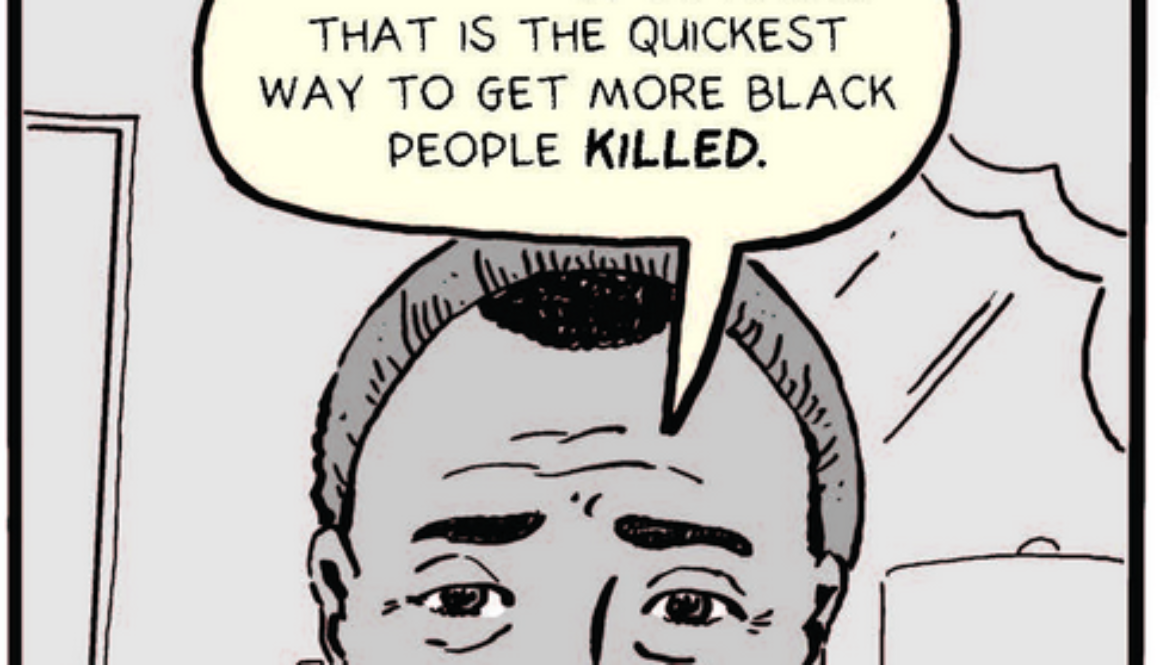
In a “A Tale of Two Pandemics: Historical Insights on Persistent Racial Disparities,” Neufeld uses the form of comics journalism to highlight a recent research article published in the Annals of Internal Medicine. The comic draws on the research article itself, along with additional sources — including interviews with co-authors Lakshmi Krishnan, S. Michelle Ogunwole and Lisa A. Cooper. The three medical doctors are the main characters of the comic, which explains racial health disparities and the spread of misinformation during the coronavirus pandemic and the 1918 influenza pandemic. The doctors’ speech-bubble quotes come directly from their interviews with Neufeld.
In cases where Neufeld quotes directly from their research article, he depicts the authors speaking in unison — akin to a Greek chorus. “I let their voices guide the narrative,” Neufeld says. “I’m so grateful that they spoke to me about their article!”
For educators and anyone else who would like to republish it in print, Journalist’s Resource provides access to a high-resolution PDF here: Download a high-resolution PDF.
Almost 60 percent of Israelis believe the IDF should be put in charge of lockdowns connected to the Coronavirus, according to a recent poll.
The same survey found that 25 years after a historic court ruling permitting females to apply to the IDF’s Flight Academy, only 43 percent of Israelis believe the Israeli army gives women soldiers equal opportunity — 50 percent of men and 36 percent of women.
Some 46 percent of Jewish Israelis believe the IDF provides religious and secular soldiers equal opportunity for personal development, according to the same poll. The more religious the respondent, the less the IDF is trusted. Only 22 percent of the ultra-Orthodox, but 38 percent of national religious and 48 percent of secular Jews trust the army to give equal opportunities to religious and non-religious Jews. The survey was conducted by the Israel Democracy Institute.
— Aaron Leibel.
^^^
Veteran journalistAaron Leibel writes for The Jerusalem Post and Washington Jewish week, and he blogs for The Times of Israel. He is the author of the acclaimed memoir, Figs and Alligators: An American Immigrant’s Life in Israel in the 1970s and 1980s, available from Amazon in Kindle and paperback, Barnes and Noble, and at every local bookstore in the U.S. and Canada.
By now, it’s redundant to praise The Queen’s Gambit, the magnificent new limited series on Netflix, which has focused a weary nation’s attention on competitive chess, rather than politics. Says chess champion Garry Kasparov, who helped with the production, “Everybody is watching it. It’s No. 1 in Russia. God knows how, but somehow Queen’s Gambit just hit all the right buttons.”
Who was Walter Tevis?
Indeed, QG is the feel-good alcoholic/drug addict movie of the year (and possibly of all time), and a terrific tribute to the vision of its creator, the novelist Walter Tevis, who wrote The Queen’s Gambit in 1983, in addition to The Hustler, The Man Who Fell to Earth and The Color of Money, but who, till now, has not been a household name.
That all may now change. Tevis’s other books are coming back into print, my copy of QG is now worth almost a thousand bucks, and a long out-of-print self-published Tevis biography by the author’s late ex-wife now fetches hundreds of dollars on the web.
A book that changed my life
I’ve known Tevis’s work for a long time. My dad bought and read The Man Who Fell to Earth in 1963, before he met my mom. My mom bought and read The Hustler in 1959, before she met my dad, and years later, in 1983, she bought me a copy of The Queen’s Gambit. Tevis’s chess novel was that kind of book, something you would buy for people and demand that they read. We QG fans have waited years for the film version, through so many announcements and cancellations. Heath Ledger chose QG to be his directorial debut, but died shortly before filming was to begin. For example.
My dad loaned me his ragged copy of Tevis’s first sci-fi novel, The Man Who Fell to Earth in the mid-1970s, which I have read many times over many decades. The movie, which I saw when it was re-released in its uncut version, around 1980, scared the hell out of me. But it made me a fan of the movie’s star David Bowie, which led me to Iggy Pop, Nagisa Oshima, Ryuichi Sakamoto, Japanese film, Japanese novels, so many things.
I interviewed the film’s director, Nicholas Roeg for The Washington Times in the early 1990s, which wouldn’t have happened if not for Walter Tevis.
Bowie’s “Berlin trilogy” of record albums was significantly influenced by The Man Who Fell to Earth, and his last project during his lifetime was a musical stage show sequel to The Man Who Fell to Earth.
Now that the world has discovered Tevis so decisively, where should curious readers turn?
The Queen’s Gambit
Well, of course, start with the novel, The Queen’s Gambit, which is not his best book, but remains his most crowd-pleasing.
With a caveat: The TV adaptation is really very faithful in its specifics, and in its exciting depiction of chess.
But it differs in attitude.
Tevis viewed addiction as a normal, unavoidable facet of the human condition. In his books, alcohol and drug abuse are just there, almost unworthy of comment.
The TV show, of course, takes a different tack, depicting alcoholism and drug-addiction as anomalies, illnesses with a cure.
And the TV show is so filled with joy.
Tevis, was a sickly, divorced man, a lifelong alcoholic who attempted suicide several times before dying young of lung cancer, and he didn’t really see much joie in the human vie.
But Tevis’s ability to write thrillingly about chess is one of the book’s major achievements, along with its depiction of the mystery, randomness and unfairness of genius.
Fans of the TV show will enjoy the book’s descriptions of chess, its 1960s flavor, and a heroine who is complex and indescribable, and simultaneously vulnerable and indestructible.
The Man Who Fell to Earth
Then turn to The Man Who Fell to Earth, Tevis’s best book, which would be almost any author’s best book, a devastating sci-fi psychodrama and quick, short page-turner. Please, if you do read this book, read the original version, published in 1963, and not Tevis’s 1980s rewrite. The original version is perfect.
Thomas Jerome Newton, the titular “man who fell,” presents himself to the world as a brilliant inventor with numerous patentable ideas, all original enough to disrupt the world economy (and put Kodak out of business).
Newton is, in reality, from a distant planet, a world starved of water and fuel, and he’s here on a mission to save his homeworld. His unique genius soon piques the attention of a suspicious FBI, and Newton’s exposure to various human vices and addictions of humanity threaten to upend his work. (Indeed, being human is perhaps the worst vice and worst addiction of all, to which even an alien will succumb.)
The novel is daringly brief, daringly sexless and unromantic, beautifully written, absolutely heartbreaking and in all ways perfect.
If you picture David Bowie while you read this novel, don’t worry, that’s OK. Bowie was iconic as Newton, and even Tevis was thrilled by the casting.
“I think he was terrific,” the novelist said, in what was probably his final interview. “That was genius casting. I think that was really wonderful, and he’s a wonderful man.”
The Hustler
Here again, it may be impossible to approach this novel, about a brilliant pool hustler in the 1950s, without thinking of Paul Newman’s iconic image as Fast Eddie, and that’s also fine.
Even Tevis admitted that Newman supplanted whatever his imagination had originally dreamed up.
“When I read The Hustler,” Tevis said, “I cannot see my characters. I can’t see Fast Eddie and I can’t see Minnesota Fats. I see Paul Newman and Jackie Gleason…. It certainly is testimony to the fact that movies can rape the imagination. I mean, when the author can’t remember what his own characters look like, it’s certainly something.”
Many of his later themes were already there, the joy of the game — Tevis writes about pool as thrillingly and skillfully as he writes about chess — and the inexplicable, random nature of genius; and the book is clean and spare, with the style and tone of nonfiction.
The end is not as dramatic as it should be, and so the filmmakers, in adapting the novel, stuck on an ending that went too-far in the opposite direction, veering towards a melodrama that was un-Tevis-like.
The novel will not move you the way Gambit or The Man Who Fell does, but it will exhilarate you.
The Later Years
After The Man Who Fell, Tevis published nothing for seventeen years, when suddenly he published, in quick succession, the dystopian SF novel Mockingbird (1980), a short story collection, Far from Home (1981), the SF novel The Steps of the Sun (1983),The Queen’s Gambit (1983) and his Hustler sequel, The Color of Money (1984), which, other than Gambit, are for completists only.
Far from Home is recommended for the early stories, which are careful, thoughtful and diabolical Twilight Zone-style science fiction; the stories from his post-gap years are sloppy and embarrassing. The Steps of the Sun, a novel expanded from one of those later short stories, about an energy shortage on Earth and a billionaire who travels to outer space to save his planet, is meandering, too derivative of both The Man Who Fell and Solaris, and rings false in both the future world Tevis created and in the life of the book’s billionaire protagonist. Mockingbird, like Steps, fails in its world-building; but Tevis’s story of a future America, in which the world’s last sentient robot rules a drug-addled, illiterate population, ends with a terrific and moving revelation. With a skilled editor and some good advice, Mockingbird could have been a great book, and it will eventually be a great movie.
Finally, The Color of Money … you ask, how bad could it be? The movie was terrific.
Well, the movie was terrific, but it bears zero resemblance to the book beyond the title. The Tom Cruise character never makes an appearance in the novel, for example.
The pool games are still beautifully, dramatically done, but the rest of the book is episodic and formless.
In his later years, Tevis indeed floundered, a once-great novelist trying to find his way out of the wilderness, with sparks of the old brilliance, but a man in a hurry, his time dwindling away.
Still, with The Man Who Fell to Earth, The Hustler, The Queen’s Gambit and his great, early short stories, Walter Tevis has earned a place in any list of our greatest writers.
Almost four years ago, Donald Trump’s presidency began with a small, silly lie about the size of his inauguration crowd. On Nov. 7, as Joe Biden’s lead in the vote count became insurmountable, the Trump presidency effectively ended with a big, dangerous lie — as the president claimed that he had won but been cheated by fraud.
Both lies flew in the face of all evidence. In 2016, however, we were only just starting to grasp the way political narratives and social media filter bubbles converged, allowing people to believe what a Trump adviser coined “alternative facts.” In 2020, we are unsurprised when such lies emerge, and we know more about how conspiracy theories are spread, deceiving millions into believing them.
One thing has not changed: we are vulnerable. As the transgressive satirist Sacha Baron Cohen shrewdly observed, “democracy depends on shared truths; autocracy depends on shared lies.” Our lack of shared truth presents a huge threat to humanity — imperilling social cohesion, confidence in democracy, compliance with public health guidelines, racial equality, respect for the rule of law, and our ability to act collectively against climate change.
Is Biden’s decisive victory a repudiation not just of Trump, but of Trump’s divisive and dangerous approach to leadership communication? No, but there are glimmers of hope. What fresh lessons can we learn today about the role of communication in achieving mutual understanding?
A defeat for hubris, not a victory for truth
Trump proved to be fallible. His surprise 2016 victory created an illusion of the president as a political and communications mastermind – skilled in gaslighting, media intimidation and misdirection.
While still a potent politician, the Trump of 2020 proved unable to adapt his message or follow a disciplined strategy to target swing voters. The narrative of grievance was ineffective from an incumbent. The call to action – “Keep America Great” – flew in the face of observable reality. He blew his best chance to reset the campaign with an erratic performance in the first presidential debate. And while Trump’s inner circle had better instincts, they harmed their chances by indulging his whims and obsessions – such as attacking mail-in voting, holding ego-boosting rallies during a pandemic, and wasting scarce advertising dollars on Washington cable shows the president likes to watch.
Would Biden still have won had Trump not shown such hubris? Since so few minds changed in the summer and fall, perhaps. Biden’s core messages were certainly sharper (“Battle for the soul of the nation” and “Build back better”). However, the Trump campaign’s success in convincing many Latino voters that Biden was a Castro- or Chavez-style socialist (an ironic claim, given Trump’s similarities to the latter) was a grim reminder of the weakness of current defences against dishonesty.
The campaign did, however, reveal more about the best defences against these dark arts.
Investing in smarter media — both news and social
In the 2016 campaign, the mainstream media were too often co-opted into complicity with Trump’s narrative. His allegations of bias made them bend over backwards to devote comparable coverage to Hillary Clinton’s use of a private email server and Trump’s much more serious misbehaviours — including misuse of charitable funds, the promotion of racist “birther” conspiracy theories against former president Barack Obama, and multiple allegations of sexual assault.
By 2020, news media outlets and social platforms alike had reconsidered their responsibilities and developed policies and practices to prevent obvious falsehoods from standing unchallenged. In the recent U.S. campaign, many professional journalists refused to be manipulated:
The Trump campaign’s attempts to claim – without evidence – that Biden profited from his son’s business dealings were given little credence, including by the GOP-friendly Wall Street Journal and Fox News. The statement by NPR’s public editor was particularly memorable.
And finally, even social media networks – such as the president’s preferred medium of Twitter – have begun to understand the need to flag misleading content – even from (and perhaps especially from) such an influential source.
Could such actions reinforce the false narrative of a “rigged media?” That is a risk – but one worth running. Investments in professional journalism, social media fact-checking and citizen media literacy are essential. The common goal must be a consistent demand for evidence over opinion.
Turning crises into educational opportunities
After Trump’s election, my greatest fear was that he would follow in the footsteps of the authoritarian leaders he admires, creating or fomenting crises and then responding by limiting civil rights and shredding democratic norms. He certainly tried — from the Muslim travel ban in his first year to the manipulation of pandemic information in his last. Often, however, America’s courts, national security agencies and scientists held his worst excesses in check.
What I did not fully appreciate was how effectively a crisis can expose falsehood and ineptitude – provided that the truth is sufficiently discernible for all to see. Crises are inherently resistant to narratives, and to attempts to spin the facts to one’s advantage.
One of the campaign’s early turning points came in June, when Trump built up expectations for a packed Oklahoma rally, only to speak to a half-empty arena. As the New York Times reported, the president “had not been able to will public opinion away from fears about the spread of the coronavirus in an indoor space.”
Making empathy a superpower
One lesson leaders can learn from Biden’s success is the power of empathy. While he lacks the persuasive power of a Kennedy, Reagan or Obama, he excels at demonstrating empathy, both on the podium and in small human interactions.
The power of empathy is that it runs both ways: when you give it, you receive it. The vicious defamation that Trump had used successfully against Hillary Clinton was largely inert when tried on Biden, as the president’s daughter-in-law discovered when she mocked his stutter, and Trump himself found out during the first debate when he mocked Hunter Biden’s struggle with addiction. If anything, such attacks increased empathy for the Democratic candidate.
While Trump is not known for empathy, it is essential to note that he understood and articulated the frustration and rage of large segments of society who felt left behind by educated, urban America. Seventy-one million people voted for him. Dismissing them all would be dangerous; Biden made a good start by pledging to govern for them, too. He must make good on that promise.
The key for ethical leaders and communicators is to turn empathy into a superpower by both demonstrating it and having the agility to act on it. New Zealand’s Jacinda Ardern has it in spades. This is partly about communication: consider how ads like this one might be more effective than angry speeches. It is, however, ultimately about turning empathy into meaningful action. The National Basketball Association’s powerful embrace of racial equity – followed by action to help turn out black voters – is a good example.
Developing ethical leaders — and rewarding them
The greatest bulwark against the dark side of communication is the most obvious: ethical leadership.
The real test of leadership is not standing for truth, justice and civility when it’s easy, but when it’s hard. History will remember the corporate leaders who distanced themselves from the president, upending traditional wisdom about never mixing business and politics.
Late in the campaign, I was struck by an article quoting Trump’s former chief of staff, John Kelly, referring to the transactional nature of all the president’s relationships. This proved to be a fatal flaw for Trump. Wise leaders will work with public relations advisers to enhance their listening and communication skills, their public engagement processes, and their strategies to build and nurture deep relationships with their public and stakeholders, based on shared values.
While Trump will soon leave office, new Trumps will surely emerge in the world’s major democracies. This is why government, business and civil society leaders must act together to support public-interest journalism, citizen media literacy and effective crisis and science communication. This is also why organizations must invest in recruiting and developing leaders with both ethics and empathy, and ensuring they have both the authority and the agility to act on what they learn. If we can summon this type of collective will, the light of shared truth can shine more brightly.
^^^
This article first appeared on Policy Options and is republished here under a Creative Commons license.
This week, Michael Nagler moves out of his seat as co-host on Nonviolence Radio to take the place of interviewee. Stephanie asks Michael about the course of his life — which could well be three or four lives! Michael was a professor of Comparative Literature and Classics at UC Berkeley and co-founded its Peace and Conflict Studies Program. He also co-founded and continues to act as president of the Metta Center for Nonviolence. At the same time, he directed the new film “The Third Harmony.”
In this interview, Michael speaks about his deep belief in the power of nonviolence and the way that principled nonviolence can help us to emerge from the spiritual crisis we’re facing now.
I feel that in the present age, the way we have to come to grips with the perennial struggle between good and evil is around the lens of nonviolence. That’s the way that it becomes most meaningful to us. That’s the way that the rubber hits the road in terms of our policies and our behaviors. And that’s the way that we can most efficiently orient ourselves to decision-making. We can ask ourselves, “Is this decision violent?” In other words, “Is there a selfish element which will benefit one party at the expense of another?”
In all his work, whether as an educator, an author, a director, Michael has been a passionate advocate for nonviolence and his efforts to reveal and celebrate its power has been a source of inspiration for many.
—
Stephanie: Welcome everybody to another episode of Nonviolence Radio. I’m your host, Stephanie Van Hook, and I am not in the studio but I’m recording the show live today from my home. I’m very happy to be able to do the show live today and interview my colleague, Michael Nagler, and not only about what nonviolence is for those who are new to it. Maybe they’ve heard some basic misconceptions about the power of nonviolence before or they have even practiced it, but have been disappointed.
We’re going to get into a little bit of some of the deeper dynamics of nonviolence with Michael, and also about the ways that nonviolence is being used right now in order to help promote and secure democracy in the United States and around the world. So, Michael, you’re usually my co-host, but welcome today as my guest to the show.
Michael: Thank you so much, Stephanie. I’m going to try to get used to my new role.
Stephanie: Now you are the cofounder of the Peace and Conflicts Studies program at UC Berkeley, and before that you were Professor of Comparative Literature and Classics at UC Berkeley.
I wonder if you want to speak first to an idea that, from “The Nonviolence Handbook” to “The Third Harmony,” is the one that stands out the most to me, that is, Our Spiritual Crisis. It is especially relevant on this day in the United States when we’re still awaiting election results and we’re still going through extreme forms of the pandemic, people are still getting sick. Speak to this. What do you mean by “Our Spiritual Crisis,” and how do you see that playing out today?
Michael: Wow. That is the key question, Stephanie, for sure. I took that term from my good friend Rabbi Michael Lerner who used it at a conference that we put on together in the year 2005. The audience just went wild with applause, and when politicians today, especially Democratic politicians, talk about the battle for the soul of America, that is essentially what they’re getting at.
What they’re saying is that this country had a particular meaning, not only in the development, the experiments with human politics, human political arrangements, but in a way, it was a step forward in human civilization. To me this means a step forward in spiritual awareness, and that is the underlying significance of the crisis that we’re going through right now.
I think that the reason that nonviolence emerges nowadays as the ideal way to address this conflict, this crisis, is that ultimately, nonviolence is a spiritual power. It’s like other forces that are invisible but potent as they swirl around us, especially in our human consciousness. Nonviolence also has a component of vision to it. One really simple way of looking at this is to see the world as a unity, which is what modern science and ancient wisdom have been telling us, and now are telling us with unanimous acclaim, we are all interconnected. We cannot injure another without injuring ourselves.
When you see the world that way and you know that things have to be changed, including things in yourself, the way you’re going to go about changing them is what Gandhi helped us understand to be nonviolence. It’s only when you see people as radically separate, meaning that possibly my welfare may have to be secured at the expense of yours, that violence begins to make sense.
Stephanie: I’m going to take a step back just for the sake of our listeners and those who may be tuning in. I recently saw somebody frame the question in an activist circle of, “Does spirituality have a role in social change movements?” That question confused me and confounded me in a way because I have a very strong sense of what spirituality means. But when you say spirituality, are you saying religion? What is the difference between spirituality and religion as it relates to the work that you’re doing?
Michael: If you wanted to separate the terms, though they can be made to substantially overlap, as when people say, for example, “I’m spiritual, not religious,” what they mean is that their feeling for the divine element in themselves and in the world and in others is not embedded in a particular sectarian framework. That’s becoming a more and more common form of spirituality in our world.
I think if you have a religious framework that is helpful – and there are parts of every major religion in the world today, including Indigenous religions, which are open to spirituality. As it happens, I was born into a non-practicing family and had no religious framework at all. I experimented with it when I was 12 years old, but I think I was mainly trying to annoy my father rather than discover God — anyway, poor dad. I came to spirituality without having a religious framework in the sense that I didn’t practice or – I didn’t practice a particular religion or try to construe the world in the framework of a particular religion.
Stephanie: And at the root, religion means — according to some accounts of its etymology — to tie together.
Michael: Yes, to tie together. And you can take that on many different levels. That’s actually, Stephanie, where The Third Harmony comes in because if you’re religatio, your reconnection with the universe as a whole, we’re calling that “The First Harmony.” If it’s religatio with fellow beings, and especially your fellow human beings, which is why the present political crisis is so acute and must be addressed, we’re calling that “The Second Harmony.” And if you try to harmonize all of the elements within yourself, within your own mind, within your own heart, your own intellect, your audio activities, we’re calling that “The Third Harmony.”
“Third,” is a bit of a misnomer because really that’s the first. That’s the harmony you have to start with or you will not be able to project the harmonic influence onto the world around you.
Stephanie: Interesting. But let’s bring it back to nonviolence because even for seasoned activists, often people have to push away the idea that nonviolence is some kind of a religious practice, that it’s something that the Jains do or it’s something that you do when you’re a Christian.
Michael: Following on the heels of what you were just saying, my strong feeling is that in this age where we’re living now, the 21st century, nonviolence is the key to spiritual development because nonviolence is an inheritance of every one of us. As we say in the film – we interview Dr. Bernard Lafayette and he says –
Stephanie: The film you’re talking about is The Third Harmony film?
Michael: Yes. The Third Harmony, Nonviolence and Human Nature which is now available for two-day viewing on Vimeo and you can get to it from ThirdHarmony.org or go to Bullfrog Films. The first interviewee is Doc Lafayette and he says, “For me, nonviolence is a kind of power, and that power is in every person because every person has the capacity to love.” As he colorfully put it, “The funny thing about nonviolence is when you step out of the shower in the morning, you’re fully armed.”
That’s a big difference between military coercion and nonviolent persuasion. In military coercion you rely on objects, things that are external to yourself and you’re mostly in a threatening posture. In nonviolent persuasion, everything you need to draw upon is within you, and what you’re doing is displaying the best that you’re capable of in your thoughts, words, and deeds to mirror that capacity in the opponent — and thus, bring it to life.
Stephanie: One thing that I find interesting about this conversation, and about the definition and the practice of nonviolence is that when properly understood, when nonviolence is actively practiced, it doesn’t look too remarkable. It looks like people getting along from the outside. But there’s this deep inner condition, this inner struggle that is taking place almost – I want to say against or in opposition to another force that’s within us that tends to aim towards separation or getting one’s own way at the expense of other people. But from the outside, nonviolence in our daily lives does look rather unremarkable.
On the other hand, a popular understanding of nonviolence is that it means loud, boisterous, extreme action, that you force your will onto the will of others, that you stop violence at systemic levels or at institutional levels with protests and marches and sit-ins, and any variety of tactics. What’s the difference between those two polarities, nonviolence as a way of being and the inner struggle that entails, and the more common perception of nonviolence looking like a set of tactics?
Michael: Yeah — or as the famous peace researcher now living in Spain, Johan Galtung said to me one time, “If you don’t have a basis in faith then your nonviolence is just a set of tricks.” And he went on to add, “And the opponent usually has better tricks.” So it is important for us to touch upon what Johan called, “That faith element”: the faith that your inner struggle matters, and that you’re not the only one who has the capacity to do that. The faith that when you do it right, it will have an impact on the world even though you may not see it in the immediate event. That’s one of the characteristics of the nonviolent approach to life and social change as opposed to a not nonviolent approach is that you may not see the results right away, but they will ripen in the course of time.
We can see in the Prague Spring Uprising in 1968-69, it failed to deter, to repel a Warsaw Pact invasion, so it looked like it failed. But 20 years later, the Berlin wall fails. And then communist hegemony in Eastern Europe fails. And you have this spectrum of countries that went through that change in a variety of ways which is interesting for us right now.
You had extreme upheaval — I think one of the really bad examples was Romania — and then you had a really peaceful creative constructive transition which was in Czechoslovakia, and undoubtedly because of the nonviolent practice that people had experienced the benefits of 20 years earlier.
Gosh, Stephanie, I may have drifted off the topic of your question, but I do think that the reason that nonviolence has been slow to catch on, especially the principled kind of nonviolence we’re talking about here, is that we in the modern world, especially in the Western industrialized countries, we don’t grow up with a very clear understanding of spiritual forces. That there can be non-material forces which show up only indirectly, except in our consciousness. We can feel them, but even there we need to get trained to recognize them when they occur.
Stephanie: Like, for example, like when I am hurting somebody and I start to feel regret or shame or pain inside.
Michael: Exactly.
Stephanie: I can either cover that up and say, “That’s just life and life is hard and it hurts,” or I can say, “Wow, that pain I’m feeling is a sign. I don’t want to do that,” and it’s connected to the pain I’m inflicting. That’s teaching ourselves to recognize the patterns between our behavior and how it makes us feel.
Michael: That is perfect. I think, unfortunately, it can be even worse. There can be situations where people simply do not feel that pain inside of them, and there can even be cases where it gets perverted in some extremely unfortunate way, and they think they’re enjoying themselves. But what they have done is they have sealed off their awareness from the most positive, the deepest most important, most characteristic part of their own personality. That suffering accumulates.
We’re beginning now – therapists, scientists – to recognize this and name it. We have a friend and we interviewed her for the film but she didn’t make it into this version. Her name is Rachel MacNair and she coined the term “Perpetration Induced Traumatic Stress.” The army felt that was too clumsy or else they never heard of it. They use the term “Moral injury” but it is real. It’s what Norman Cousins used to call a “therapeutic reality,” and it’s driving people to their death.
We have this epidemic of suicides among military personnel and we don’t know why and it’s actually because when they’re trained to be violent, abusive, to regard others as completely alien from themselves, as potential enemies, even if they don’t go into combat, that very attitude hurts them very deeply.
I think in kind of a backwards way it’s a hopeful sign that this tragic response is increasing. It might be a sign that human spiritual awareness, after all is said and done, is creeping forward a little bit.
Stephanie: In this interview portion of the show, I get to interview my mentor, Michael Nagler — also at times my co-host — about your own thoughts and opinions about the spiritual crisis facing humanity right now, and also about your work and how you’ve made your life a work of art in terms of using your professorship to create a Peace and Conflicts Study program in education.
In the educational field as a professor, you tried to raise questions within the university of, “Let’s talk about the purpose of why we’re here. Let’s talk about the purpose of an education. Let’s talk about the meaning of life.” You tried to do that with your students, and onto the work of the Metta Center, and finally for this film. You’ve just done so much with your life and you keep doing new things — and you’re in your early 80s! It’s quite inspirational and hard to keep up with.
Talk about the Metta Center. It was about in 2007 when you left the University of California and you turned entirely to the work of your nonprofit, the Metta Center for Nonviolence. Why have you dedicated yourself to this organization, of all the things you could be doing at this time?
Michael: What an interesting question. That was a difficult time for me. I spent a long time waking up to the fact that what I wanted to do with my life and whatever little good I could offer the world was not going to go through the university. It was very painful for me because I come from generations of teachers and education is almost a sacred profession for me.
But I chose Metta Center, you could say, for two reasons. One, you might call the religious reason: because my spiritual teacher told me to way back in 1981. But secondly, because I do feel that – I’m loving the bird sounds in the background Stephanie — I do feel that in the present age, people may have other approaches, but here’s mine. I feel that in the present age, the way we have to come to grips with the perennial struggle between good and evil is around the lens of nonviolence.
That’s the way that it becomes most meaningful to us. That’s the way that the rubber hits the road in terms of our policies and our behaviors. And that’s the way that we can most efficiently orient ourselves to decision-making. You know, we can ask ourselves, “Is this decision violent?” In other words, is there a selfish element which will benefit one party at the expense of another?
Or is it nonviolent in the sense that it will, if slowly and awkwardly at first, lead to something for everyone — which might look different. It might mean that I voluntarily take on some suffering to protect others, to protect you from having to undergo that suffering, much less me imposing it on you. This is where, as you were saying before, Stephanie, it sometimes gets hard to tell on the surface what the nonviolent quality of a given act is.
I might refuse to let you do something and the critical thing is why? Why am I refusing to let you do it? Am I refusing to let you do it because I don’t like it? It would bother me? Or because I feel that it’s the wrong thing to do. Like if you picket at a polling – at a recruiting station, we all have polling on our minds, of course — if I picket a military recruiting station, yes, it’s inconvenient for them. It’s awkward for them. It makes them stop and think about what they’re doing.
In that sense, it looks like it’s harmful. But I’m taking a chance that I know what I’m doing well enough to risk feeling that this difficulty, this inconvenience is in the long run going to be helpful for them and for everyone.
Stephanie: That’s just a beautiful way to describe why you’ve given your life at this point to the work of social transformation through nonviolence, through the Metta Center as your vehicle for that.
Michael: And I’m mature enough to recognize that other people may have different paradigms. They may have different frameworks, and they may be perfectly valid. Probably it has to be like a composite of all of these worldviews that will really get us out of danger and back on the road to progress. But I’m perfectly secure in the belief that this is where I can make my best contribution because in a way, I’m combining two skills that have been slowly acquired in two different professions, if you will.
One, the formal profession of being an academic and a scholar and publishing learned books and so forth, knowing how to do research and knowing how to think clearly and sift through evidence, and knowing – this is something I always enjoyed about it and benefitted from – knowing how people faced life and what they thought of 2-3000 years ago and where we’ve come from there. This has really broadened my horizons.
So there’s all of that intellectual training, but on the other hand, it’s the spiritual practice that I’m schlogging away in, I hope, to the best of my ability, which does sometimes shine a searchlight right onto, or pretty darn close, to the heart of nonviolence. Being able to combine those two things gives me a capacity to do this work — i not all that successfully, at least it’s the best that I can do.
Stephanie: It’s really interesting to hear you say those things, Michael, because I’ve seen so many people come to you over the years that you and I have worked together, which has been about 12 years now.
Michael: Glorious years.
Stephanie: A lot of people come to you with that very same question, “How do I shape my life and give my life to my deepest values?” And you give them that same advice, what your strengths are, what have you been doing up until now, and how do you then take those skills that you’ve honed and use them? Then you take them to the next level, how you want your values to play out. To hear that you’ve done that in your own life is very inspiring because you can tell that part of the power of what you share with people is coming from your own experience.
Michael: I think we have no power unless we do that. You know the famous story about Gandhi that our teacher tells in his book, “Gandhi the Man,” by Eknath Easwaran, how this mother came to Gandhi with a 4-year-old child and said, “Bapu, please help me. This boy is eating too much sugar.” And Gandhi said, “I can help you. Come back in a week.”
So she came back in a week expecting he would have really thought this through and have all these arguments. And he just looked at the boy and said, “Stop eating sugar.” And the mother said, “Thank you, thank you. But do you mind my asking why you didn’t do that a week ago?” And Gandhi said, “A week ago, I was still eating sugar.”
When we can recognize what is authentic in our own experience and share that with the world, it will help because every single one of us has a contribution to make. And that contribution will come from our own authenticity, from our own ability to understand what our experiences are telling us, and for that we mostly need some guidance from outside.
Stephanie: Yeah — that’s what I was pointing at in this sort of unremarkable way that nonviolence does its work in the world, it helps people to address questions like this one, “What do I do with my life?” And then it ties into what you were saying at the beginning about nonviolence. It has to do something with who we think we are, what we think our capacities are. That’s why I think people appreciate the work that you’re doing, and appreciate the work of the Metta Center, if they only want to learn the fine points of nonviolent tactics, there are a lot of new organizations out there doing exactly that.
Michael: And doing it very well.
Stephanie: But you’re really focused on this idea of purpose and dharma and human nature, which tend to be the key to unlocking the power in the tactics that people choose to use. And you are now a film director, Michael, of The Third Harmony, Nonviolence and the New Story of Human Nature. How about we get into a little bit of conversation about the film? What is it? What motivated it? And how can people find it?
Michael: Sure, thought you’d never ask — just kidding. It’s been a dream of mine that has been percolating for a long, long time because I had, myself, had been so affected by films and by scenes that I saw in films. I knew that this would be a way to reach people, that would be complementary to; and in many cases, more powerful than reaching them through books. I also was able to draw upon my many, many years of work in the nonviolence field which gave me access to some of the greats in this film.
So in The Third Harmony we interview activists like David Hartsough, Bernard Lafayette, Ali Abu Awwad, and others. We interview scholars like Erica Chenoweth, and we interview students who are exploring the world of restorative justice, which is one of the two big institutions that have grown out of nonviolence in the modern world. The other being nonviolent intervention, which is prominently called today, “Third Party Nonviolent Intervention,” or rather “Unarmed Civilian Peacekeeping.”
The film gives quite a broad spectrum, and I’m happy to say that basically everyone who has seen it has been inspired. Many of them said “I want to go back and see it again” because it’s an introduction that works on the introductory level, but it also shows you that we’ve got a lot to learn when it comes to nonviolence. So there are many dimensions to the subject.
We’ve designed a version of the film for school, it’s 42 minutes or so.
Stephanie: 44 minutes.
Michael: 44 minutes with all the credits, right. Teachers can use it in two segments, or not. And that’s why we went to this particular distributor, Bullfrog Films.They are probably the premiere educational distributor in the country, so that’s an easy way people can get to the film, by going to BullfrogFilms.com and putting in The Third Harmony. Or they can go to the film’s website, thirdharmony.org.
Stephanie: For local listeners, this film is really a child of West Marin in some ways because the film’s editor is a resident of Bolinas. And you would have never found her if you hadn’t been living in West Marin yourself, Michael.
Michael: This is true. I found her through a notice that led me to her in a tea shop in Sebastopol. Through a series of phone calls I connected with Sarah who is a marvelous, marvelous film editor and deeply committed to the welfare of her fellow beings.
Michael: And she is appearing with me on a panel at the International Leadership Association. This is one of the seventh or eighth places the film has appeared with panel discussions so far. People can also organize community screenings very easily. They do that through Bullfrog Films also.
Stephanie: And, I think Michael, that on your website, the thirdharmony.org, there is something called “an activist challenge.” It’s an interesting thing that you guys have set up in Metta because people right now are saying, “What can I do?” and they may or may not be willing to go out in the streets because of the pandemic. They may or may not feel that that’s the most effective way for them to act.
But one thing that they can do is they can host a screening, a virtual screening of the film about nonviolence, which would help everybody who sees it take their nonviolence to the next level. There’s a way through Bullfrog to get a community screening license for activists that’s a reduced cost screening license. They then set up a virtual screening platform so that everybody can watch the film in your group over a two-day period at whatever point they have time to do so. Nobody has to be on Zoom or try to watch some movie through Zoom, which is a terrible experience! This is a streaming platform.
Then they can host a conversation, “What do we do next?” discussion in conjunction with resources from other organizations, like the International Center for Nonviolent Conflict or the work of some friends that did the guide, Hold the Line, Defending Democracy. They can use the film as a step.
Actually, today we just got an email from Extinction Rebellion in the Netherlands asking if they could do a community activist screening of the film.
So, for people who want to use it for this kind of thing, they can find that activist challenge on The Third Harmony website, thirdharmony.org, and then look for “Activist Challenge.”
Michael: That will send you to the tab called “Resources.”
Stephanie: There’s a tab on your website called “Activist challenge.”
Michael: Okay. I stand corrected. Stephanie, it makes me very happy to hear about XR wanting to use it – that is precisely what we were hoping for. That is, of course, we do want to get the film into schools and give young people a better framework in which to understand their lives. That’s the long-term goal, but in the short term, we had always hoped that this film would be a training tool.
Stephanie: Yeah. There’s also been Unitarian churches that are putting on screenings, and the Nonviolent Peaceforce is going to put on a screening in the next few days.
Michael: There are two different ways that you can organize those virtual screenings. The one that you are describing is called “On Demand” where you can set up a window of two days, five days, and then come together to talk about it. Or you can do the one called “On Time” where you have this streaming platform. They’re quite affordable, and I think, extremely useful. We would be delighted to hear from you if you do something like that and tell us how your experience went.
Stephanie: Michael, I think the question that’s on everybody’s mind, getting to hear a little bit of your life path and your dharma, your life path unfolding as you’re in your early 80s. You just became a director of a very successful documentary film, so what is next for Michael Nagler?
Michael: The short answer –
Stephanie: Are you going to Broadway?
Michael: The first thing that our executive producer, Steve Michelson, told us – he’s a very, very experienced producer, he has done maybe a 1000 documentaries — the first thing he told us was, “Michael, you are not going to walk down the red carpet. Forget it. This is not where you’re going.” And that wasn’t what I really cared most about anyway. So the short answer to your question “What’s next?” is I have no idea.
I expect, left to my own devices, what we’ll do is just continue to deploy and develop these resources because as you know, it’s not just a film. It’s a film, it’s a book, it’s a boardgame — thanks to you. And it’s now going to be developed into a media campaign. I’m happy to say that we will be able to get Sarah Gorsline back to help us create spots for that. It’s a repertoire, an array of resources. There should be something for everyone. My guess is that we’ll just be servicing that, developing it.
Stephanie: I’m looking forward to Third Harmony, the musical, coming to a town soon. I think you should still get the red carpet. Michael. Thank you so much for your interview today. I’m now going to take off the magic hat of your guest-hood, and I’m going to don you as our news reporter.
There’s nonviolence happening all over the world, not just in the United States. And thanks to Metta intern, Jewelia White, we have a bit of news to report on the show and a little bit of time to do that in. Would you like to enlighten us as to what is going on out there in the world of nonviolence?
Michael: I will sure try, Stephanie. There is a lot, and it won’t fit into just the amount of time we have now, but it will carry over. I want to ease into the main issue, which is the presidential election here in this country. I’ll start with a little side element that came about which actually points to something important.
While all this polling was going on, a group at Yale University conducted their own poll of about 2000 voters and asked them about clean power and should it be a primary U.S. energy goal? 82% of voters said yes, that they believe it should. The same total percentage who said that they would support requiring electric utility companies in the United States to generate 100% of their electricity from renewable sources like wind and solar by the year 2035.
Personally, I think 2035 would take too long, but it does bring us to one of the things that has been clear to me in this struggle, this electoral crisis: it has been a huge distraction from a looming problem that the human race now has to face together. In the nonviolence field, we know from this book by Sherif and Sherif called In Common Predicament, that the most powerful way to bring people back together who have been in a conflict is to have a serious project to work on together. That’s better than common entertainment, by heartfelt conversation even! And by gosh, it looks like the world, the human race on this planet has one big huge looming problem that needs everyone one of us to work on.
I think that once the election is behind us, Inshallah, we would be well advised to address two things. One of them is the sharp division that’s been exposed in the country. But the other is this tremendous job of preserving planet earth as a life support system. There are people like the director of this Yale program who said that the conventional wisdom has clearly changed. Voters strongly support a national transition from dependence on coal, oil, and gas to renewable sources like solar and wind. And they believe that transitioning to a 100% renewable energy economy is an important element. This kind of transition to a 100% clean energy economy will positively impact jobs and economic growth in many, many ways.
I remember Alexandria Ocasio-Cortez suggesting this, and people say, “But it will cost a lot to do this transition.” Well, it’s been calculated that if we don’t do the transition, uncontrolled climate change would cost $480 trillion. That’s trillion with a T. So it’s a bargain among other things, and that does matter.
To go to the main issue and our nonviolent angle on it, I’m very happy to report that nonviolence had a huge win in the sense that amid threats of intimidation at the polls, thousands of people took training in nonviolent de-escalation. They worked with groups like Election Defenders, Nonviolent Peaceforce, Meta Peace Teams. That’s Meta with a single T – organized by the Shanti Sena Network. The D.C. Peace Team and more groups like it.
And on election day, they showed up at the polls and assured that everyone could exercise their right to vote safely. It’s an incredible victory. As one commentator pointed out, “It probably won’t make headlines.” That’s what we’re here for. It probably won’t make headlines. It didn’t. But it is something to celebrate as we make sure that every vote is counted.
By coincidence, I’m getting a phone call right now that I’ll have to get around to later from a good friend Michael Beer at Nonviolence International. I want to add them to the list of groups that are producing marvelous resources. They say, “This is the time that Nonviolence International was made for.” Actually, I would amend that sentence slightly. This is the time that nonviolence was made for. More power to them. They are working to build a global culture of nonviolence.
They have a lot of resources already, including a repertoire of training archives that they did in partnership with Rutgers. That could be used as a backbone organization of the global nonviolent movement. And now they’re adding to these resources. They’re launching their own YouTube channel. You can find that at YouTube.com/nonviolence, and they have a new series of videos called, “Spotlight on Nonviolence.”
There’s one commentator recently who said about the last four years, “For those Americans who put us through this hell, nothing will be forgiven or forgotten.” I would say that is the perfect example of a violent response, so we have to take this training, get this orientation, and do it in a way that will really lead to reconciliation.
Campaign Nonviolence, which is an offshoot, I guess, of the Pace e Bene Franciscan organization, they have created something called, “The Nonviolent Action Lab,” particularly for this crisis. People throughout the Campaign Nonviolence and Nonviolent Cities Network are putting on a lot of website and webcam resources, like webinars. Ken Butigan from Pace e Bene and Rivera Sun will be hosting a lot of them. Their particular series will be every Thursday. It started yesterday, but it goes on to the 12th, the 19th, from 7:30 PM to 9:00 PM Eastern, which is 4:30 to 6:00 our time on Zoom. You can get to that through Campaign Nonviolence.
Another group that you mentioned was Choose Democracy and coming up soon, is something called, “At the Brink: Getting Ready to Stop a Coup.” You can register with Choose Democracy. Now a rather – I’m trying to choose a careful word here — okay, I’ll use the word ‘extreme’ though it can have the wrong connotations. This is nonviolence carried to extremity because of the situation which is extremely dangerous. I’m quoting now a spokesperson from the Sunrise Movement which was a U.S. version of Extinction Rebellion.
This person says, “If the president suppresses protests, claims victory without counting every vote, or tries to get electors to declare victory for him without winning the popular vote, our movement will call for a strike. We refuse to go to school. Refuse to go to work. We’ve seen the power that this has from the labor movement. And we know that we could bring this nation to a grinding halt.”
I sincerely hope that they never have to use that tactic, but I think it’s important for us to note that nonviolence can start with a conversational approach. In the end – we call this at the Metta Center “the escalation curve.” If you try all of these conversational, diologic techniques and they don’t work and this is something you cannot – you simply cannot abide — then you must be ready to go to extremes.
And those extremes can include shutting down the country. This has happened around the Middle East and Europe very often in recent crises very similar to our present crisis. In the end you may just have to take an extreme risk. You may have to risk your own life. The good side of that is that when you risk your life in nonviolence, you very often don’t lose it, whereas if you risk it using violence, you often do.
I guess another group to mention is ProtectTheResults.com. I’m happy to say that while this kind of work is going on, not everything has been drawn into the crisis. For example, Meta Peace Teams that I mentioned earlier, they are still hoping to send a team to Palestine in April. Actually, there are two people from Sonoma County who intend to be on the team. They’ve got a flier ready and are running out of time before applications are due. We got about a week to do this. So, if you look up Meta Peace Teams – again, that Meta is with only one T — ask about this Palestine trip. This is a superb example of cross-border unarmed civilian peacekeeping.
The Center for Freedom and Justice in Colorado is also conducting a series of Zoom interviews on Israel/Palestine. The first one will be conducted on the 16th of this month at 7PM mountain time, which I guess is 6PM ours. That’s going to be including Richard Forer, who is an author of a newly released book called, Wake Up and Reclaim Your Humanity. How about that for a title? This should be an extremely interesting interview. It could get us to the root causes of suffering and a Q&A will follow.
Black Lives Matter also is continuing its other activities. For example, at McMaster University in Canada they are holding the 20th annual Mahatma Gandhi lecture on nonviolence. They will be interviewing or putting forward none other than Rev James Lawson, a grand strategist of the Civil Rights Movement. There will be a YouTube link for that. That’s McMaster University, 20th Annual Mahatma Gandhi Lecture.
There will also be a virtual conference November 10-12 with Rev William Barber that we know originally from the moral – what is it, Moral Tuesdays?
Stephanie: Monday.
Michael: Oh, Mondays, okay. They’re all moral as far as I’m concerned. But Moral Mondays, that’s right. Alliterate. And he now is, I think, a major player in the Poor People’s Campaign. And this will be found online at facingrace – one word. Facingrace.raceforward.org. Here in nearby Sonoma County there is an ongoing conversation called, “Awkward conversations with a black man” and they’re being held between, typically, police and their African American host.
All that kind of thing, I think, is extremely helpful and extremely important. You know, Mother Teresa of Calcutta once said, “Don’t wait for a leader. Get to work. Work person to person.” And that’s where it has to start.
Stephanie: Michael, one last piece before we wrap up the news today.
Michael: All right, let me mention something that we mentioned before, that is that the U.N. treaty on the prohibition of nuclear arms was passed. It got its 50th nation state ratifying it on October 24. The Secretary General of the U.N. Antonio Guterres says this represents, “The culmination of a world-wide movement to draw attention to the catastrophic humanitarian consequences of any use of nuclear weapons.”
An interesting element to this side of this is that as of January 22, two days after the inauguration of the new – whoever he may be — two days after his inauguration, this country will be out of compliance with international law unless he takes steps to dismantle our nuclear arsenal.
Stephanie: Thank you. Thank you so much for that news report, Michael. We want to thank our mother station, KWMR, thank you very much Jeffrey Manson for helping us do the show at a distance that’s also live today. Michael, thank you for being my guest. Thanks for doing the Nonviolence Report as well. We want to thank Matt Watrous and Jewelia White who are helping with preparing and making the show available afterwards, Waging Nonviolence, Bryan Farrell, to all of the Pacifica stations who syndicate us, and all of our listeners and everyone out there. Until the next time, as we say, do take care of one another.
Design by Steven S. Drachman from an Image by Geralt / Pixabay
My wife, Bonnie, is a cat person, and, over the years, her creatures have been nice enough to let the two of us share their homes.
For those not familiar with felines, they’re like dogs, except when a bad guy tries to break into the house, they don’t bark. Instead, they run for cover and stay hidden until the danger has passed.
Don’t misunderstand me, I love our animals — at the present time, it’s Trevor and Glenda — and I try not to hold their species against them. After all, they didn’t ask nature (I doubt if the Almighty is anxious to take credit for them) to make them cats.
On the positive side, my long association with Bonnie’s felines have helped to increase my understanding of, and compassion for, the idle and the unemployed.
But my love does not match Bonnie’s Just let me say that if you believe in reincarnation, pray to come back as one her cats. You couldn’t do any better.
Our first foray into the world of cats in Israel was our adoption in the late 1970s of an orange tomcat whom the daughters insisted on naming “Mickey.” One warm summer evening, the window was open in our sixth-floor apartment in the Neve Ya’akov neighborhood in Jerusalem, and Mickey was on the window’s ledge. Maybe he jumped, trying to get away from the cloying affection of the females in the apartment or from the shame of his name, or, perhaps, he fell — I was never able to determine.
In any case, my distraught women immediately had me scurrying downstairs to scrape up Mickey’s body so that he would be given a Jewish (cat’s) funeral. But to all our surprises, I found nothing in the garden into which the cat had plunged.
So, apparently, Mickey had survived his long fall, joining the many wild cats in our neighborhood trying to eke out a living from the scraps in the garbage dumpsters and seeking companionship from those felines of the other sex.
He apparently was very successful in the latter enterprise —he was not spayed before we got him — for we spotted many orange kittens in our neighborhood in the ensuing years.
But I digress. It seems as if Bonnie’s love for felines has been passed down genetically to our daughters — especially to Abby, daughter number 3. (Lauren, number one, takes in strays: Debra, number two, shares her abode with a cat named Golda.)
I recall during a visit to her apartment in Ramat Hasharon, Israel, in the late 1990s — she presently lives in the western suburbs of Boston — how she and her boyfriend, now husband, Meir, fed the hungry felines.
There are thousands, probably tens or hundreds of thousands, of cats who live outdoors on their own in the Jewish state. The humane society tries spaying and neutering them, but there are so many that it’s really mission impossible.
Abby and Meir already had two kittens — Tuli and his sister Tula (in Hebrew, a male cat is a hatul, a female hatula). So, every afternoon when they got home from work, after they fed T&T, they would put two big plates of dry cat food in the parking lot of their apartment building, and some neighborhood strays had dinner.
Not everyone in their building on Naomi Street liked the idea. One of their neighbors threw water at the diners who would temporarily retreat, but quickly returned to the meal when “the rain” ceased.
When they came to America, the four of them lived in the basement of our home while the two humans looked for jobs. Tula, the very incarnation of “scaredee cat,” rarely left their basement room. Tuli is best remembered at our house for stripping the bark from a newly planted tree in our front yard, killing it.
Tuli and Tula long ago have left their earthly paradise for whatever form of gan eden awaits cats.
As if to show how independent of her mother she has become, Abby has replaced them with two dogs.
^^^
Veteran journalistAaron Leibel writes for The Jerusalem Post and Washington Jewish week. He is the author of the acclaimed memoir, Figs and Alligators: An American Immigrant’s Life in Israel in the 1970s and 1980s, available from Amazon in Kindle and paperback, Barnes and Noble, and at every local bookstore in the U.S. and Canada.
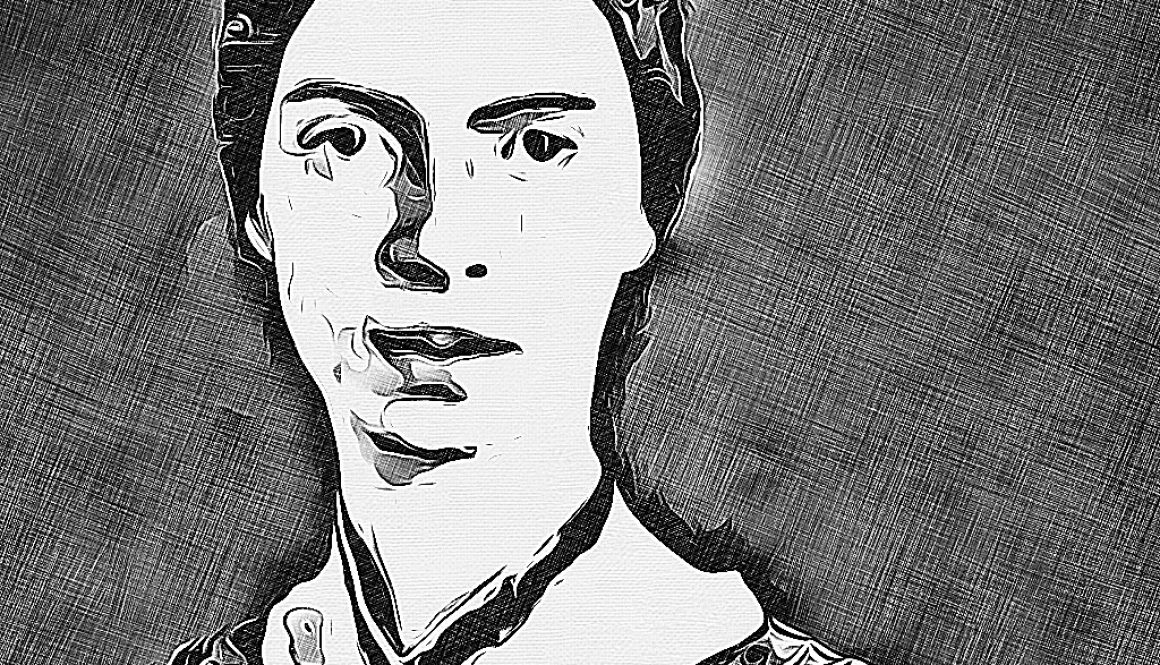
Since her death in 1886, Emily Dickinson has haunted us in many forms.
She has been the precocious “little dead girl” admired by distinguished men; the white-clad, solitary spinster languishing alone in her bedroom; and, in more recent interpretations, the rebellious teenager bent on smashing structures of power with her torrential genius.
As the world continues to endure the ravages of COVID-19, another ghost of Dickinson steps into view. This one, about 40 years old, seems by turns vulnerable and formidable, reclusive and forward. She carries the dead weight of crises beyond her control, but remains unbowed by it.
It was while drafting my dissertation, which explores the meaning of old age in America, that I first encountered this Dickinson. She has been with me ever since.
The depths of loss
Most admirers of Dickinson’s poetry know that she spent a considerable part of her adult life in what we call self-imposed confinement, rarely venturing outside the family homestead in Amherst, Massachusetts. Less known, perhaps, is that the final 12 years of her life were passed in a state of nearly perpetual mourning.
It began with the death of her father. For all his stern comportment, Edward Dickinson had enjoyed a special relationship with Emily, his middle child. When her surviving letters declare him “the oldest and oddest sort of a foreigner,” one hears the affectionate annoyance that comes with real devotion. He died in 1874, away from home.
Loss followed loss. Favorite correspondent Samuel Bowles died in 1878. With the passing of Mary Ann Evans, otherwise known as George Eliot, in 1880, Dickinson lost a kindred spirit – a “mortal” who, in her words, had “already put on immortality” while living. A very different loss was that of Dickinson’s mother, Emily Norcross Dickinson, with whom she enjoyed little or no rapport for much of their life together, but who became at least somewhat precious to her daughter on her deathbed. That was in 1882, the same year that took from her literary idol Ralph Waldo Emerson and early mentor Charles Wadsworth.
The following year saw the death of her cherished eight-year-old nephew, Gilbert, from typhoid fever, his illness having spurred one of Dickinson’s rare excursions beyond the homestead. The year after that, Judge Otis Phillips Lord, with whom she pursued the only confirmed romantic relationship of her life, finally succumbed to an illness of several years and was wearily dubbed by the poet “our latest Lost.”
What impact did so much grief have on the mind of one of America’s greatest visionary artists? Her letters say little enough. Writing to Mrs. Samuel Mack in 1884, however, she frankly admits: “The Dyings have been too deep for me, and before I could raise my heart from one, another has come.”
The word “deep” is an arresting choice, making it sound as though Dickinson is drowning in a pile of dead loved ones. Each time she comes up for air, yet another body is added to the great mass.
This is characteristic of Dickinson. If her imagination shrinks from visualizing breadth, it thrives on depth. Some of the most captivating images in her poetry are piles of things that cannot be piled: thunder, mountains, wind. During the Civil War, she uses the same technique to represent soldiers’ heroic and terrible sacrifice:
  The price is great - Sublimely paid -
  Do we deserve - a Thing -
  That lives - like Dollars - must be piled
  Before we may obtain?
In describing her more personal losses of the 1870s, Dickinson seems to imagine yet another pile of human corpses rising before her eyes. Or maybe it is the same pile, her loved ones added to the dead troops whose fate she kept contemplating to the end of her own life. Seen in this light, the “Dyings” appear not just too deep but unfathomably so.
Life after death
At the time of this writing, the pile of lives that overshadows our lives is 800,000 deep and getting deeper by the hour. Dickinson’s imagery shows how keenly she would have understood what we might feel, dwarfed by a mountain of mortality that will not stop growing. The same anger, exhaustion and sense of futility were her constant companions in later life.
Fortunately, she had other companions. As recent studies have shown, Dickinson was the best kind of social networker, maintaining profoundly generative relationships by correspondence from the family homestead. Her poetic output, though greatly diminished toward the end of her life, never ceases, and its offerings include some of her richest meditations on mortality, suffering and redemption.
  I never hear that one is dead
  Without the chance of Life
  Afresh annihilating me
  That mightiest Belief,

  Too mighty for the Daily mind
  That tilling it’s abyss,
  Had Madness, had it once or, Twice
  The yawning Consciousness,

  Beliefs are Bandaged, like the Tongue
  When Terror were it told
  In any Tone commensurate
  Would strike us instant Dead -

  I do not know the man so bold
  He dare in lonely Place
  That awful stranger - Consciousness
  Deliberately face -
These words resonate in the current crisis, during which protecting the “daily mind” has become a full-time job. News reports, with their updated death tolls, erode our intellectual and spiritual foundations. All seems lost.
But if strain and sorrow are palpable in this poem, so is courage. Dickinson’s lonely speaker chooses to express what she has felt, to measure and record the burden of loss that life has thrust upon her. Beliefs, once bandaged, may heal. And while no man has ever been bold enough to confront the deeper “Consciousness” that so many deaths expose within the human mind, the speaker will not rule out doing so herself. There is still room in this blighted world for the kind of visionary experience from which hope not only springs, but flourishes.
Living in the shadow of death, Dickinson remained enamored of life. This, as much as anything, makes her a hero of our time.
Audere Magazine regularly publishes poetry, and its sister publishing house, has recently published Bloomsbury’s Late Rose, Pen Pearson’s novel about Charlotte Mew, which is available in paperback and ebook at Amazon, B&N, all over the web, and at your favorite local bookstore.