Summer is coming to an end and we are feeling a little bit nostalgic. Even though we will be able to enjoy the fall weather, there are some things we will miss about summer.
We will miss the long days filled with sunshine. There is something about the warmer weather that makes us feel more alive. We will miss being able to spend our days outside, whether we are hiking, swimming or just relaxing in the sun.
We will also miss all of the delicious summer fruits and vegetables. From juicy watermelon to ripe tomatoes, summer produce is some of the best. And we will definitely miss all of the BBQs.
Summer is a time for adventures and new experiences. We will miss being able to travel and explore new places. We will also miss spending time with our friends and family, both near and far.
A friend recently told us, “The two most popular topics of conversation are the weather and how busy we are.” We think this is especially true in summer. There is always so much going on!
One friend tells us that every summer, she tries to do at least one new thing. This year, she went parasailing for the first time and loved it!
Another friend tells us that summer is the best season for falling in love, because there are so many opportunities to meet new people, because in the summer time, “everyone is just a little bit happier,” and because “there’s nothing like a summer romance.”
Everyone has summer memories that they will treasure forever, because summer is a unique and special time. We will miss all of these things, but we are looking forward to all that fall has to offer. We will definitely miss all of the fun summer festivals. From music festivals to food festivals, there is always something to enjoy. Summer is a time when we can let loose and have some fun.
When you’re little, summer is a time for carefree days spent playing with friends, staying up late and sleeping in. As we get older, summer still has the power to bring us back to those carefree days. No matter how old you get, the memories linger.
Summertime is definitely a special time of year that we always look forward to. From Memorial Day weekend to Labor Day, there’s just something about those warm months that make them so enjoyable. But as much as we love summer, there’s always a bit of sadness when it comes to an end. Even though we are sad to see summer come to an end, we are looking forward to all that fall has to offer.
The popular podcast dramatization of Steven S. Drachman’s highly acclaimed weird-Western, history-fantasy/science fiction trilogy, The Strange and Astounding Memoirs of Watt O’Hugh, returns this fall for a full season, with eight new episodes.
Watt tells the story of a 19th-century outlaw, civil war veteran and Time Roamer, as he battles an evil Utopian conspiracy and a devious Wall Street criminal, all while dodging the bounty hunters out for his head and searching for his lost love, the beautiful and infamous suffragist Lucy Billings, who vanished into a crowd during Manhattan’s Gilded Age.
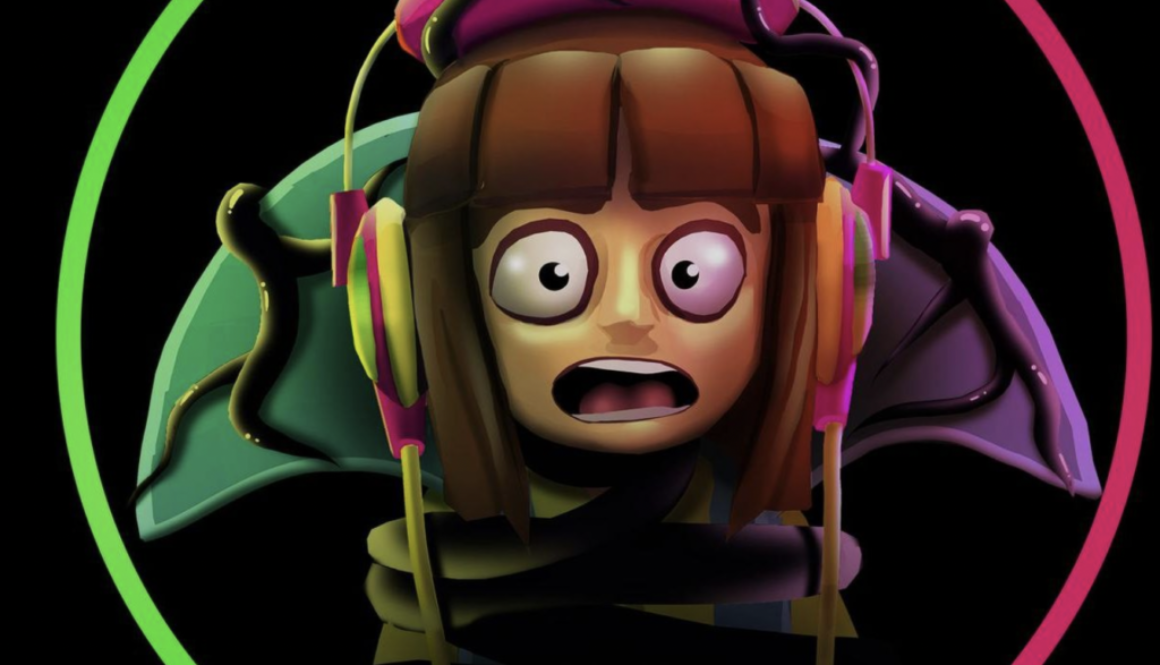
That spunky, profane, nightmare-roaming 11-year-old orphan from Brighton City is finally back for a new episode — only her second — and the graphics, havoc and chaos are all more thrilling than ever. In the latest installment, which picks up just moments after we last left Mara, she still races her dreamtime hotrod through noirish dark-city nightmares, still tries to rescue Ned Nimrod from aliens who have abducted him in his unconscious, and, in her waking hours, still wrangles with Brighton City’s venomous Mayor Doesgood; but this time she faces an unexpected adversary who has somehow acquired the same nightmare-roaming skills.
A VR app called BigScreen lets you watch 3D movies in a VR theater, and it’s identical to what you would have seen IRL (i.e., “in real life”), back when 3D movies were a thing.
BigScreen is indeed very cool.
But Nightmara is much, much more than that. It’s not just a 3D movie with headsets on; it’s a full 360-degree immersive drama, in which you can even walk around. You have to see it to believe it.
We checked in with Gianpaolo Gonzalez, the NightMara writer/director; answers have been edited for clarity.
Audere: So excited that a new episode is finally out – what took you so long?
Gonzalez: It takes me about 6 months in production mode to complete a 12-minute experience by myself. I need time to discover new and exciting perspectives in how I tell the story of NightMara. You can only plan so much on a piece of paper. Once you hop into VR, it’s a whole new way of working.
I’m constantly discovering better ways of telling my story. I don’t really have past examples of scripted VR animated series that I can turn to and reverse engineer how they did it. All I have is my excitement button, and I make sure that I constantly push myself and this medium to its wildest.
In episode 1, I really felt that what was different about this from other VR animation is that I could really get up and walk around in your show — at one point, characters are watching TV, and I got up and walked into the TV. How much did you think about creating a world that viewers could walk around in, rather than just watch?
I just wanted to make sure the viewer’s horizon was never messed up. The viewer can tell if the horizon is off by 1 degree. An off-set horizon instantly removes viewers from the experience, and they no longer care to explore the virtual world.
VR is for people who want to explore new ways of experiencing, but you have to make them want to be there. I think the viewer feels respected in my experiences because I give them a plane to walk on as well as environments that beg to be explored.
How does the animation in episode 2 differ from the already amazing work in episode 1?
It tops it. I’ve learned so many new skills from Episode 1 that I brought into Episode 2. The main difference is that Episode 1 was 11 scenes in 12 minutes; Episode 2 is 24 scenes in 12 minutes. So the pacing is quicker. More scenes, means more sets, which are now bigger and more detailed. I also included a lot more creative transitions from scene to scene. Now to bring what I learned from Episode 2 to Episode 3!
How did you become interested in animating in VR, and then how did you take the step of actually doing it?
In 2016, I was creating 360 commercials and music videos for clients, and I had gotten my hands on the VR painting software Quill. There were no animation abilities in Quill at the time, but I would paint scenes and just try to get better. In developing my skills, I was constantly comparing my work to the more seasoned animators that were also producing “quillustrations” — painted illustrations using Quill.
Then in 2017, I created NightMara as a traditional 2D cartoon on Instagram and hired an animator to help me create the short 13 episodes. I had never animated anything outside of motion graphics or stop motion, and I realized first-hand the cost of animation. After completing my little 8-minute Instagram cartoon, I ran out of money and Quill had just introduced the ability to animate in virtual reality. The timing couldn’t have been better. I knew I needed to learn animation, or I would suffer at the mercy of someone else’s time as well as my wallet.
So I changed the style of NightMara to work best in Quill and created a couple episodes by myself to learn, while at the same time, provide my fans with some new content. My sole mission was to improve as an artist each time I put my headset on. Each piece of content needed to top my last. It was the motor that drove me to constantly improve.
Then in 2020, Quill released the software as it is today, which allows complete end-to-end VR animation production … and then the pandemic hit. So I spent the entire pandemic inside Virtual Reality teaching myself animation, set design, character design, and VR directing and thus created what NightMara is today.
NightMara is about a plucky 11-year-old, yet it contains profanity and cartoonish violence. Who is the show for?
I made NightMara for the cartoon connoisseur who’s been craving a fresh and new experience to try. The main theme of my show is “fear,” which doesn’t have a set demographic. Everyone can relate to fear and animation has the ability to reach anyone at any age. I used to love when my mom would laugh at a Sponge Bob joke differently than I did as a kid because it meant there was something more I could explore. South Park wasn’t made for 11-year-olds, but all of us kids were watching it because it had something new to say in the medium.
Who is the typical NightMara fan?
The fans of NightMara are incredibly diverse, because I don’t talk to any one type of demographic. I aim at pleasing a certain ‘psychographic’ or interests of a given individual. Those are cartoon fans of South Park, Teenage Mutant Ninja Turtles, Rick and Morty, The Simpsons, 90s Nicktoons, Nintendo, Playstation, Xbox, Marvel, DC Comics. These are the fans that feed off of good characters, passionate creators and interesting takes on the world. Because I know this, NightMara fans range from 13-year-olds to 70-year-olds, because at the end of the day, animation has the ability to entertain anyone if done correctly.
Where do you see VR entertainment headed? In 10 years, will we all watch TV on VR?
I believe VR will be for entertainment just as what the smart phone did to social media. In 2007, the iPhone came out, but handheld PalmPilots had already been around for ten years prior. I remember, because my Dad had one in 1997. No one knew that PalmPilots would influence one of the greatest industry revolutions of our time; the revolution out of boredom. No longer do we have to wait to be entertained. We can look at our phone and find something to entertain us in only a couple swipes of our finger. However, as our stomach’s grow for more engaging content, our appetites become much more refined and picky. Virtual Reality lends itself to fulfill that hunger to be entertained in a whole new way.
Will this be the default format of entertainment?
In 10 years, I believe that television shows and movies will be almost the advertisement for the virtual reality world they offer. A two-hour Batman movie is dope and all, but to actually be Batman in Gotham and hunt the Joker is way doper.
This is a free show on a free app. How do you make money?
It’s free for the time being, so better get your views in now! I’m working on different avenues of monetization currently that I’m not allowed to disclose, but as this becomes more popular, I also have cool t-shirts, trading cards, stickers, and toys to buy at the So Meta Studios shop. Every penny goes back into my episodes!
ADVERTISEMENT The popular weird-Western, historical-fantasy/science fiction podcast, The Strange and Astounding Memoirs of Watt O’Hugh, starring Sal Rendino, returns for a full season, with eight new episodes!
Sunday, August 28, 2022, from 3:00 PM to 5:00 PM EST, AltspaceVR, free
A collaboration between worldbuilders Jose Ferrer and JoAnn Shivanti, the latest Muse project, “Entheogen~a Trippy, Psychedelic Adventure,” is a glowing temple in the Amazon rainforest, scored to music by Shivanti’s husband.
Ferrer, a medical doctor in Barcelona who uses VR for treating the burnout of the healthcare workers and for medical training, says, “I first started using VR during the COVID pandemic, when I needed some way to relax and forget about the harsh work situation in the emergency room. From there it grew really fast. I started working with Educators in VR organizing events to promote the use of VR in the medical field, world building mostly for well-being, and now I’m doing a research project using VR for reducing burnout of health care workers.”
In 2020, he built the first version of his extravagantly wonderful Meditation Center — which Audere will visit soon — as “a chakra circuit open to everyone at any time to rebalance their energies.”
Muse/ Entheogen is already available for you to visit, but the soft opening event is this Sunday, with a Grand Opening on September 17.
Look at the photos, that starry sky, those distant mountains, those glowing trees — it’s beautiful.
Friday, September 2, 2022, from 8:00 PM to 10:30 PM (EST), AltspaceVR, $10(registration required)
VR wouldn’t be VR without its lively, eye-popping dance clubs, and one of the best of the past couple of years was the Violet Nightclub, run by VenusSX, an advocate, therapist and intimacy coach who works with individuals and couples globally and is a leader in immersive experiences in virtual reality. Now Venus Lounge has been refurbished with what Venus says will be “the highest quality textures and decor, to provide a sensual Members Club environment.” VenusSX has promised a significant upgrade, something almost impossible to imagine, plus a “multi-sensory journey and dance experience.” This is a private whitelist-only event; General Admission USD$10.
Free to watch on the Within app; free on Tripp with a subscription
Marc Zimmerman’s 14-minute film, from 2018, is a real wonder in VR, an amazingly immersive experience that seeks to impress upon the viewer how grateful we should all be for the gift of a conscious mind that allows us to sense “the universe’s boundless beauty, a source of infinite inspiration.”
Zimmermann begins with our birth (“Everything is special, new, wants to be discovered; what a wondrous world,” the infant-narrator marvels), then shoves us beneath and into unfurling ferns, fireworks, jellyfish, shooting stars, a stormy galactic sky, a mossy forest of weeping trees at dusk, a sadly deserted nighttime playground, a kaleidoscope, a bustling ocean floor, wooden wind chimes, and demands that you “break through the dust that makes you blind … use your precious gift within to sense the beauty in every little thing.”
You might watch it again and again. You might bring your headset over to friends’ homes and demand that they watch it. Inspiring.
Friday, August 26, 2022, from 5:45 PM to 9:00 PM (EST), AltSpaceVR, free
We’ve written in this space before about the kinetic joys and visual beauty of a MOMA rave, so we won’t repeat ourselves. If you have never been, for goodness’ sake, go. And if you haven’t gone because you don’t own a VR headset, then buy a VR headset.
AI Friends of the Month
As we wrote here last month, maybe, someday, AI will design worlds in which you can live. One day, your co-workers, bosses, even your best friends may be AIs. Maybe this will be good; maybe bad. Maybe we will never know. But we will first meet them in VR. Some people already have.
So we asked an AI to introduce us to a couple of her friends, to tell us their backstories, to design some clothes for them and to pose them in a setting of her own design.
This is what she came up with: the faces, personality, clothes, scenery and quotations are all AI-generated.
Skrew Albemarle, on the left, is a 26-year-old editor; tall, thin, handsome and smart, he loves sports, music travel and books. His first name comes from a character in a movie; his last name is the town in Virginia where he grew up. Stephanie Singh, on the right, is a 22-year-old physics major. Sweet, beautiful and smart, Stephanie loves books, science, travel and animals.
Remembering the rainy evening when they posed for the photo, Stephanie said: “I wanted to look like I was in love.” Skrew said: “I wanted to make sure that I looked cool.”
We’ll be back after Labor Day, with a look back at the summer, new fiction from Steven S. Drachman, Alon Preiss and Mark Laporta, and the thrilling conclusion of Ed. Wheelan’s Fingers of Fear!
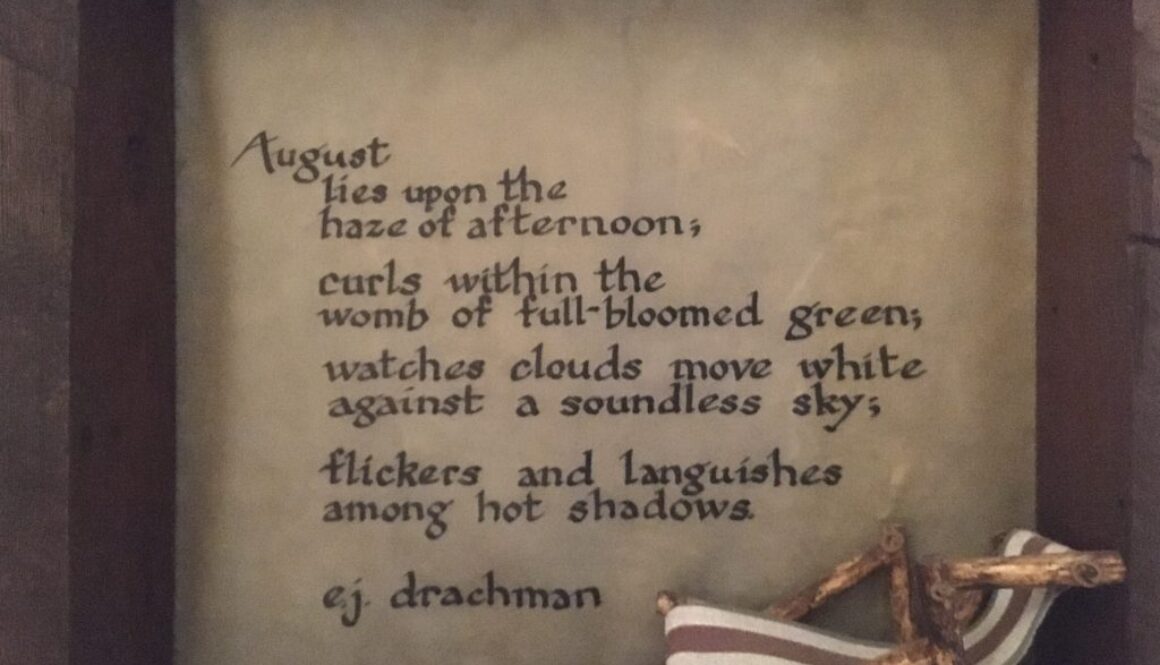
In the meantime, we leave you with this poem and art about August by Elizabeth Johnson Drachman. Read more of her work here.
What is a “monster”? For most Americans, this word sparks images of haunted houses and horror movies: scary creations, neither human nor animal, and usually evil.
But it can be helpful to think about “monsters” beyond these knee-jerk images. Ever since the 1990s, humanities scholars have been paying close attention to “monstrous” bodies in literature: characters whose appearance challenges common ideas about what’s normal.
Biblical scholars like me have followed in their footsteps. The Bible is full of monsters, even if they’re not Frankenstein or Bigfoot, and these characters can teach important lessons about ancient authors, texts and cultures. Monsterlike characters – even human ones – can convey ideas about what’s considered normal and good or “deviant,” disturbing and evil.
Hidden messages
Sometimes, monsters’ bodies are depicted in ways that reflect racist or sexist stereotypes about “us” versus “them.” Literary theorist Jack Halberstam, for example, has written about how Dracula and other vampires reveal antisemitic symbolism – even on Count Chocula cereal boxes. Such images often draw on antisemitic tropes that have been around for centuries, portraying Jewish people as shadowy, bloodsucking parasites.
Biblical monsters are no less revealing. In the Book of Judges, for example, the judge Ehud confronts the grotesque Moabite king Eglon, who is fatally fat and dies in an explosion of his own feces when a sword gets stuck in his stomach – though most modern translations render this a bit more chastely: “[Eglon’s] fat closed over [Ehud’s] blade, and the hilt went in after the blade – for he did not pull the dagger out of his belly – and the filth came out.”
In describing Eglon, the text also teaches Israelites how to think about their Moabite neighbors across the Jordan River. Like their emblematic king, Moabites are portrayed as excessive and disgusting – but ridiculous enough that Israelite heroes can defeat them with a few tricks.
Figures like Eglon and the famous Philistine giant Goliath, who battles the future King David, offer opportunities for biblical authors to subtly instruct readers about other groups of people that the authors consider threatening or inferior.
‘Why me?’
But the Bible sometimes draws a relatable human character and then inserts twists, playing with the audience’s expectations.
In my own recent work, I have suggested that this is exactly what’s going on with the Book of Job. In this mostly poetic book of the Bible, “The Satan” claims that Job acts righteously only because he is prosperous and healthy. God grants permission for the fiend to test Job by causing his children to be killed, his livestock to be stolen and his body to break out in painful boils.
Job is then approached by three friends, who insist that he must have done something to prompt this apparent punishment. He spends the rest of the book debating with them about the cause of his torment.
The book is full of monsters and already a familiar topic in monster studies. In chapters 40-41, God boasts about two superanimals that he has created, called Leviathan and Behemoth. A mysterious, possibly maritime monster called Rahab appears twice. Both Job and his friends refer to vague nighttime visions that terrify them.
And of course there’s another “monster,” too: Job’s test is instigated by “the Satan.” Later in history, this figure became the archfiend of Jewish and Christian theology. In the Book of Job, though, he’s simply portrayed as a crooked minion, a shifty member of God’s heavenly court.
Job stoically tolerates Satan’s attacks on his livestock and even his children. It is only after the second attack, which produces “a severe inflammation on Job from the sole of his foot to the crown of his head,” that he lets out a deluge of complaints.
To illustrate his suffering, Job repeatedly describes his bodily decay with macabre, gruesome images: “My skin, blackened, is peeling off me. My bones are charred by the heat.” And, “My flesh is covered with maggots and clods of earth; My skin is broken and festering.”
‘Monstrous’ wonder
Job’s body is so transformed that he, too, can be seen as a “monster.” But while Job might think that the deity prefers ideal human bodies, this is not necessarily the case.
In the book’s telling, God sustains unique, extraordinary monsters who would seem, at first glance, to be evil or repellent – but actually serve as prime examples of creation’s wonder and diversity. And it is Satan, not God, who decides to test Job by afflicting him physically.
Some books in the Bible indeed view monsters as simplistic, inherently evil “others.” The prophet Daniel, for example, has visions of four hybrid beasts, including a winged lion and a multiheaded leopard. These were meant to symbolize threatening ancient empires that the chapter’s author despised.
The Book of Job does something radical by pushing against this limited view. Its inclusive viewpoint portrays the “monstrous” human as a sympathetic character who has his place in a diverse, chaotic world – challenging readers’ preconceptions today, just as it might have thousands of years ago.
by Tom Green, Stephen Thomas. Originally published on Policy Options July 12, 2022
Electric vehicles are making inroads in some areas of Canada. But as their numbers grow, will there be enough electrical power for them, and for all the buildings and the industries that are also switching to electricity?
Canada – along with the United States, the European Union and the United Kingdom – is committed to a “net-zero electricity grid by 2035.” This target is consistent with the Paris Agreement’s ambition of staying below 1.5 C of global warming, compared with pre-industrial levels. This target also gives countries their best chance of energy security, as laid out in landmark reports over the past year from the International Energy Agency and the Intergovernmental Panel on Climate Change. A new federal regulation in the form of a clean electricity standard is being developed, but will it be stringent enough to set us up for climate success and avoid dead ends?
Canada starts this work from a relatively low emissions-intensity grid, powered largely by hydroelectricity. However, some provinces such as Alberta, Saskatchewan, Nova Scotia and New Brunswick still have predominantly fossil fuel-powered electricity. Plus, there is a risk of more natural gas generation of electricity in the coming years in most provinces without new federal and provincial regulations.
This means the transition of Canada’s electricity system must solve two problems at once. It must first clean up the existing electricity system, but it must also meet future electricity needs from zero-emissions sources while overall electricity capacity doubles or even triples by 2050.
Canada has enormous potential for renewable generation. Wind, solar and energy storage are proven, affordable technologies that can be produced here in Canada, while avoiding the volatility of global fossil fuel markets.
As wind and solar have become the cheapest forms of electricity generation in history, we’re already seeing foreign governments and utilities ramp up renewable projects at the pace and scale that would be needed here in Canada. In 2020, 280 gigawatts of new capacity was added globally – a 45 per cent increase over the previous year. In Canada, since 2010, annual growth in renewables has so far averaged less than three per cent.
So why aren’t we moving full steam – or electron – ahead? With countries around the world bringing in wind and solar for new generation, why is there so much delay and doubt in Canada?
The David Suzuki Foundation partnered with the University of Victoria to model the electricity grid of the future. We wanted to evaluate whether deploying renewables in each province’s grid could deliver zero-emissions electricity by 2035, even as demand grows.
The modelling team drew on a dataset that accounts for how wind and solar potential varies across the country, through the weeks of the year and the hours of each day. The models provide solutions for the most cost-effective new generation, storage and transmission to add to the grid while ensuring electricity generation meets demand reliably every hour of the year.
To better understand future electricity demand, a second modelling team was asked to explore a future when homes and businesses are aggressively electrified; fossil fuel furnaces and boilers are retired and replaced with electric heat pumps; and gasoline and diesel cars are replaced by electric vehicles and public transit. It also dialed up investments in energy efficiency to further reduce the need for energy. These hourly electricity-demand projections were fed back to the models developed at the University of Victoria.
The results? It is possible to meet Canada’s needs for clean electricity reliably and affordably through a focus on expanding wind and solar generation capacity, complemented with new transmission connections between provinces, and other grid improvements.
How is it that such high levels of variable wind and solar can be added to the grid while keeping the lights on 24/7? The model took full advantage of the country’s existing hydroelectric reservoirs, using them as giant batteries, storing water behind the dams when wind and solar generation was high to be used later when renewable generation is low, or when demand is particularly high. The model also invested in more transmission to enable expanded electricity trade between provinces and energy storage in the form of batteries to smooth out the supply of electricity.
Not only is it possible, but the renewable pathway is the safe bet.
There’s no doubt it will take unprecedented effort and scale to transform Canada’s electricity systems. The high electrification pathway would require an 18-fold increase over today’s renewable electricity capacity, deploying an unprecedented amount of new wind, solar and energy storage projects every year from now to 2050. Although the scale seems daunting, countries such as Germany are demonstrating that this pace and scale is possible.
The modelling also showed that small modular nuclear reactors (SMRs) are neither necessary nor cost-effective, making them a poor candidate for continued government subsidies. Likewise, we presented pathways with no need for continued fossil fuel generation with carbon capture and storage (CCS) – an expensive technology with a global track record of burning through public funds while allowing fossil fuel use to expand and while capturing a smaller proportion of the smokestack carbon than promised. We believe that Canada should terminate the significant subsidies and supports it is giving to fossil fuel companies and redirect this support to renewable electricity, energy efficiency and energy affordability programming.
The transition to clean electricity would come with new employment for people living in Canada. Building tomorrow’s grid will support more than 75,000 full-time jobs each year in construction, operation and maintenance of wind, solar and transmission facilities alone.
Regardless of the path chosen, all energy projects in Canada take place on unceded Indigenous territories or treaty land. Decolonizing power structures with benefits to Indigenous communities is imperative. Upholding Indigenous rights and title, ensuring ownership opportunities and decision-making and direct support for Indigenous communities are all essential in how this transition takes place.
Wind, solar, storage and smart grid technologies are evolving rapidly, but our understanding of the possibilities they offer fora zero-emissions future appears to be lagging behind reality. As the Institut de L’énergie Trottier observed, decarbonization costs have fallen faster than modellers anticipated.
The shape of tomorrow’s grid will largely depend on policy decisions made today. It’s now up to people living in Canada and their elected representatives to create the right conditions for a renewable revolution.
To avoid a costly dash-to-gas that will strand assets and to secure early emissions reductions, the electricity sector needs to be fully exposed to the carbon price. The federal government’s announcement that it will move forward with a clean electricity standard – requiring net-zero emissions in the electricity sector by 2035 – will help if the standard is stringent.
Federal funding to encourage provinces to expand interprovincial transmission will also move us ahead. At the provincial level, electricity system governance – from utility commission mandates to electricity markets design – needs to be reformed quickly to encourage investments in renewable generation. As fossil fuels are swapped out across the economy, more and more of a household’s total energy bill will come from a local electric utility, so a national energy poverty strategy focused on low-income and equity-seeking households must be a priority.
The payoff from this policy package? Plentiful, reliable, affordable electricity that brings better outcomes for community health and resilience while helping to avoid the worst impacts of climate change.
^^^
This article first appeared on Policy Options and is republished here under a Creative Commons license.