
location unknown, date unknown, artist unknown
Beautiful photograph. Sometimes the beauty in a work of art comes from what one doesn’t know.
 This originally apeared in Oblivioni, a website devoted to obscure and underrated movies, books and art.
Beautiful photograph. Sometimes the beauty in a work of art comes from what one doesn’t know.
This originally apeared in Oblivioni, a website devoted to obscure and underrated movies, books and art.

Florida. July 4th, 2018
I visited my favorite beach hot dog joint last Friday evening.
Okay, don’t ask why a reasonably intelligent guy might think it’s a good idea to order a foot-long jumbo hotdog at 9:30 at night, an act that’s the coronary equivalent of jumping off the Golden Gate Bridge, but there I was … again.
As usual, I ordered the bun slightly toasted, paid in advance for the arterial nightmare, and was sipping on a beer while awaiting the sandwich that resembles a red wooden hammer handle on a bun. The cook even puts a little yellow mustardy smiley face on each end of the masterpiece, so that each can leer at you for a moment as you contemplate which one to begin to devour.
There was a group of ten vacationers seated at two combined tables directly in front of me. They were dressed in t-shirts, shorts, and flip flops, and six of them were children of various sizes. They were laughing and eating, and as it happened, the older of the two men in their group was seated facing away from me. He had a crisp military haircut and was wearing a faded blue t-shirt. The entire back was filled with chipped white lettering that said … “In memory of Lt. Michael Patrick Murphy, U.S. Navy SEAL, killed in service to his country, June 28, 2005. Afghanistan.”
I’ve lived near a naval base here for about three years, and I must confess that I’m continually astounded by the people who populate that base. And the same is true of those who serve and live at two nearby Air Force bases, as well. To a man (and woman) they are all cut from the same cloth. First, they are all extremely polite and respectful. They are soft-spoken and articulate. And their dedication to the tasks before them and the apparent love they share for this country speaks volumes about their character. Just talking to them, for lack of a better term, I feel safer for the experience. Clearly, these are some of our nation’s very finest.
I would be remiss to not explain that I’ve mentioned navy and air force personnel because I encounter them most often in this part of Florida, so don’t get the idea I favor those branches of service over the Marine Corps or the U. S. Army. I do not. To emphasize that point, I’ll mention that a couple of months ago, I was seated at the bar of my favorite beach wings place (yes, I once ate a salad), and there were four young men seated next to me. They were in their early twenties, all were in obviously good shape, three were in casual clothes, and one was wearing the dress uniform of a U.S. Marine. As I was leaving, I gave the bartender an extra twenty bucks to pay for the Marine’s dinner, stopped, shook his hand, and thanked him for his service. I like myself better for that simple act of kindness, but it pales in comparison to the actions of someone I know in Chicago. For more than twenty years, perhaps thirty, whenever he goes out to lunch and sees uniformed armed forces personnel in the restaurant, he always buys each of them a dessert to accompany their meal. Doesn’t say anything, doesn’t shake a hand as did I; instead, he simply instructs the server, pays, and leaves. A great ongoing gesture of gratitude.
Bravery, loyalty, dedication, and patriotism should be lauded and respected. Without those traits imbued in a prior American generation, we’d all be speaking German today, and it’s mindboggling to me that the current generation of French nationals doesn’t care much at all for Americans.
Perhaps these locations should be on the blood-red t-shirts we all wear, whenever visiting France.
WW I Meuse-Argonne American Cemetery near Romagne-sous-Montfaucon, 14,246 Dead.
WW II Lorraine American Cemetery and Memorial in Saint-Avold east of Metz. 10,489 Dead.
Not once, but twice, our finest died on French soil during the prior century in an attempt to liberate them, and they have the audacity to treat us with disdain.
But enough bashing of the French. They did give us vital assistance in 1775, after all, and when you consider that Japan and Germany are now our allies, maybe the French aren’t all that bad.
Back to the faded blue t-shirt, Lt. Michael Murphy, and my research in Wikipedia about him. Much of the following information is paraphrased or quoted directly from that source.
He was born in Suffolk County, New York, raised there, and attended Penn State University where he graduated with honors and dual degrees in political science and psychology. He accepted a commission in the U.S. Navy upon his graduation from Penn State and became a Navy SEAL in July of 2002. In early 2005, Lt. Murphy was assigned to SEAL Delivery Vehicle Team ONE as officer in charge of Alpha Platoon and deployed to Afghanistan in support of Operation Enduring Freedom.
Operation “Red Wings” was a counter-insurgent mission in Kunar province, Afghanistan, involving four members of the United States Navy SEALs. Lt. Murphy and two other SEALs, Danny Dietz and Matthew Axelson, were killed in the fighting, in addition to sixteen U.S. special operations soldiers, who were killed when their helicopter was shot down while attempting to extract the SEAL Team. That was the largest loss of life for U.S. Special Forces since the invasion began and the largest loss for the SEALs since the Vietnam War. Marcus Luttrell was the only surviving SEAL from the squad; he was protected by local villagers, who sent an emissary to the closest military base, allowing a rescue team to locate him.
Murphy was the commander of the four-man reconnaissance team. They were on a mission to kill or capture a top Taliban leader, Ahmad Shah (code name Ben Sharmak), who commanded a group of insurgents known as the “Mountain Tigers” west of Asadabad. The SEAL team was dropped off by helicopter in a remote, mountainous area east of Asadabad in Kunar Province near the Pakistan border. After an initially successful infiltration, local goat herders stumbled upon the SEALs’ hiding place. Unable to verify any hostile intent from the herders, the team decided not to detain them. Hostile locals, possibly the goat herders the SEALs allowed to pass, alerted nearby Taliban forces who surrounded and attacked the small group. After Lt. Murphy called for help, an MH-47 Chinook helicopter loaded with reinforcements was dispatched to rescue the team, but was shot down with an RPG, killing all 16 personnel aboard … eight SEALs and eight other service members from the 160th SOAR.
Murphy, Dietz, and Axelson were killed in the action. Luttrell was the lone U.S. survivor and was eventually rescued, after several days of wandering in the mountains and being protected by the people of an Afghan village. All three of Lt. Murphy’s men were awarded the Navy’s second-highest honor, the Navy Cross, for their part in the battle, making theirs the most decorated Navy SEAL team in history. Lt. Murphy was killed on June 28th, 2005 after he left his cover position and went to a clearing away from the mountains, exposing himself to a hail of gunfire in order to get a clear signal to contact headquarters for relaying the dire situation and requesting immediate support for his team. He dropped the satellite phone after being shot multiple times but picked the phone back up and finished the call. While being shot, he signed off saying, “Thank You”, and then continued fighting from his exposed position until he died from his wounds.
On July 4th, 2005, Murphy’s remains were found by a group of American soldiers during a combat search and rescue operation and returned to the United States. Nine days later, on July 13th, Lt. Murphy was buried with full military honors at Calverton National Cemetery.
On October 11th, 2007 The White House announced that Lt. Michael Patrick Murphy would be presented the Medal of Honor, and it was awarded posthumously during a ceremony at the White House on October 22nd, 2007 to Lt. Murphy’s parents. Ironically, the name “Murphy” means “sea warrior” in Irish Gaelic.
The tragic demise of Lt. Michael Murphy, his two SEAL compatriots on the ground and sixteen other brave men on their rescue mission were the basis of the Hollywood movie, “Lone Survivor”, a title that left little guesswork to its plot.
But Hollywood and mediocre cinema aside, we cannot and should not ignore the sacrifices of our brave men and women. Fifty-six Navy SEALS have given their lives during combat missions in Iraq and Afghanistan to date, and while that is a tragic statistic, this is the number that is most sobering. Arlington National Cemetery has beautifully manicured grounds, and its gracefully rolling hills cover more than six hundred and twenty acres. Within that sacred facility there are more than 400,000 headstones, memorials to those who gave their lives so that this great nation may remain a free society.
The fireworks on the 4th were spectacular. And you already know how much I adore hot dogs. But I also have a deep respect for our military personnel, whether they are white or black, red, yellow or any shade thereof, whether they are of a particular religion, or they practice none at all. To help your mindset, I’d like to mention a gentleman named Master-At-Arms, Second-Class Michael Anthony Monsoor, recipient of the Bronze Star, the Silver Star, and the Congressional Medal of Honor. He was a member of SEAL Team 3 and was killed in Iraq on September 29th, 2006 when he threw himself selflessly on a grenade in order to protect his fellow SEALs. He was posthumously awarded the Medal of Honor on April 8th, 2008 by President George W. Bush. Master-At-Arms Monsoor’s father is Mr. George Paul Monsoor. He was formerly a U.S. Marine, and he is a Muslim.
We should all follow the demonstration of love and admiration exhibited by the United States Navy when dealing with our heroes.
The USS Michael Monsoor is a Zumwalt class guided missile destroyer.
And the USS Michael Murphy is an Arleigh Burke-class destroyer.
I hope you enjoyed your hot dogs and beer. And the next time you’re in a restaurant and see men or women in uniform, buy them a piece of cake or a slice of pie, walk over, shake their hands, and thank them for their service. You will feel good for the experience, and you’ll feel something else, as well …
Safer.
Alan Levy is the author of The Tenth Plague, which will be published by Chickadee Prince Books in 2019.
Photograph and design by Steven S. Drachman.

I started writing this column on Father’s Day, hoping to post it in the evening, when the illustration would still be topical, showing you the serious shortcoming I have as a columnist. But Father’s Day doesn’t really pass by without my thinking about Woody Allen, and that year that his son Ronan, ne Satchel, wished him a Happy Brother-in-law Day. (You see, while Woody Allen did not marry his daughter, as Woody defenders will consistently point out, all over the web – and what better evidence of a man’s ethical goodness is there, than the simple fact that he did not marry his daughter! – he did marry his son’s sister, which makes him Ronan’s father and Ronan’s brother-in-law. Shades of Chinatown, directed by Ronan’s mom’s good pal, Roman Polanski.)
It is pure hubris to sling an unprovable and probably untrue accusation at someone who has already done something so awful – running off with his girlfriend’s daughter, his son’s sister! – that no one would ever forgive him unless he were falsely accused of something even worse. So instead of declaring victory and going home, Mia Farrow accused her one-time partner of becoming an all-of-a-sudden, one time only child molester, and, let’s be honest, it almost certainly didn’t happen (although I suppose anything is possible). Now, as the many-decades old debunked accusations heat up again, the Farrow family has demanded, as appropriate recompense for their trauma, that all the actors and actresses in Hollywood pick a side in a dispute over something that no one could possibly know for sure. If the Farrows win on points, what will they have won? In the past, when acting with Woody meant an Oscar, Variety might note that, say, Cate Blanchett was “simply an actress who worked with a filmmaker who was never charged with a crime,” and Blanchett herself might address the situation by saying, “It’s obviously been a long and painful situation for the family and I hope they find some sort of resolution and peace,” but that kind of fence-straddling will cut it no more. I suggest a Hollywood scoreboard, with some “wins” more valuable than others. (Susan Sarandon and Alec Baldwin both lose points for crazy; Baldwin scores slightly hire based on career velocity. So Sarandon, who is on team Farrow, counts as a two; Baldwin, who is on team Woody, counts as a 4; and Kate Winslet, who switched from team Woody to team Mia, is a 6, for career velocity and a decided lack of crazy; she loses points for obvious insincerity in the haste of her team-switching.) Internet opinion from the sweaty masses, of course, also counts in this game; while sympathy seems to have swung a little bit back Woody’s way over the last few weeks, the I Believe Dylan Farrow Facebook site still has more members than the I Believe Woody page; but perhaps demonstrating public exhaustion with the whole thing, both pages have considerably fewer members than Medieval Puns.
Look, I am not sure why anyone wants to “win” the internet. Until the public gets to vote on someone’s guilt or innocence on the web, what exactly do all your followers get you? But, still, people think there is some kind of benefit. For example, Roseanne Barr. She asks, on Twitter, “Can you all help me get more followers here? The more I have the more my words will have weight.” Then, a couple of weeks later, in a now-deleted post, she wrote, “Help me reach 1M followers. Support me. I went out on a limb for America and against mind control & child trafficking. Help me use my voice….”
Is Roseanne somehow under the impression that her problem is that maybe people aren’t paying enough attention to the things that she says on Twitter? Doesn’t she understand that if everyone had just ignored her twitter feed, she would still have a job!
Finally, this: In another now-deleted tweet, Roseanne wrote, “I ask God2 help me use this bad experience 2 move in2 a better place….” Because God might read Twitter? Certainly, his presence has not exactly been noticeable anywhere else for a couple of thousand years, so who knows?
In recent weeks, the web has moved from condemnation of Roseanne to a grudging realization that the web has spent the last few weeks angrily condemning a pathetic, ruined figure who, after having brought joy to millions for decades, is almost certainly now mentally ill. Some corners of the web feel bad about this.
 Meanwhile, the Fibber McGee and Molly fan page is up-in-arms today to learn that back in 1960, the network recast the show for an ill-fated TV version. Look, it’s a little bit wonderful that some small divot within the world wide web can get riled about this admittedly outrageous snub of long-forgotten radio stars, which occurred 58 years ago. Fibber and Molly were a wildly popular radio couple who lived in one of those eccentric small towns. They were really quite hilarious and lovable on the radio, and their shows hold up even today. When they retired from their show because of Molly’s worsening health problems, which resulted from her alcoholism, the network hired two new actors to “play” Fibber and Molly on TV. It’s sort of as if NBC, rather than hiring a new host for the Tonight Show, had just recast the “role” of Johnny Carson.
Certainly recasting Fibber and Molly resulted in disastrous TV, and it occurred to me that if someone chose to replace Torsten Krol, the entirely anonymous and mysteriously reclusive author of the bestselling modern classic novels Dolphin People and Callisto, you might get something like 2018’s Torsten Krol disastrous novel rollout. Two months ago he published the first two books in a new six-book series, something called Foreverman, he even released a weird promotional video, and no one anywhere cares even at all. How is it possible that one of the greatest authors of our time – and a famous great author, at that – a great author who has sold many books and been acclaimed in little papers like the New York Times, and who once set the literary world on fire trying to guess whom he could possibly be – how could an entertaining, talented and mysterious gadfly like this have sunk so low? Man oh man, I really hope this isn’t the end of the line for Torsten Krol.
On that note, good night.
Alon Preiss is the author of A Flash of Blue Sky (2015) and In Love With Alice (2017), which are both available from Chickadee Prince Books.

Granville Wyche Burgess’s latest novel, Fork in the Crick, will be published September 15, 2018 by Chickadee Prince Books. It is available for pre-order right now, along with the first book, in paperback and Kindle from Amazon, and in paperback from Barnes and Noble, and your local bookstore.
Interviewed by CPB author Donna Levin
Donna: Fork in the Crick is your second in a series of novels set in Pennsylvania’s Lancaster County. Tell us how you came to write Amish fiction.
Granville: My wife, Reba Beeson, was raised on an Amish farm in Lancaster County, a farm we still visit at least once a month. In marrying outside her faith, Reba had to confront certain “challenges” from her family, and a few years ago her cousin Howard suggested we write up these challenges as a series of humorous family anecdotes. The stories just naturally morphed into an Amish romance, and, as we worked, we added a subplot of mystery and danger. The root of the series, however, is definitely autobiographical: a young man from South Carolina, like me, meets and falls in love with an Amish woman and together they struggle to follow their heart’s desire.
Does Reba read your drafts and give you input?
Yes! Reba tells me anecdotes about her life on her Amish farm, the meanings behind the coverings that Amish wear, the church services, recipes. She answers who drives a buggy and why some buggies are covered and others not and what it was like to harvest tobacco and how hay was put in the barns. She is my fountain of knowledge about Amish culture and faith, one from which I drink greedily and often.
One of Rebecca’s chief conflicts is over whether she can express herself as an artist through her talented quilt-making, but in the process risk committing the sin of pride. As an artist yourself, I doubt you consider pride in one’s artistic endeavors a sin, or even a mistake.
As an artist myself, it never occurred to me not to be proud of my art. The artistic ego is the engine that drives the artistic process. But the more I thought about it, the more I saw the beauty in the idea of not drawing attention to oneself, and to focus more on my thanks to God for having been given the gift of artistic expression. I think the Amish cautions about the sin of pride are very valuable because they help to keep the focus on the work, and not on the person who created the work.
There are hints that Rebecca’s love interest, Gregory, might have Amish roots. Can we predict that this couple will have to choose between the Amish life and the “English” world?
In my third book, they will definitely have to choose between the two worlds. I’m leaving open the possibility that the choice I think they will make now, before I begin writing, may not be the choice the characters actually make once I start writing and they take on a life of their own. Characters can really surprise the writers creating them.
Do you personally find the simplicity of Amish life attractive?
I admire very much the Amish commitment to simplicity of being. I have lived most of my adult life in the fast-paced Northeast, but I try as often as possible to get back into nature by taking a quiet walk in the woods, to go to church and find peace in prayer, to appreciate the pure taste of a vegetable grown in my own garden.
How do you envision the future of the Amish community in the age of globalization, when technology is a bigger part of our lives than ever?
When I go back to Reba’s farm, I see the Amish in the fields, I hear them speaking their Pennsylvania Dutch dialect, I watch the school children march happily by our window, and I tend not to worry so much. The Amish will always have their deep faith in God, and that will sustain in these globalized and tech-driven times.
You’re known for teleplays and stage plays. Why write a novel, and an Amish one at that, at this stage of your career? How has it been to shift from the play to the prose model?
It was a challenge and I love challenges, especially artistic ones. An Amish romance was a good fit for me because I am extremely romantic and I have an abiding faith in God. And it surprised me how easy is was to shift from dramatic to narrative writing. The words just flowed, I am happy to say. Of course, saying less is oh-so-much-harder than saying more.
 You’ve had at least 10 plays and musicals produced, and they represent an extremely wide range of subjects. Why these far-reaching interests?
My writing simply reflects who I am. My mother loved Winnie-The-Pooh, so I adapted it to a musical. I was born and raised in South Carolina in the days of segregation, and I felt keenly the injustice of how African-Americans were denied the basic rights that I enjoyed, so I have written about this injustice. My next project is a play about Maine, because a friend of mine wants me to adapt her favorite book, and so I am going to challenge myself again by writing about something I know nothing about.
Tell us about one of your most acclaimed works, the musical Conrack.
It’s based on Pat Conroy’s memoir The Water Is Wide, about a white teacher who goes to teach on an island off the coast of South Carolina in 1969 only to discover that the children there have been terribly neglected. In fighting “the system” to get his kids the education they deserve, Conroy—called “Conrack” by the children—discovers his own path through life.
The original composer, Lee Pockriss, wrote 18 gold records, among them Itsy Bitsy Teenie Weenie Yellow Polkadot Bikini. I wrote a musical with the composer of that classic? Wow! And when we presented it at Ford’s Theatre, then President George H.W. Bush came to see it with his wife and the Prime Minister of England and his wife. Another wow!
I have just finished directing it in Pat’s hometown of Beaufort, SC, and the people there loved it, including Pat’s immediate family. Pat’s widow gave me a closing-night gift that brought tears to my eyes: a ballpoint pen. Her card said: “This is one of the pens Pat wrote with. I only give them to very special people.” So you see, Conrack has brought me so many wonderful memories, as well as the incredible pleasure of seeing audiences respond so enthusiastically to my work.
When can we expect to see Book 3?
When the characters start writing it! I shall just have to trust that, when I sit down to write, God will speak and the words will flow.

By Linda Lee Kane.
Just a few weeks ago the French police discovered a large cache of Cotes du Rhone wine … but it was all fake. It was bulk stuff of no particular distinction, and the CEO of the company was charged with fraud. This was just the latest in a long series of such discoveries in recent years, and further proof that counterfeiters target cheap wines just as readily as the grand crush.
The name Domaine Ponsot will ring a bell with those who follow the wine-fraud news. In a story made famous by the documentary Sour Grapes. The domain’s proprietor, Laurent Ponsot, attended a 2008 wine auction in New York where fake bottles of Ponsot wines were offered for sale. The consignor was Rudy Kurniawan, a high-profile collector from California.
An investigation into Mr. Kuriawan’s dealings culminated in a search of his Arcadia, California home, which turned out to be filled with the tools of wine fakery: counterfeit labels, blank corks, and empty bottles to be filled. Mr. Kurniawan went on trial in New York for Counterfeiting and was convicted in 2014. He was ordered to pay 28.4 million in restitution to seven of his victims, to forfeit 20 million in property, and is serving a 10-year sentence in federal prison.
Counterfeit wines are sold at many places: Auction houses and eBay have had a massive problem with people selling fakes. The the vast majority of fake wine is made in Europe, but there areat least five counterfeit wine rings working the wine circuits.
Though quite a few high-profile seizures of counterfeit Chateau Petrus and Domine de la Romanee-Conti (DRC) have been made in France in recent years, the sentences have been so light they hardly seem like a deterrent at all. A Russian counterfeiter got a mere two-year jail term in France for selling 400 bottles of fake DRC, but the sentence was suspended, and he walked.
Some European wineries, including Domain de la Romanee-Conti, are working to combat fraud. A couple of methods that have been adopted include invisible ink, holograms and serial numbers on labels as well as embossing directly on the bottles and proof tags hung around the bottles’ necks. A potential form of protection is a registry where collectors could provide information about wines and their histories, which could then be accessed by other collectors. A similar method is used in the diamond trade.
So how can you tell if the bottle of wine you purchased is real or fake? No one can tell by taking a taste test; this has been proven over and over again. Wine is a living thing, and it changes with time; no one knows what the original bottle of the Jefferson-Lafitte tasted like.
What you can do is look for inconsistencies in the bottle, the labels, and the corks to see if the wines were actually produced the year noted on the label, although it is harder to fake the newer, more exceptional wines because many bottles are outfitted with anti-counterfeiting technology in the labels and bottles.
And don’t think it’s just your rare wines that are being counterfeited. Your ten to twenty-dollar bottles of wine are being faked. You can produce them in vast quantities, and nobody is likely to catch you. If you figure fifty dollars a case and you move two hundred cases, it’s a pretty good living.
***
Linda Lee Kane’s bestselling mystery novels have been translated into forty-two languages in forty countries. Visit her at www.lindaleekane.com.

One of my heroes passed away on the 21st of June.
Dr. Charles Krauthammer was his name, and over the years, he and I agreed on many things. But the theme he repeatedly stated and I often pondered centered on his moral indignation at the “liberal monopoly” in reporting the news in this nation.
According to a Business Insider article written in March of this year, of the fifteen news media sites mentioned, only Fox News was considered “conservative” in nature. Yahoo News seemed to assume a remarkable position of neutrality in that report, and in a different article altogether, the Wall Street Journal’s editorial page was declared conservative in substance. So that’s roughly thirteen or fourteen to two. In these daily and endless wars of words, should this be a prelude to some pre-medieval battle of Carthaginians against the mighty Roman Empire, Carthage would field scarcely four legions while Rome, in all her decadent glory, could easily field twenty-eight. In layman’s terms, that’s barely twenty thousand against seven times that number. In the year 202 B.C. during the Second Punic War, the Carthaginian General Hannibal, upon realizing how greatly outnumbered his forces were by vast Roman legions led by Scipio Africanus, probably knew all was lost. During the ensuing and pivotal battle, Rome emerged as victorious and the predictable result showed how clearly time and circumstance were Hannibal’s enemies, in addition to the mighty Roman legions encamped on the plains before him. And as always, history tends to repeat herself, again and again and again.
I would hope you can nod your head in instant or begrudgingly reluctant agreement with the late Dr. Krauthammer and the statement that the body of liberally leaning journalists in this nation far outweighs their conservative associates, and that the sheer number of articles they can pen, either legitimate or not, is vastly greater than the capabilities of their conservative colleagues. It’s Rome against Carthage, once again. We have become a divided nation insofar as what we feel, what we sense, and what we fear. We disagree, as is our right to do so in a free society, but the truth remains that we have experts in both camps who attempt each day to manipulate our thoughts, opinions, and votes. And the moment that honest and concise depiction of events becomes biased or misleading, by either liberal or conservative members of the press, we are done a grievous injustice. “Fake News” (aka biased reporting) and its blind acceptance is a great challenge to a democracy. A leader or revolutionary figure may stimulate the masses, play upon our fears and weaknesses, promise us hope and perhaps redemption, and worst of all, give us a unifying target to despise. “Following” along and throwing reason to the winds is an incurable disease, as occurred in 1932 in Germany. With only thirty-seven percent of the vote in the election that year in his favor, Adolph Hitler nonetheless rose to power.
No, I do not believe that permitting Fake News to permeate our daily lives is a prelude to this nation becoming a fascist state. It’s blindly believing Fake News that may lead us down that destructive path. And while the foundation of this nation is being tarnished and may be somewhat crumbling beneath us, I am reminded that Roman Emperor Nero purportedly was consumed with playing his violin while Rome burned before him. Opinion: perhaps it is time for our president to take up the violin. He can easily afford a rare Stradivarius, and that preoccupation would be refreshingly better and more dignified than sophomorically issuing streams of boyish tweets during the wee hours of the night.
Math Quiz: If it’s true that members of the liberal press outnumber their conservative adversaries at a scale of seven-or-so to one and Dr. Krauthammer was correct in decrying a “liberal monopoly” in news reporting, then what is the ratio when it comes to the development and deployment of Fake News?
Answer: We simply haven’t a clue. Truth, if there remains such a concept, is so intertwined with twisted leanings to the left or the right that I, for one, find it difficult to discern sincere journalistic prose from attempts at mass manipulation. It’s at this point that I must disagree with Dr. Krauthammer, but with the utmost respect for his memory. He may have been correct in assailing the liberal monopoly within the press, but if we are above manipulation, if we remain firm in our ancestral belief that the measure of all things must be their constitutionality, then who or how many might be of the left or the right simply no longer matters.
Ardent supporters of our president would have us believe that Fake News is an evil child of the left, a relentless program of guerilla warfare designed to humiliate and incapacitate the current incumbent. But while the vast, liberal legions of Rome have surrounded and are laying siege to the castle, the outnumbered Carthaginians of the right aren’t wearing white, unblemished uniforms in this feature film, by any means. There was a certain honesty and glory when they decided to square off and go toe to toe against those Roman legions more than two thousand years ago. Battle lines were drawn, and men stood firmly, each believing that justice and immortality was his for the taking. It was, to say the least, a far simpler time. Today, we fight wars where innocents and combatants cannot be distinguished from one another, and the wars for our hearts and minds are fought with key strokes. There are no longer lines in the sand, and the concepts of clarity and victory are all but lost.
Allow me to explore the modern-day version of Roman Legion domination of Carthage’s meager forces, or in the words of Dr. Krauthammer, the enormous liberal monopoly in the press engaging against the beleaguered right. The subject matter here is one lone missive, a “Hail Mary” desperate attempt to strike back at the Roman forces engaged with the Carthaginian King. And while you may remember Doug Flutie’s remarkable moment on behalf of Boston College many years ago, the Hail Mary offered here was a pathetic and fizzling dud.
The other day, I was emailed an article, supposedly recent, but not, about Donald Trump’s many acts of kindness over the years. The article is actually a rerun of something entitled “Trump Does the Unthinkable” by entertainment columnist Liz Crokin. Written on July 10th, 2016, it was a lukewarm attempt to absolve Mr. Trump of his transgressions by tipping the scales of justice with a litany of his better and most generous moments. By posting the article once again as newsworthy, it was nothing short of an insult to us all.
Perception … be kind and generous on occasion, or even often, and your general persona can be overlooked or ignored.
And that’s what I’d like to explore with you, today … perception versus reality.
One particularly good deed, as Ms. Crokin described, began on the day Donald Trump’s limousine suddenly developed a flat tire in 1995. A motorist stopped and assisted, and Mr. Trump asked how he might reward the Good Samaritan. The man simply asked that flowers be sent to his wife. A short time passed, the flowers arrived accompanied by a brief note that stated, “We’ve paid off your mortgage.”
“Wow, what a guy,” you might contend. And that would have been, without question, a truly magnanimous gesture by Mr. and Mrs. Trump, had it occurred. Ms. Crokin’s list goes on, a description of many acts of kindness throughout the years with a golden checkbook as the centerpiece of those truly generous moments. But according to the fact-checking website Snopes, the change-a-tire-and-we-pay-off-your-mortgage story is purely fiction. This same or similar stories over decades have featured Perry Como, Mrs. Nat King Cole, Mrs. Leon Spinks, Bill Gates, Henry Ford, according to Snopes, and was even the basis of a short story entitled, “A Model Millionaire” in 1891 by Oscar Wilde. The team at Snopes also mentions that Mr. Trump’s staff members in 1997 were actively denying the truth of this story. Fake news, in all its glory, but a story that most assuredly has captured the hearts of so many who fail to seek verification of what’s in print.
Now, a word or two about donations. According to a Forbes analysis of IRS documents, The Donald J. Trump Foundation provided charitable contributions totaling $10.9 million from 2001 to 2014. In that same time period, but ending in 2015, Bill and Hillary Clinton have itemized similar contributions of 23.1 million dollars on their tax returns, a matter of public record according to the Washington Post. I do realize that Mr. Trump and the Clintons didn’t have to engage in any of those random acts of kindness, but I also hope that each of us realizes that periodic deeds and generosity have little bearing on the reality we, as citizens of this nation, must now face.
Maimonides wrote in the “Eight Levels of Charity” that anonymous giving is a good deed performed solely for its own sake, and it may very well be that paying off a stranger’s mortgage, if that were true, is an excellent example of that philosophy. But what Maimonides was attempting to teach is that giving anonymously is a truly special and godly form of philanthropy, while a person who gives in order to boast is in danger of losing all the merit of his gift. How apropos at this moment in time, even though this Jewish philosopher wrote those words more than nine hundred years ago. Leaping now from the Talmud to the New Testament, we have this … Luke 21:1-4, The Widow’s Offering … “As Jesus was sitting opposite the treasury, He watched the crowd placing money into it. And many rich people put in large amounts. Then one poor widow came and put in two small copper coins, which amounted to a small fraction of a denarius. Jesus called His disciples to Him and said, ‘Truly I tell you, this poor widow has put more than all the others into the treasury. For they all contributed out of their surplus, but she out of her poverty has put in all she had to live on.'”
Can anyone dare to trivialize Mr. Trump’s contributions to strangers and to charities over the years? Tough to be the guy to do just that, but honesty remains my best policy. I simply cannot drink this man’s Kool Aid, when everything he says and does is self-aggrandizing in so very many ways. I guess I could accept showmanship and ego in a Vaudeville act, or in a Vegas lounge show, or even emanating from a repugnantly loud table in an elegant restaurant, because each of those experiences is extremely short-lived. We’ve all been subjected to the loudmouth at a nearby table who thinks his voice must carry for all to hear, with his bulbous ego replacing grace and good manners. In the privacy and solitude of our car on the way home, perhaps my wife and I might muse about how our dinner’s ambiance was disintegrated by the obnoxious fellow we’d encountered. In a moment of subtlety, I might even murmur, “Thank you, God.” And naturally, my wife, always the straight man in our duet, would say, “For what?” I then would reply, “That he’s not my brother-in-law.” Two hours of exposure to someone who is obnoxious in a restaurant is difficult, but moderately bearable. Four years of this sort of behavior is not.
Can you imagine having Mr. Trump as your brother-in-law, by the way? And I don’t mean President Trump, I just mean plain ol’ every day Donald when he was married to Marla Maples. Because you’re afraid of heights, flying to New York City and going to Trump Tower is not an option. So every Thanksgiving and every Christmas, he and his entire family come to your home, instead. In rural Georgia. The first thing you might notice upon the Donald’s arrival is that he gazes just a few seconds too long at your seventeen-year-old daughter, Pauline. This is a man who said of his own daughter, Ivanka, “If Ivanka weren’t my daughter, perhaps I’d be dating her.” There aren’t words to express how despicable that comment was about his daughter, and that comment goes hand-in-hand with Mr. Trump’s consistently undignified demeanor.
Reality time … This is not a Blue State or Red State question, nor should your answer be based upon being a liberal or a conservative. Dig deep. President Trump does as he pleases, as though he’s some medieval warlord, a Carthaginian King. He is brash, unpredictable and self-serving, as witnessed by the number of new assistants and ancillary personnel who periodically ebb and flow through the White House like a summer tide. If the owners of the Redskins created a special box at FedExField for former Trump administration staffers, it might now stretch for twenty yards in width and as many feet in height. So the question is not, “Do you like him?” Instead, it is, “Do you truly respect him?” And, at this point, let’s bring in Bill Clinton, for I cannot ignore him in this commentary. Some may have the perception that these are two great men, but the reality is that their behavior has shown an absolute lack of respect for the office they hold and held. They do dishonor to the presidency, and by doing so, they dishonor each and every one of us.
John Brennan, former Director of the Central Intelligence Agency, said this in an interview on June 2nd. “The impact of the Trump presidency will be felt for many years to come. Most worrisome is that his use of falsehoods, his mean-spirited and malicious behavior, and his self-absorption will be emulated by many young Americans — indeed, young people globally — who look to the President of the United States as a role model.”
I, for one, feel in good company with Director Brennan. The presidency, as an institution, carries massive obligations. The man or woman sitting in the Oval Office must, above all else, be a person of resolute character, with hands firmly on the Resolute Desk in a daily attempt to guide this nation through storms and toward greatness. The office of the presidency requires and demands a moral compass that’s beyond reproach, and while individual presidents may or may not live up to these stringent requirements, there can be no shirking away from or watering down of the covenants required when accepting this office. We do not currently have a man at that desk who can keep a steady hand on the proverbial tiller of our ship of state. He is easily swayed, influenced, perturbed, distracted and angered by trivialities. Greatness will elude him and not be his, even though that is what he so desperately seeks. The names Lincoln and Trump will never be mentioned together in a single history of this nation that discusses our very finest, and as John Brennan also recently said so eloquently, “The esteem with which I held the presidency was dealt a serious blow when Donald Trump took office. Almost immediately, I began to see a startling aberration from the remarkable, though human, presidents I had served. Mr. Trump’s lifelong preoccupation with aggrandizing himself seemed to intensify in office, and he quickly leveraged his 1600 Pennsylvania Avenue address and his Twitter handle to burnish his brand and misrepresent reality.”
There is a phrase that decent people use periodically. When we slide by those seated in a crowded movie theater or those mingling around the office coffee machine, we say, “Pardon me.” It’s a common phrase, and using it is an integral part of being aware of others and being humble and polite. But in the scant days since John Brennan’s scathing remarks concerning the President of the United States, those two words have taken on an entirely new meaning. Our president contends he may pardon himself for whatever transgressions he may be ultimately accused. The iceberg looming beneath that arrogant philosophy is that without responsibility and penalty, no transgression might later be ruled out. However bold, however heinous, however outrageous the offense, our president may merely pardon himself and those around him for committing an unconscionable act. This caste system consisting of an elitist coterie of those who are above the law, if adopted and perpetrated, will be at the expense of the Republic the president has sworn to serve and protect. As we witness highly perilous times looming before us, to have a president who regards himself completely above the law is a tradition we cannot tolerate, and we are but a stone’s throw away from that reality.
As a final thought, I’d love to be a fly on the wall when William F. Buckley, founder of the National Review who passed away in 2008, and Charles Krauthammer get together for the first time. Mr. Buckley, with his ever-present legal pad and Eastern Establishment debating skills and Dr. Krauthammer, with his calm ability to cut to the chase with rock-solid logic and brilliantly direct commentaries. Not Rome against Carthage, but rather, Titan versus Titan.
Go get ‘em, Chuck.
Alan Levy is the author of The Tenth Plague, which will be published by Chickadee Prince Books in 2019.
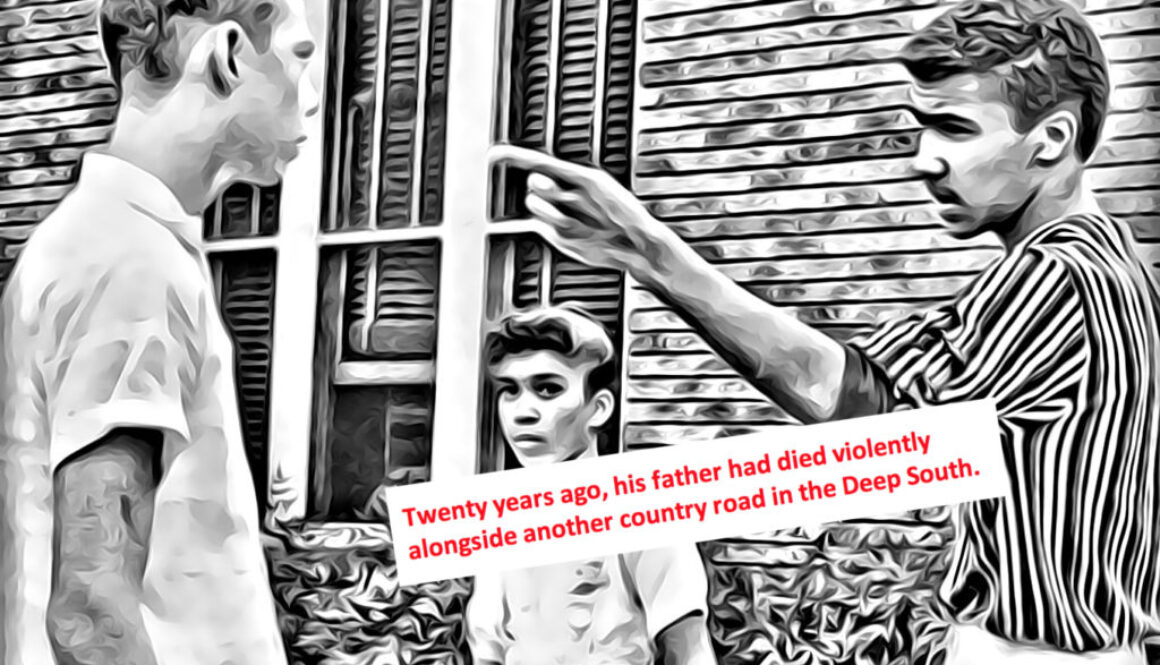
July 12, 1964 (Freedom Summer)
Celeste, Louisiana
Frank knew he was violating three basic rules: Don’t drive on country roads, particularly at night. Never drive alone. Always let the office know where you are. He stepped on the gas and violated a fourth: Don’t go above the speed limit. If he followed these rules, he might violate the most basic rule of all: Don’t get killed. It had been barely a month since the three civil rights field workers — Chaney, Schwerner and Goodman, a Black and two Jews — had been murdered in Mississippi. It had been a day since Frank’s picture was on the front page of newspapers throughout Louisiana, and he had already received death threats. In the Celeste Sentinel, which he had seen a half hour ago, the headline above his picture said, “Landmark Ruling — Local Restaurants Ordered to Integrate”; the caption below the picture reported, “New York Civil Rights Lawyer, Frank Shapp, tells Judge Burke, ‘It’s a new world.’”
How the hell had he gotten here — an ambitious Jewish boy from Rockaway with a wife, two children and an enviable job at a prestigious law firm? The answer, he knew, went back to both his father and to Willie Gunn. He must not think of them. Willie, the only Black friend he had ever had (if they were friends), had told him two days ago: “Your Celeste case is going to do more harm than good; it might kill people.” Twenty years ago, his father had died violently alongside another country road in the Deep South. Frank pressed the pedal to the floor.
* * *
WILLIE GUNN
1944–1946
Bronx and Rockaway, NY
Willie Gunn was a colored kid. That’s what we called them then, and that’s what they wanted to be called — at least I think so. I was afraid of him long before I saw him or heard his name. But for a while, in 1946, when I was almost thirteen and preparing for my bar mitzvah, he was my friend—or almost my friend.
My cousin Ira first made me afraid. In 1944, soon after my father went to North Carolina to organize garment workers, Ira and my Uncle Danny came to our Bronx apartment to help my mother and me with the final packing. We were moving to Arverne, a summer town in Rockaway, at the other end of the City, where you were never more than a few blocks from both the Atlantic Ocean and Jamaica Bay. We were going to share an apartment in a two family house with my mother’s parents so that Grandma could take care of me while my mother went back to work as a nurse.
“It’s only temporary,” both my mother and father had assured me before he left — “a trial arrangement.” They said that if the North Carolina job worked out and we could have a good family life there, we would all move south. Otherwise, my father would come back to New York and either continue working for the Union or join Uncle Danny’s real estate business.
I never believed my father’s move to North Carolina was temporary. There had been too many arguments between my parents, too many days of silence, and they looked away from each other when one of them told me “trial arrangement.”
My mother asked Ira, who was eighteen months older than me, to go with me to my room and make sure I threw out everything I didn’t need. “Otherwise,” she said, “there won’t be enough space in Arverne.”
Ira, who never paid attention to his own parents, paid no attention to her. He closed my bedroom door behind us, pointed to a chess set at the top of one of the cartons I was packing, and said, “Let’s play.”
I nodded yes. Although I usually beat him quickly, I planned to drag the game out so he wouldn’t talk about the move. But he didn’t even wait until the pieces were set up.
“You going to P.S. 34?”
“It’s the only school in Arverne.”
“They got a lot of colored kids in 34. Big kids — with grown up bodies almost. I met this guy who goes there when I was visiting my grandma’s summer bungalow by the Rockaway beach — not our Grandma Shapp, my grandma on the other side — and he told me about them.”
“Let’s play.”
Ira stroked the white king in his hand and continued. “You ever have colored kids in your class?”
“No.” Almost all the kids in P.S. 93, my school until now, were Jewish. The few Irish or Italian kids who came into the class usually didn’t stay very long.
“You know anything about them?”
I didn’t answer. Except for Uncle Danny’s and Aunt Lilly’s maids, I’d never spoken to a colored person. I read about the “Negro problem” in Solidarity, the United Women’s Garment Workers Union newspaper my father brought home twice every month, and in a letter my father sent me from North Carolina. But these weren’t about individual people — certainly not about anybody I knew. The Solidarity articles, which I have to this day, were essentially editorials condemning segregation, particularly in the military during a “war for democracy,” and calling in bland language, for “social and economic spade work both in American labor and in the general community so that the Negro will come into his own as a worker and as a citizen.”
My father’s letter — five pages of small script — was passionate. He mentioned “the horrors of segregation in the South,” “the hypocrisy in the North,” and “the special duty of Jews to stop discrimination in this country because we’re being persecuted by Hitler.” But he gave only one specific:
“In the South, even the white workers who support the Union don’t want to work side-by-side with Negroes. One guy who invited me to his house for Sunday dinner and who will probably be the shop steward if we ever organize the factory, said, ‘They’re shiftless, and they smell, and they just want what we have without working for it.’ I didn’t argue with him because we need him so badly, but the next time we meet I’m going to have to educate him about the causes and evils of racism and how important it is for all workers to pull together.”
Sitting over the chess board and surrounded by cartons, I decided to write to my father as soon as Uncle Danny and Ira left. But what should I say about Negroes? Should I mention that the Union itself seemed segregated? That the names in Solidarity were all Jewish or Italian and, except for choruses or bands, the pictures were of white people only? That all of our friends from the Union — from every place — were Jewish?
“Frank, you hear me?” Ira asked. “You okay?” I had to concentrate on what Ira was saying because, otherwise, Uncle Dan would tell my mother that I was acting funny again, and she would become even more upset.
“I don’t know about colored kids,” I answered. “Why don’t we just play? You can be white.”
Ira lifted the white king and passed it from hand to hand. “I think you should know so you’ll be careful.”
“They’re just like white kids, I guess. Why should I be careful?”
I was pleased with my answer — my father would have liked it — but Ira ignored it. “I had some in my class,” he said with authority, “and I know some kids who had a lot, including that kid from Arverne. It ain’t too good. In P.S. 34, they’re a lot bigger because they just came up from the South after the war started and they got left back a couple times. They don’t have real schools for them down there. A lot are from Mississippi where they really hate white people and think Jews are like the Devil, and you might get punched. They ask for money. You might even get beaten up. You gotta watch yourself.”
“Ira, I don’t want to talk about colored kids. Let’s just play, okay?”
Ira, who had been very kind to me since my father went to North Carolina, put the king on the board and made the first move.
* * *
My father died in North Carolina on the day we moved. I don’t want to think about it, let alone write about it. But if I’m going to write about Willie Gunn and Louisiana, I have to say something about my father because my memories and thoughts of him, even though cloudy and inaccurate, steered much of what I did.
I’ll mention only three things:
First, from the moment my mother collapsed alongside our new Rockaway telephone, I tried to convince myself that his death made little difference to me — and, to a large degree, I succeeded. He left my life when he went to North Carolina, and now I had to accept what I had suspected: He was gone forever, and I had to move on without him. Did I miss him? Why think about it?
Second, we never knew the cause of death. While he was driving alone on a winding country road, his car went down an embankment and crashed head-on into a large oak. The autopsy reported massive internal injuries as well as a coronary. But which came first? And was he forced off the road? The accident report of the Fayette County Sheriff stated: “Decedent was a controversial figure who was trying to unionize several large dress factories. His life had been threatened by an anonymous caller who claimed to be a Dragon in the Ku Klux Klan.”
Third, I was determined not to absorb a single word said at the funeral and, here also, I succeeded. I didn’t even listen to the eulogy by Joseph Pearlstein, the revered International President of the United Women’s Garment Workers who had been a confidante of President Roosevelt. But that night, I learned a little of what Pearlstein had said, plus some things I didn’t want to know.
As hardly anything had been unpacked in our new apartments, my mother and I spent the night after the funeral at Uncle Danny’s and Aunt Lilly’s house. My room, a new spare room in the attic, was directly above their bedroom, and they must have forgotten I was there. It was impossible not to hear them and, unlike at the funeral, I couldn’t close my mind to what was being said.
“It’s a great honor, Pearlstein, himself, giving the eulogy,” Lilly said. “He painted Norm like the hero he was.”
“Great honor?” Danny replied angrily. “It’s a great pile of crap. If it’s such a noble cause, why didn’t Pearlstein go himself, or send some of his flunkies in their handmade suits? Hero! My poor brother was cannon fodder in hopeless causes: Trying to unionize hillbillies so Pearlstein could become labor czar of the whole country. And trying to do something about segregation in the South so he can go down in history as the Jewish Abe Lincoln.”
“Show some respect,” Lilly hissed.
“Respect!” The whole house could have heard my uncle. “For what ?” His voice returned to its normal loudness. “I spoke to Normy the day before the so-called accident. No accident. The bastards must have forced him off the road. He said that Pearlstein himself had called him and told him to lay off the colored stuff. It was upsetting the union supporters they were counting on. They’re pro-union but they’re southerners. Take the world as it is, Pearlstein ordered him. Get the union in the door, get FDR reelected, and get the Nazis and Japs beaten before we worry about the colored. When Norm started to argue, Pearlstein said he should come home if he wasn’t willing to follow union policy. The great man didn’t mention any of that in his eulogy.”
“Was Normy planning to come back?” Lilly asked. “Were he and Celia going to try again?”
“He was leaning that way, but wanted some time before making up his mind. I loved my big brother,” Danny’s voice trembled, and I wondered whether my uncle would cry. But then, his voice steadied. “For the hundredth time, I tried to convince him to forget that utopian crap and go into business with me. With my street-smarts and his brains, we would make three fortunes. And I would have an honest partner — not like your Uncle Velvel.”
For a while, both Lilly and Danny said nothing and, although I knew I was imagining it, I heard them breathing loudly. Finally, Lilly spoke at a measured pace, enunciating each word clearly:
“I’m sick of your criticizing my uncle.”
“And I’m sick of your uncle—of your whole damn family.”
Then there was silence; then more silence; and then a door slammed.
* * *
Ira was right about the colored kids in P.S. 34: They were older and bigger. My new friend, Eddie Mandelbaum, whom I met in the ocean just before Labor Day, told me, “they smell different, even when they don’t fart.” I vowed not to get near them.
They sat in the back of the room, never raised their hands, and were hardly ever called on. When the teacher was there, they weren’t behavior problems like I had become in my new school. But when the teacher wasn’t around, some of the colored boys would punch us and demand something small like a pencil or baseball card. The punches weren’t hard enough to make a bruise, and they never asked for money. There was an unwritten treaty: They wouldn’t cross an invisible boundary, and we wouldn’t tell. I kept out of their way as much as I could and, for the most part, they ignored me.
But the boundary was crossed soon after the start of 7-A, my second year at P.S. 34. Eddie and I were in the boys’ room at the end of lunch recess, each of us standing in front of an enamel urinal that began on the floor and was taller than most of the boys who used it. That fall, for the first time, Eddie and I were taller than the urinals, but only barely.
“I used to be afraid some colored kid would push me in while I was peeing, but now I won’t fit,” Eddie said laughing. “Let’s write our names in pee like we did in the sand under the boardwalk. You have enough left?”
I turned towards Eddie to tell him I couldn’t write the letters if I was laughing. Three colored kids were by the door, two of them with folded arms. I looked back down into the urinal and could see my hands trembling. Maybe they had heard what Eddie said about being pushed in. My stream was going from side to side and I was afraid some of it might get on my pants. Miss Boylan, our 7-A homeroom teacher, would see the stain. She didn’t like me and might say something — maybe to the whole class. I stopped urinating even though I wasn’t through, buttoned my fly, and turned to leave, without flushing. Eddie’s hands were shaking more than mine.
The biggest of the three, the one whose arms weren’t folded, was Willie Gunn, a neck and a head above the urinals. He had just started P.S. 34. Some kids said he had moved from Mississippi and had never worn shoes before. Others said he had moved from Brooklyn and had been in reform school.
They were blocking the door. I was afraid to stand still and afraid to move. Please God, I silently prayed, let the bell ring.
Willie came to us and grabbed the top of Eddie’s tie. “Hey Mandelnuts.” He yanked the tie down. “Take out your funny-looking little Jew dick so we can see where they sliced you.”
He’d demand the same from me, and what would happen after that — or tomorrow? The bell should ring soon, I reminded myself but, by then, Eddie might have obeyed. “Don’t, Eddie. You don’t have to.” I was amazed by what I said. It’s not safe to refuse colored kids flat out.
Willie stared at me, still holding Eddie’s tie, and the other boys smiled meanly, without separating their lips. Eddie looked as if he would cry. Now that I had time to think, I was afraid I would wet my pants; this hadn’t happened since I was a little boy but, after my father died, I often worried about it.
Then, as I’d hoped, the bell clanged and I was saved. Lunch was over, and we had to line up in the boys’ yard, by class in size places. Willie seemed to relax; maybe he, too, was saved by the bell. He let go of Eddie’s tie and punched him in the arm, but not very hard. He turned to me, laughed, and shook his head in wonderment. “You are one crazy, lucky sucker, Shit-Shapp.”
After we had lined up in the boys’ yard and were climbing the stairs single file towards the classrooms, I could see that the other boys knew what had happened. Although we weren’t allowed to talk on line, Eddie must have told them. They looked at me differently, but I wasn’t sure whether it was admiration or pity.
Soon after we reached the homeroom, the bell rang for gym, and we returned to the boys’ yard to choose up sides for softball. I expected to be picked near the end and I stood to the side. But Willie, who had been chosen by Miss Boylan as one of the captains, picked me second. He told me to play second base and to bat second even though I usually played the outfield and batted seventh or eighth. When we went into the field, he whispered in my ear, “Don’t let me down, tough guy.” I made no errors and got a hit. From then on, second base was my regular position and I batted second or sixth.
Even if Willie hadn’t crossed back over the boundary and rewarded me for showing guts, I couldn’t tell any adult what had happened in the boys’ room. I’m not a snitch, and there was nobody to tell. Miss Boylan would glare; she wouldn’t have to say “snitch.” My mother would only look more tired and hopeless. Grandpa would turn away in defeat — another failure to understand America.
Grandma would try to understand and to help me, but she might call the three boys “rotten schvartzes.” Then what would I do? Give her a lecture or ignore a word my father had hated? Not as bad as the N word, but bad enough.
* * *
There was a snowstorm on the Sunday before Thanksgiving — eight inches. Eddie called and said we should shovel walks. People were paying a dollar a walk, and we could finish one in less than an hour — good money. We did the walk for Mr. Kaplan, our landlord, who lived downstairs from us, and then went next door to Mr. Lazar.
Mr. Lazar opened the door about an inch, and we asked him if he wanted his walk shoveled. Smoke from the cold came out with our words. “How much for the walk and driveway? I have to get my car out and I don’t want to skid in that little space and maybe hit something.” There was no smoke with his words. I looked at the driveway. It was a lot more work than just the walk.
“Three dollars,” Eddie answered. I was shocked although the price seemed reasonable.
“A colored kid was just here, and he said he’d do it for two. I told him to come back in an hour.”
“But he’s colored!” Eddie said it as I was thinking it. I wondered what I would have said if Eddie hadn’t been so quick.
“Could you explain to me what that’s got to do with shoveling snow?”
“We’ll do it for two dollars,” Eddie came right back while I wondered what my father would think.
I shoveled as fast as I could because I feared that Willie was the colored kid coming back. When, after nearly two hours, we were through shoveling, Eddie planted his shovel in a pile of dirty snow and said: “There’s no colored kid. Lazar said that just to get the price down. I should’ve asked for two-fifty.”
“It’s too cold,” I said, aiming the smoke from my words right at Eddie’s face. “Let’s go to Paulie’s to see if he wants to play Monopoly.” Eddie nodded. Holding the shovel in both my hands, I started to run the two blocks to Paulie’s. Willie might still come back.
* * *
The next day, Miss Boylan told us we would be taking achievement tests just before Christmas vacation. “If anyone is more than a year behind, he’ll be left back although we’ll work hard to try to make sure that that doesn’t happen.” After pausing and slowly surveying the room with her pale blue eyes, she went on: “Because the class sizes are out of balance, one or two of you may skip 7-B and go directly to 8-A and start high school at the beginning of 1947. The tests may decide that.”
The news upset me. I expected to get the highest scores — I usually did — but I was afraid that no matter what my scores, Miss Boylan would not let me skip a grade.
Willie, I soon learned, was even more concerned. We were lining up in the boys’ yard after lunch, when another new colored kid — Shoot was what he wanted to be called although his real name was Earl Collins — grabbed Willie’s arms and shouted almost gleefully: “Hey, boy, after those tests, they’re gonna leave our ass back again.”
In what seemed to be a single movement (although it couldn’t have been), Willie pinned Shoot’s shoulders to the ground with his knees and held an open switchblade knife at his throat. They both were sweating in the cold. Shoot’s dark brown head was on a patch of snow; his eyes seemed all white.
“You leave me, Nigger,” Willie said slowly, his chest heaving. The word overwhelmed me. “You leave me alone or….” Short bursts of smoke shot from his mouth. “I ain’t doing this grade again no matter what.”
Suddenly seeming to appear out of nowhere, Miss Boylan was bending over Willie and Shoot. “Give that to me, William,” she said calmly. “Right now.” Her white hair, with a tint of blue in it, almost glowed next to Willie’s short black hair. She put her hand out.
Willie handed her the open knife without looking up from the ground. His knees still on Shoot’s shoulders, his body shook and he started to cry. Miss Boylan closed the blade and then touched him on the cheek. “We better go to the Principal.” She handed Willie a handkerchief, and he got up slowly. “You get up also, Earl, and come with us,” she told Shoot. “The rest of you, line up. Everything will proceed normally.”
Willie did not come back to class that day or the next, but he was in the boys’ yard Wednesday morning, looking glum. Everybody stayed away from him, even the colored kids.
We all followed the No Talking Rule as we climbed the four flights to Miss Boylan’s homeroom. Nobody even whispered until we went through the door and could see the word “FRACTIONS” printed on the blackboard in large capital letters right under the picture of General MacArthur accepting the surrender of the Japanese on the U.S.S. Missouri a few months earlier. “Oh man, fractions; that’s tough stuff,” an anxious white boy’s voice whispered behind me, and several other voices grunted concern. I wouldn’t tell anybody that Ira had taught me fractions a month ago.
During math, while Miss Boylan was writing some fractions on the blackboard, I turned around to look at Willie. He wasn’t even trying to follow what she was saying. I saw what would happen: Fractions would be on the achievement tests, Willie wouldn’t understand them, and he would be left back again. How could I permit that when Willie respected me? After he put me on second base and moved me up in the batting order? After my father wrote to me about the evils of racism? I had to tutor him.
But as I sat there, acting as if I were paying attention, I realized it wasn’t that simple. Where could I do the tutoring? We couldn’t go to my house. My mother was on night duty at Rockaway Beach Hospital, and she slept in the afternoon. Would Grandma ask me: “Why do you bring a schvartze into the house? Aren’t you afraid he’ll steal something?”
I couldn’t imagine going to Willie’s house. Some of the colored streets weren’t paved, and I had seen from the bus that some of the houses had boarded-up windows even though people lived in them. The dogs in the street seemed ready to attack. And who else would be in his house? How would it smell? I had never been in a colored person’s house.
For a moment, I thought of asking Miss Boylan if I could tutor Willie in the homeroom after school, but that was the worst idea of all. Everything in 7-A had gone wrong. Maybe it was me, maybe it was Miss Boylan, but I always seemed to be doing something that annoyed her — not tucking in my shirt, getting ink on my fingers, chewing paper and putting the little wet balls on the bottom of my desk seat, forgetting the homework, talking in class, not staying in line when we climbed the stairs from the boys’ yard. Once I even sat down at my desk when the seat was raised and landed on the floor. Miss Boylan led the class in laughing; it was the only time anyone had ever seen her laugh. I was sure she would say no to anything I asked about Willie; she would tell me I was acting out of place again, and would advise Willie to stay away from me.
Then I saw the solution — the library annex on Seventy-third Street, just at the end of the Jewish neighborhood and before the colored neighborhood began. The lady in the children’s room always seemed happy to see me; she called me “Super Reader.”
But even talking to Willie alone wasn’t easy. Miss Boylan was always watching both of us and, in the schoolyard, you just didn’t walk up to Willie Gunn and talk about fractions. On the way to and from school, Willie walked only with colored kids and I walked only with white kids. Nobody planned it that way; it was just how things were.
I did the best I could. When we were lining up in the schoolyard, I handed Willie a note and asked him to put it in his pocket:
“Come early tomorrow to school and meet me in front of Bernie’s Candy Store. I have to talk to you about something very important. Don’t forget.”
Willie was at Bernie’s the next morning when I got there, but he looked angry. I was glad to see white grownups coming in and out of the store.
“What’s important? What you want from me? I don’t want more trouble.” Willie jerked his head sharply down after each question or statement. “I leave you alone. You leave me.”
I told him about the tutoring. “We can do it in the library on Seventy-third Street. The librarian there’s nice — not like Miss Boylan — and she’ll let us. That way you won’t get left back.”
Willie inhaled deeply, and I thought of Shoot. “You crazy, boy.”
“Why? You’re smart even if you have trouble with tests. I’d be a good teacher.”
“I don’t need you.”
“But I can help you. You helped me when you gave me second base.”
“Look, Frank.” Willie had never before called me by my first name. “Look. I don’t want to get left back again. Okay? I’m the biggest one in the class now, and almost two years older. How am I gonna look if I get one more class behind?”
“But that’s why—”
“I don’t need your help, I just said. Miss Boylan, she told me she would help me for the tests after school. We’re going to start today.”
Although it was cold out, I felt myself perspiring. “But I can help you, too.”
Willie took a step back. “Boy, I said no.”
“I want to. Please.”
I grabbed Willie’s coat sleeve, and Willie pulled my hand from it. He moved his face close to mine and spoke softly, stretching out the vowels: “I said no. Fuck you, you little Jew bastard. Don’t try to run my life.” He turned and left me standing there.
***
Design from a photo from Getty Images. Jay Greenfield is a writer and lawyer. His last novel, Max’s Diamonds (Chickadee Prince Books, 2016), is available on Amazon and Barnes & Noble in paperback and e-book, and at your local bookstore.